
The clear difference, a simple test, usage rules, and plenty of examples.
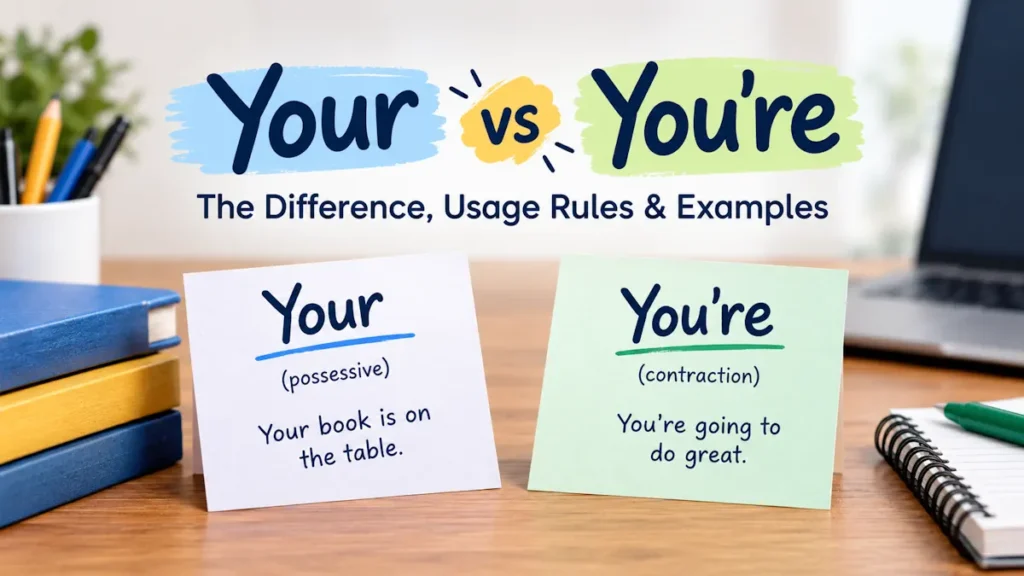
“Your” and “you’re” sound exactly the same, so they’re among the easiest words in English to mix up, even for native speakers. The difference, though, is simple and never changes. Your shows possession (something belongs to you). You’re is a contraction of “you are.”
Get these two right and your writing instantly looks more polished; get them wrong and even a great message can lose credibility. This guide gives you the one-second test to tell them apart, the usage rules, lots of examples, and the common traps to avoid, including the sneaky third word, yore.
Quick Answer:
Use your to show something belongs to you: “Is this your phone?” Use you’re when you mean “you are”: “You’re late.” If “you are” fits, use you’re.
Why Your and You’re Get Confused
The reason is simple: they’re homophones, words that sound identical but are spelled differently and mean different things. When you say them out loud, there’s no way to tell them apart, so the mix-up only shows up in writing. Autocorrect and fast typing make it even easier to pick the wrong one. The good news is that a single quick test settles it every time.
Your: The Possessive
Your is a possessive adjective. It tells us that something belongs to or is connected with the person being addressed. It always sits right before a noun.
Examples of “Your”
✓ Is this your jacket?
✓ I love your new haircut.
✓ Please bring your ID to the desk.
✓ What’s your favorite movie?
You’re: The Contraction
You’re is a contraction of the two words “you are.” The apostrophe stands in for the missing letter a. If you can replace it with “you are,” then you’re is correct.
Examples of “You’re”
✓ You’re going to love this.
= You are going to love this.
✓ I think you’re right.
= I think you are right.
✓ You’re my best friend.
= You are my best friend.
✓ Call me when you’re ready.
= … when you are ready.
The One-Second Test
Whenever you’re unsure, try swapping in “you are.” If the sentence still makes sense, use you’re. If it sounds wrong, use your.
✓ “You are keys are on the table” sounds wrong → use your: “Your keys are on the table.”
✓ “You are amazing” sounds right → use you’re: “You’re amazing.”
Quick Test: Expand it to “you are” in your head. Fits? Write you’re. Doesn’t fit? Write your. This one trick catches almost every mistake.
Your vs You’re: Comparison Table
| Feature | Your | You’re |
|---|---|---|
| Type of word | Possessive adjective | Contraction of “you are” |
| Meaning | Belonging to you | You are |
| Has an apostrophe | No | Yes (you’re) |
| Comes before | A noun | A verb or adjective |
| Test: does “you are” fit? | No | Yes |
| Example | your book | you’re reading |
Usage Rules: When to Use Each
Use “Your” to Show Possession
Reach for your whenever something belongs to the person you’re talking to: your car, your idea, your turn.
Use “You’re” to Mean “You Are”
Reach for you’re whenever you’re describing the person or saying what they are doing: you’re kind, you’re winning, you’re here.
Everyday Examples of Both Words
“Your” (possessive)
- Don’t forget your umbrella today.
- Your presentation was excellent.
- I borrowed your charger, sorry!
- Your dog is so friendly.
- Is this your seat?
“You’re” (you are)
- You’re doing a great job.
- I hope you’re feeling better.
- You’re the first to arrive.
- Let me know if you’re coming.
- You’re going to be fine.
Common Mistakes to Avoid
| Meaning Intended | Incorrect | Correct |
|---|---|---|
| You are late | You’re late. | |
| Belongs to you | Is this your bag? | |
| You are welcome | You’re welcome. | |
| Your opinion | Your opinion matters. |
Watch Out: “Your welcome” is one of the most common errors online. Since it means “you are welcome,” it must be “You’re welcome.”
Memory Trick
Remember This: The apostrophe in you’re is a tiny “a” standing in for you + are. If there’s an apostrophe, you can stretch it back into “you are.” No apostrophe means your (possession).
Bonus: What About “Yore”?
There’s a rare third homophone: yore. It’s an old-fashioned noun meaning “long ago,” almost always used in the phrase “days of yore.” You’ll see it in storytelling or poetry, but almost never in everyday writing. It does not mean possession and is not a contraction.
✓ In the days of yore, knights roamed the land.
| Word | Meaning | Example |
|---|---|---|
| your | Belonging to you | your house |
| you’re | You are | you’re happy |
| yore | Long ago (archaic) | days of yore |
You vs. Your vs. You’re
One more quick distinction, since all three look similar.
| Word | Role | Example |
|---|---|---|
| you | The person (subject/object) | Can you help? |
| your | Possession | your help |
| you’re | You are | you’re helpful |
Practice Quiz: Test Yourself
Pick the correct word for each sentence. The answer key is at the bottom; no peeking!
Q1. ___ going to be late if we don’t leave now.
a) Your
b) You’re
c) Yore
Q2. Is this ___ umbrella by the door?
a) your
b) you’re
c) yore
Q3. Thanks so much! ___ welcome.
a) Your
b) You’re
c) Yore
Q4. I really admire ___ patience.
a) you’re
b) your
c) yore
Q5. Which word means “you are”?
a) your
b) you’re
c) yore
Answer Key: 1-b 2-a 3-b 4-b 5-b
Final Verdict
The rule never changes: your shows possession, and you’re means “you are.” When in doubt, expand it to “you are” and listen. If it fits, use you’re; if not, use your. Master that, and this mistake disappears from your writing for good.
Frequently Asked Questions
What is the difference between your and you’re?
“Your” shows possession (your book). “You’re” is a contraction of “you are” (you’re reading). If “you are” fits the sentence, use you’re.
Is it “your welcome” or “you’re welcome”?
It is “you’re welcome,” because it means “you are welcome.” “Your welcome” is incorrect.
How do I know when to use you’re?
Replace it with “you are.” If the sentence still makes sense, use you’re. If it doesn’t, use your.
What does your mean?
“Your” is a possessive adjective meaning something belongs to or relates to you, such as your car, your idea, or your name.
What does you’re mean?
“You’re” is short for “you are.” The apostrophe replaces the missing letter a, as in “you’re kind” (you are kind).
What is “yore”?
“Yore” is a rare, old-fashioned word meaning long ago, used mainly in the phrase “days of yore.” It is not related to possession or “you are.”
How can I remember which is which?
The apostrophe in you’re is a stand-in for the a in “you are.” No apostrophe means your, which shows possession.
If “you are” fits, it’s you’re. If not, it’s your. That one test is all you need.

Benen
My name is Benen, and I am an English teacher from the US and UK. I am passionate about helping people improve their English language skills, including grammar, vocabulary, and sentence structure, while building their confidence in a supportive and patient learning environment.