
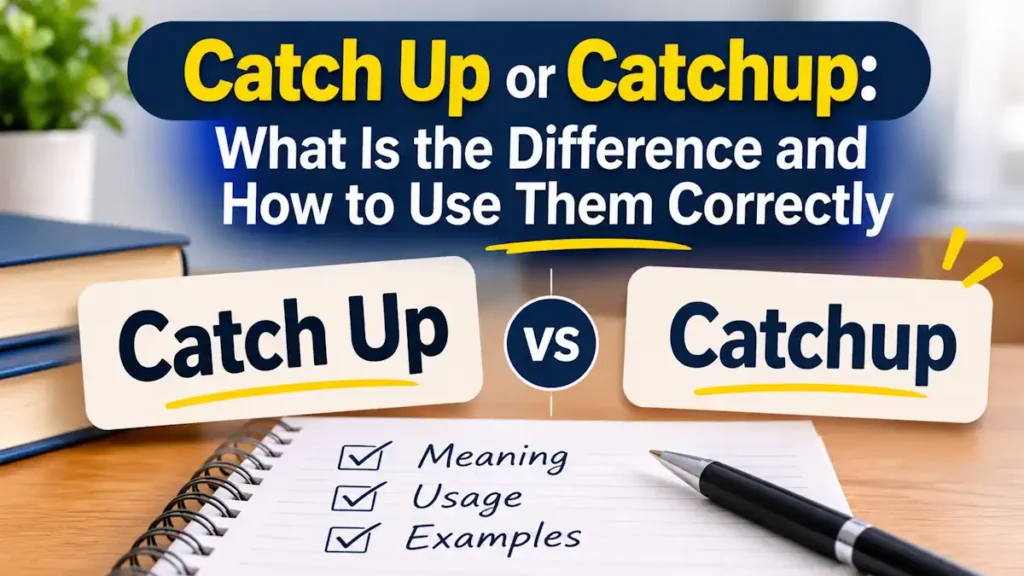
You are typing a quick message to a friend: “We should catch up soon.” Or is it “We should have a catch-up”? Or maybe “catchup”? Your cursor blinks, and you wonder if spellcheck is hiding a mistake.
This guide settles it in plain English. You will learn when to write catch up as two words, when catch-up needs a hyphen, why catchup is almost always the wrong choice, and how to remember the rule for good.
QUICK ANSWER
Catch up (two words) is a verb: “I need to catch up on sleep.”
Catch-up (hyphenated) is a noun or adjective: “Let’s have a catch-up” or “a catch-up call.”
Catchup (one word) is not the standard spelling for either one. In dictionaries it is an old variant of ketchup.
What Is the Difference Between Catch Up, Catch-Up, and Catchup?
All three forms look almost the same, but each one has a different job. The table below shows the difference at a glance.
| Form | Part of Speech | Status in American English | Example |
| catch up | Verb (phrasal verb) | Standard | “I’ll catch up with you later.” |
| catch-up | Noun or adjective | Standard | “We had a quick catch-up.” |
| catchup | None for this meaning | Nonstandard | Avoid it; it is a rare spelling of ketchup |
The reason for the split is simple. English keeps a phrasal verb as two words, then joins the pieces with a hyphen when the phrase turns into a noun or an adjective. The same thing happens with log in (verb) and log-in (noun), or back up (verb) and backup (noun).
Catch Up as a Verb (Two Words)
When you use it as an action, catch up is always two separate words. It means to reach the same level, pace, or point as someone or something that was ahead of you, or to learn the news you missed.
Common Meanings of the Verb
- To reach someone who is ahead: “Jordan jogged faster to catch up with the group.”
- To get up to date on something: “I have to catch up on my emails after vacation.”
- To talk with someone you haven’t seen in a while: “Let’s grab coffee and catch up.”
- To finish work that has piled up: “She stayed late to catch up on paperwork.”
How the Verb Changes Form
The verb part is catch, so it changes with tense. The word up stays the same.
| Tense | Form | Example |
| Base | catch up | “I want to catch up.” |
| Present, he/she/it | catches up | “She catches up on the news every morning.” |
| Past | caught up | “We caught up over dinner.” |
| Continuing | catching up | “I’m catching up on my shows.” |
Quick test: If you can change the word to caught up, catches up, or catching up, it is a verb, so write two words with no hyphen.
Catch-Up as a Noun (Hyphenated)
When catch-up names a thing, such as a conversation, a meeting, or a period of recovery, most American dictionaries write it with a hyphen.
Example Sentences
- “Let’s schedule a catch-up for Friday afternoon.”
- “It was a short catch-up, but it made my whole day.”
- “Our weekly catch-up keeps the team on the same page.”
- “After the long break, the class needed a catch-up before the exam.”
The plural is catch-ups: “We have two catch-ups on the calendar this week.”
Quick test: If you can put a, the, our, or my in front of it, it is a noun, so use the hyphen.
Catch-Up as an Adjective (Hyphenated)
The hyphenated form also works as an adjective. It describes something that helps a person or group get back up to speed.
- “The school offers catch-up classes for students who missed a semester.”
- “She booked a catch-up call with her manager.”
- “The team spent the weekend on a catch-up sprint.”
- “Many workers over 50 can make catch-up contributions to their retirement accounts.”
That last example is a very common American use. In personal finance, a catch-up contribution is an extra amount that older savers are allowed to add to their retirement plan.
Is Catchup Ever Correct?
For the meaning we are talking about here, no. Spelling it as one word is not standard in American English, and it can confuse readers for a second reason.
Catchup is listed in dictionaries as an older spelling of ketchup, the tomato condiment. Another old variant is catsup. All three words trace back to the same sauce, but ketchup is the spelling you will see on nearly every bottle in the United States today.
| Word | What It Means | Use It? |
| ketchup | The tomato sauce for fries and burgers | Yes, standard spelling |
| catsup | Older variant of ketchup | Rare, but seen on some labels |
| catchup | Older variant of ketchup | Avoid; do not use it for “catch-up” |
So if you write “I need to catchup on work,” a reader may pause and wonder whether lunch is involved. Using catch up or catch-up keeps your meaning clear.
A Quick Note on Informal Writing
You will sometimes see “catchup” in texts, social posts, or app menus. That does not make it correct; it just shows how often people blur the line between verb and noun. In emails, school papers, resumes, and anything professional, stick to the standard forms.
Catch Up vs. Catch-Up: Side by Side
Here is the same idea written both ways, so you can see how the grammar changes.
| Verb: Catch Up | Noun or Adjective: Catch-Up |
| “I’ll catch up with you later.” | “Let’s plan a catch-up soon.” |
| “He needs to catch up on sleep.” | “This was a much-needed catch-up.” |
| “They caught up on old times.” | “It turned into a long catch-up session.” |
| “We should catch up this weekend.” | “Put our catch-up on the calendar.” |
Handy Ways to Remember the Rule
- Action or thing? If someone is doing something, use two words. If you are naming something, use the hyphen.
- The tense test: If it can turn into caught up, it is a verb.
- The article test: If it follows a or the, it is a noun.
- The condiment test: If you see one word, ask yourself whether you mean ketchup. If you do not, add the space or the hyphen.
Common Phrases With Catch Up
The verb teams up with small words to make phrases you will hear every day.
| Phrase | Meaning | Example |
| catch up on | Get updated on something | “I’m catching up on the latest news.” |
| catch up with | Reach someone ahead of you, or meet after time apart | “I finally caught up with my old roommate.” |
| catch up to | Reach the level or position of someone | “Our sales are starting to catch up to last year’s numbers.” |
| all caught up | Fully up to date | “I cleaned my inbox and I’m all caught up.” |
| catch-up call | A short call to share updates | “Can we do a catch-up call at noon?” |
Similar Words and Alternatives
Sometimes a different word fits better. Here are some options.
| Instead of | Try | Example |
| catch up (get updated) | get up to speed, brush up | “Let me get up to speed on the project.” |
| catch up (reach someone) | overtake, draw level with | “The runner drew level with the leader.” |
| catch up (reconnect) | reconnect, touch base | “Let’s touch base next week.” |
| catch-up (meeting) | check-in, sync, update | “Join us for a quick check-in.” |
How Americans Usually Say It
In everyday American speech, the verb is the star. People say “Let’s catch up” far more often than “Let’s have a catch-up.” The noun form shows up more in the workplace, in school settings, and in British English, so do not be surprised if you hear it on a work call or see it in a calendar invite.
Style guides and company handbooks can differ on small points. If your employer, school, or publisher has its own style guide, follow it, but the verb and hyphenated noun pattern in this article is the safe default.
Common Mistakes to Avoid
Mistake 1: Writing Catchup for the Verb
- Incorrect: “I need to catchup on my homework.”
- Correct: “I need to catch up on my homework.”
Mistake 2: Using the Verb Form Where a Noun Belongs
- Less standard: “We had a great catch up yesterday.”
- Better: “We had a great catch-up yesterday.”
Mistake 3: Hyphenating the Verb
- Incorrect: “I’ll catch-up with you tomorrow.”
- Correct: “I’ll catch up with you tomorrow.”
Mistake 4: Mixing It Up With Ketchup
- Confusing: “Please pass the catchup.”
- Correct: “Please pass the ketchup.”
When to Use Each Form: Cheat Sheet
| Situation | Correct Form |
| Describing an action | catch up |
| Naming a meeting, chat, or session | catch-up |
| Describing a class, call, or plan meant to help someone get current | catch-up |
| Talking about the tomato sauce | ketchup |
Frequently Asked Questions
Is catch up one word or two words?
As a verb, it is always two words: “I need to catch up.” The hyphenated catch-up is used only as a noun or an adjective.
When do I use a hyphen in catch-up?
Use the hyphen when the phrase names a thing or describes another noun, such as “a catch-up” or “a catch-up meeting.”
Is catchup ever correct?
Not for the meaning “to get updated.” In dictionaries, catchup is an old variant of ketchup, so it is best to avoid it.
What is the plural of catch-up?
The plural is catch-ups, as in “We have three catch-ups this week.”
Is it okay to say “a catch up” without a hyphen?
You will see it in casual writing, but the hyphenated catch-up is the more standard choice in professional and academic writing.
How do you pronounce catch-up?
It sounds like KATCH-up. As a noun, the stress usually falls on the first part: CATCH-up. Ketchup is pronounced KETCH-up, which is one more reason to keep the spellings separate.
Final Thoughts
Remember it this way: catch up is what you do, catch-up is what you have, and ketchup is what you put on your fries. Keep those three straight and your writing will read clean every time. Now go catch up with someone you have been meaning to text.

Benen
My name is Benen, and I am an English teacher from the US and UK. I am passionate about helping people improve their English language skills, including grammar, vocabulary, and sentence structure, while building their confidence in a supportive and patient learning environment.