
Few grammar mix-ups sneak into writing as often as this one. You type a quick email, hit send, and then notice you wrote “the dog wagged it’s tail.” If the it vs it’s question has ever made you pause, you are in good company. Even careful writers get tripped up, mostly because the rule seems to break a habit we learned in elementary school.
This guide breaks down the difference between it’s and its in plain English. You will get a two-second test, clear examples, a list of the most common mistakes, a short quiz, and answers to the questions people ask most.
Quick Answer: It’s or Its?
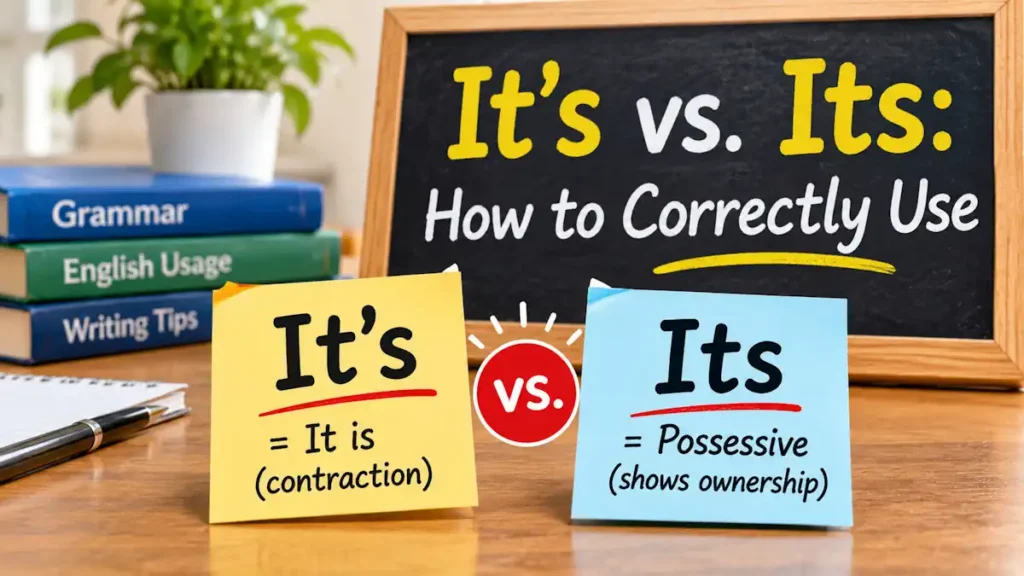
- It’s is a contraction. It means “it is” or “it has.”
- Its is a possessive. It shows that something belongs to “it.”
- Two-second test: say “it is” or “it has” in the spot. If the sentence still works, use it’s. If not, use its.
- Remember: its’ is never correct.
The Key Difference Between It’s and Its
Both words are tiny, they sound identical, and they differ by a single apostrophe. That is exactly why they cause so much trouble. Here is how each one works.
| Word | What it is | What it means | Example |
|---|---|---|---|
| It’s | Contraction | It is, or it has | It’s raining. It’s been a long week. |
| Its | Possessive pronoun | Belonging to it | The cat licked its paw. |
The apostrophe in it’s works the way it does in any contraction: it marks the missing letters. In “it is,” the letter “i” drops out. In “it has,” the letters “ha” drop out. The apostrophe is a stand-in for what is missing, not a sign of ownership.
When to Use It’s
Use it’s whenever you can replace it with “it is” or “it has” and the sentence still makes sense.
It’s = It Is
- It’s getting colder outside. (It is getting colder.)
- I think it’s time to go home. (It is time.)
- Do you know if it’s open on Sundays? (If it is open.)
- It’s a beautiful day for a walk. (It is a beautiful day.)
- She said it’s the best pizza in town. (It is the best.)
It’s = It Has
This one catches people off guard. When “it has” is followed by a past participle (a verb like been, gone, rained, or taken), it is usually shortened to it’s.
- It’s been three years since we last met. (It has been.)
- It’s rained every day this week. (It has rained.)
- I wonder if it’s gone out of style. (If it has gone.)
- It’s got a great battery life. (It has got.)
When to Use Its
Use its when you want to show that something belongs to or is connected with “it.” It works just like other possessive pronouns: his, her, our, their, your.
- The company updated its website last week.
- The bird built its nest in the maple tree.
- Every city has its own charm.
- The restaurant is known for its homemade pasta.
- The laptop lost its charge in an hour.
- Give the plant its water in the morning.
A Simple Trick to Remember It’s vs. Its
When you are stuck, run through these quick checks.
Test 1: Expand It
Replace the word with “it is” or “it has.” Read the sentence aloud.
- “The dog wagged it is tail.” That sounds wrong, so the answer is its.
- “It is been a long day.” That sounds wrong too, so try “it has”: “It has been a long day.” That works, so the answer is it’s.
Test 2: Swap in “His” or “Her”
If you can replace the word with “his,” “her,” or “their” and the sentence still works, you need its.
- “The dog wagged his tail.” That works, so write its tail.
Memory Hook
Possessive pronouns never use apostrophes: his, hers, ours, yours, theirs, its. Think of “its” as part of that family. The apostrophe in it’s belongs to a contraction only, and a missing letter is the only reason it is there.
Why Do People Confuse It’s and Its?
- The noun rule gets in the way. With nouns, we add ‘s to show ownership: Maria’s car, the dog’s bowl. Our brain naturally tries to do the same with “it.”
- They sound the same. There is no spoken clue, so you have to rely on the spelling rule.
- Typing fast and autocorrect. Even people who know the rule slip when they are rushing or when a phone auto-adds an apostrophe.
- Pronouns are an exception. Possessive pronouns such as his, hers, and its all break the apostrophe pattern, and that is the part many of us never learned clearly.
Common Mistakes With Its and It’s
| Incorrect | Correct |
|---|---|
| The team celebrated it’s victory. | The team celebrated its victory. |
| Its going to rain tomorrow. | It’s going to rain tomorrow. |
| The company announced its’ new policy. | The company announced its new policy. |
| The kitten chased it’s tail. | The kitten chased its tail. |
| I think its a great idea. | I think it’s a great idea. |
| The phone has it’s own case. | The phone has its own case. |
Is “Its'” Ever Correct?
No. Its’ is not a word in standard English. “Its” is already possessive, so it never needs an extra apostrophe after the “s.” If you see “its’,” it is always a typo.
Special Cases Worth Knowing
Its vs. Their
Use its for a singular thing and their for a plural one. In American English, a company, team, or group is usually treated as singular, so its is the standard choice.
- The company raised its prices. (one company)
- The companies raised their prices. (several companies)
“Its Own”
The phrase “its own” is always spelled without an apostrophe, because “own” follows a possessive: “Each room has its own thermostat.”
“Itself”
The word itself never takes an apostrophe either: “The door closed by itself.”
Capital “It’s” at the Start of a Sentence
The rule stays the same. “It’s late” means “It is late,” and “Its engine is loud” shows ownership. A capital letter never changes the meaning.
Similar Pairs That Follow the Same Pattern
If you learn the it’s/its rule, you get several others for free. In each pair, the contraction has an apostrophe and the possessive does not.
| Contraction (with apostrophe) | Meaning | Possessive (no apostrophe) |
|---|---|---|
| it’s | it is / it has | its |
| you’re | you are | your |
| they’re | they are | their |
| who’s | who is / who has | whose |
| there’s | there is / there has | (no possessive form) |
Practice Quiz: It’s or Its?
Choose the correct word for each blank, then check the answers below.
- The bakery is famous for ______ cinnamon rolls.
- I hope ______ not too late to sign up.
- ______ been a pleasure working with you.
- The old house has lost ______ charm.
- Every book has ______ own story.
- The movie is great, but ______ too long.
- The river changed ______ course after the flood.
- Do you think ______ going to snow tonight?
Answers
- its (the cinnamon rolls belong to the bakery)
- it’s (it is not too late)
- It’s (it has been a pleasure)
- its (the charm belongs to the house)
- its (its own story)
- it’s (it is too long)
- its (the course belongs to the river)
- it’s (it is going to snow)
Proofreading Tips to Catch It’s and Its Mistakes
- Search for “it’s” before you publish. Use Find in your document and check each one by expanding it to “it is” or “it has.”
- Read the sentence aloud. Your ear catches “it is tail” much faster than your eye catches a stray apostrophe.
- Do not trust autocorrect. Spell checkers often miss this pair because both words are real words.
- Slow down on fast messages. Most errors happen when we type quickly on a phone.
Frequently Asked Questions
What is the difference between its and it’s?
It’s is a contraction meaning “it is” or “it has.” Its is a possessive pronoun that means “belonging to it.” One has an apostrophe for missing letters; the other shows ownership without one.
Why does “its” not have an apostrophe if it shows possession?
Possessive pronouns, including his, hers, ours, yours, theirs, and its, never take apostrophes. The apostrophe-s pattern is for nouns, such as “Sarah’s book” or “the dog’s leash.”
Is “its'” a word?
No. “Its'” is never correct in standard English. If you mean ownership, write “its.” If you mean “it is” or “it has,” write “it’s.”
Can “it’s” mean “it has”?
Yes. In phrases like “it’s been” or “it’s got,” the contraction stands for “it has.” Test it by spelling out “it has” and checking that the sentence still sounds right.
Do I use its or it’s before “own”?
Use “its.” The phrase “its own” is always possessive, as in “The house has its own garden.”
How can I quickly remember which one to use?
Replace the word with “it is” or “it has.” If the sentence still makes sense, use it’s. If it does not, use its.
Final Thoughts
If you can say “it is” or “it has,” write it’s; if something belongs to “it,” write its, and never add an apostrophe to a possessive pronoun.

Benen
My name is Benen, and I am an English teacher from the US and UK. I am passionate about helping people improve their English language skills, including grammar, vocabulary, and sentence structure, while building their confidence in a supportive and patient learning environment.