
What they mean, how they differ in tone and region, and when to use each.
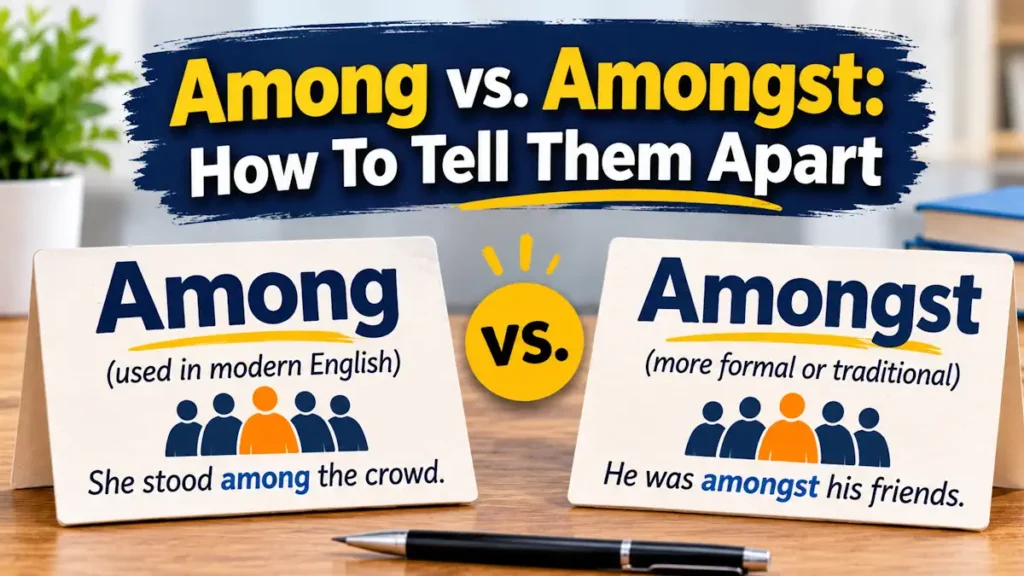
“Among” and “amongst” are two of the most commonly confused words in English, and here’s the reassuring part: they mean exactly the same thing and are almost always interchangeable. Both are prepositions meaning “in the middle of” or “surrounded by.” The real difference is tone and region, not meaning.
Among is the more common, modern choice, especially in American English. Amongst means the same thing but sounds more formal and old-fashioned, and it’s a little more common in British English. This guide shows you exactly when each one fits, with side-by-side examples.
Quick Answer: Among and amongst mean the same thing: “in the middle of.” Use among for everyday and American English; use amongst for a more formal or British tone. Both are correct.
Definition: What Do They Mean?
Both among and amongst are prepositions that show something is in the middle of, surrounded by, or part of a group. You use them with three or more things, or with a collective group.
✓ She felt calm among her friends.
✓ She felt calm amongst her friends.
Same meaning, slightly more formal tone.
Using the Word “Among”
Among is the standard, everyday choice. It works in casual conversation, business writing, and academic work alike, and it’s the dominant form in American English.
Examples of “Among”
✓ The red rose stood out among the white ones.
✓ He found his keys hidden among the clutter.
✓ Our team ranked first among all the schools.
Using the Word “Amongst”
Amongst carries the same meaning but a more formal, literary, or old-fashioned tone. It appears more often in British English, in formal writing, and in poetry or elevated prose. It’s never required, but it can add a touch of formality.
Examples of “Amongst”
✓ Amongst the many options, one clearly stood out.
✓ A sense of unity grew amongst the guests.
✓ The tradition was passed amongst the elders.
Among vs Amongst: Side by Side
Because they’re interchangeable, you can swap one for the other without changing the meaning. Only the tone shifts.
| Among (common) | Amongst (formal) |
|---|---|
| Divide the prize among the winners. | Divide the prize amongst the winners. |
| She was lost among the crowd. | She was lost amongst the crowd. |
| Trust grew among the team. | Trust grew amongst the team. |
So What’s the Real Difference?
The difference is register and region, not grammar or meaning:
- Tone: among is neutral and modern; amongst is more formal and literary.
- Region: among dominates in American English; amongst is a bit more common in British English.
- Frequency: among is far more common overall in modern writing.
Key Point: There is no grammar rule that makes one right and the other wrong. They’re true synonyms. Choose based on your audience and the tone you want.
Among, Amongst, and Their Synonyms
Both words share several close synonyms. These can add variety, though each has a slightly different flavor.
| Synonym | Tone / Use | Example |
|---|---|---|
| among | Neutral, most common | happy among friends |
| amongst | Formal, literary | happy amongst friends |
| amid | Formal; often for situations | calm amid the chaos |
| amidst | Very formal, literary | calm amidst the storm |
| in the midst of | Emphatic, descriptive | in the midst of a crowd |
Quick Tip: Use “among/amongst” for countable people or things (among the players). Use “amid/amidst” more for uncountable situations or mass nouns (amid the confusion).
Which One Should You Use?
- Writing for an American or general audience? Use among.
- Want a formal, literary, or British tone? Amongst works.
- Not sure? Use among. It’s never wrong and always sounds natural.
Common Mistakes to Avoid
- Using among/amongst for only two things. For two, use between (“between you and me”), not among.
- Thinking amongst is “more correct.” It isn’t; it’s just more formal.
- Mixing both in one piece. Pick one and stay consistent.
How to Remember the Difference
Remember This: Amongst has an extra “st,” like “old-fastioned” and formal. Among is shorter and simpler, like modern everyday writing. When in doubt, go shorter: among.
Quick Quiz: Test Yourself
Pick the best answer. The answer key is at the bottom; no peeking!
Q1. Which word is more common in modern American English?
a) amongst
b) among
c) neither
Q2. “Amongst” sounds more:
a) casual
b) formal
c) incorrect
Q3. For only TWO items, you should use:
a) among
b) between
c) amongst
Q4. Is there a grammar rule making one correct and one wrong?
a) yes
b) no
c) only in the US
Q5. Writing for a general US audience, the safest choice is:
a) amongst
b) among
c) amidst
Answer Key: 1-b 2-b 3-b 4-b 5-b
Final Verdict
Among and amongst are true synonyms, so neither is wrong. Use among for everyday and American writing, and reach for amongst only when you want a more formal or British tone. When in doubt, among is always a safe, natural choice.
Frequently Asked Questions
Is among or amongst correct?
Both are correct. They mean the same thing. “Among” is more common and modern; “amongst” is more formal and slightly more common in British English.
What is the difference between among and amongst?
Only tone and region. Both mean “in the middle of.” “Among” is neutral and common; “amongst” sounds more formal or literary.
Is amongst used in British English?
Yes, “amongst” appears a bit more often in British English, though “among” is still common there too. American English strongly prefers “among.”
Is amongst more formal than among?
Yes. “Amongst” has a more formal, old-fashioned, or literary tone, while “among” is the everyday choice.
Should I use among or between?
Use “between” for two items (between you and me) and “among” for three or more (among the players). This is the one real grammar distinction.
Can I use among and amongst in the same text?
You can, but it’s better to pick one and stay consistent throughout a single piece of writing.
Among or amongst, the meaning is the same. Go with among unless you want a formal, British tone.

Benen
My name is Benen, and I am an English teacher from the US and UK. I am passionate about helping people improve their English language skills, including grammar, vocabulary, and sentence structure, while building their confidence in a supportive and patient learning environment.