
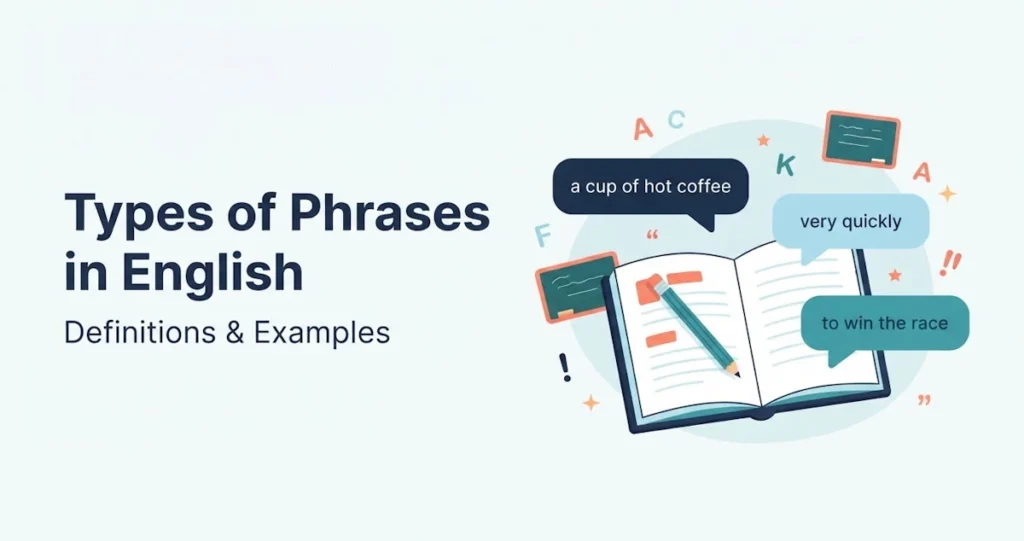
Phrases are the building blocks of every sentence you speak or write. A phrase is a small group of words that work together to do one job, and once you can recognize the different types, both reading and writing English become much easier.
In this guide, you will learn what a phrase is, how it is different from a clause, and the main types of phrases in English, each explained with a simple definition and clear examples. Whether you are a student, a teacher, or an English learner, this lesson will help you understand and use phrases with confidence.
What Is a Phrase?
A phrase is a group of related words that work together as a single unit inside a sentence. Unlike a full sentence, a phrase does not contain both a subject and a matching verb that can stand on its own, so it cannot express a complete thought by itself. Instead, a phrase does one particular job, such as naming a thing, describing an action, or adding extra detail.
For example, in the sentence “The little kitten slept on the soft blanket,” the words “the little kitten” form one phrase, and “on the soft blanket” form another. Each group of words works together, but neither one can stand alone as a complete sentence.
Phrase vs Clause: What Is the Difference?
Learners often mix up phrases and clauses, but the difference is simple. A clause contains a subject and a verb that go together, while a phrase does not. A clause can sometimes stand on its own as a complete sentence, but a phrase always needs to be part of a larger sentence.
| Phrase | Clause |
|---|---|
| A group of words that work together as a unit | A group of words that contains a subject and a verb |
| Has no subject-and-verb pair that can stand alone | Has a subject and a predicate that go together |
| Cannot express a complete thought by itself | An independent clause can express a complete thought |
| Example: in the morning | Example: the sun rises in the morning |
Look at these examples: in the morning is a phrase, because it has no subject or verb, while the sun rises in the morning is a clause, because it has a subject (the sun) and a verb (rises).
Types of Phrases in English
English grammar has several main types of phrases. Each type is named after its head word, which is the most important word in the group, or after the job it does in the sentence. Below are the ten most common types, each with a clear definition and examples.
1. Noun Phrase
A noun phrase is a noun together with all the words that describe or point to it, such as articles, adjectives, and other modifiers. The whole group works as a single noun, so it can act as a subject, an object, or a complement in the sentence.
Examples:
- The tall man in the grey coat waved at us.
- I bought a beautiful bunch of red roses for my mother.
- My younger sister’s best friend is coming over tonight.
- She enjoys a warm cup of tea every morning.
- The old house at the end of the street is finally for sale.
2. Verb Phrase
A verb phrase is a main verb along with its helping (auxiliary) verbs. Together they show the tense, mood, or voice of the action. In a wider sense a verb phrase can also include the words that complete the verb, but at its core it is the main verb plus any helping verbs.
Examples:
- She has been studying for three hours.
- They will have finished the project by Friday.
- The letter should have been sent yesterday.
- We are planning a surprise party.
- He might not come to the meeting.
3. Adjective Phrase
An adjective phrase is a group of words built around an adjective. It does the job of an adjective by describing or giving more information about a noun or a pronoun. The other words in the phrase, such as “very” or “too” or a following prepositional phrase, modify the adjective.
Examples:
- The test was extremely difficult to pass.
- He is a boy full of energy and curiosity.
- This soup is far too salty for me.
- The mountain path was steep and covered in ice.
- She gave an answer clever enough to impress everyone.
4. Adverb Phrase
An adverb phrase, also called an adverbial phrase, is a group of words that works like an adverb. It tells how, when, where, why, or to what extent something happens, and it usually modifies a verb, an adjective, or another adverb. Many adverb phrases are prepositional phrases doing an adverb’s job.
Examples:
- She finished the race in record time.
- He spoke very softly and politely.
- We will meet early in the morning.
- The children played as happily as ever.
- Please handle the vase with great care.
5. Prepositional Phrase
A prepositional phrase begins with a preposition and ends with a noun or pronoun called the object of the preposition, along with any words that modify it. It usually works as an adjective or an adverb. To spot one, look for a preposition such as in, on, under, with, by, or about, followed by its object.
Examples:
- The keys are on the kitchen counter.
- We walked through the quiet forest.
- The gift in the red box is for you.
- She sang with great confidence.
- They arrived after a long journey.
6. Gerund Phrase
A gerund phrase is built around a gerund, which is the -ing form of a verb used as a noun. The phrase includes the gerund plus its objects and modifiers, and the whole group acts as a noun. Even though it starts with an -ing word, it names an activity and works as a subject, object, or complement.
Examples:
- Swimming in the ocean is her favorite hobby.
- He enjoys reading mystery novels late at night.
- Winning the championship was their greatest dream.
- She is very good at solving difficult puzzles.
- Baking fresh bread fills the whole house with a lovely smell.
7. Infinitive Phrase
An infinitive phrase is made up of an infinitive, which is the word “to” plus the base form of a verb, along with its objects and modifiers. It is flexible and can work as a noun, an adjective, or an adverb, depending on its job in the sentence.
Examples:
- Her goal is to become a doctor.
- He has a lot of work to finish before lunch.
- They stopped to admire the beautiful view.
- To learn a new language takes patience and practice.
- We were happy to help our new neighbors.
8. Participial Phrase
A participial phrase is built around a participle, which is a verb form used as an adjective. It can be a present participle ending in -ing or a past participle ending in -ed, -en, or an irregular form. The phrase describes a noun or a pronoun. Note that although present participles also end in -ing, a participial phrase acts as an adjective, while a gerund phrase acts as a noun.
Examples:
- Running down the street, the dog chased the ball.
- The vase, broken into several pieces, could not be repaired.
- Covered in fresh snow, the fields looked magical.
- The girl wearing a red hat is my cousin.
- Exhausted after the long hike, they fell asleep quickly.
9. Appositive Phrase
An appositive phrase is a noun phrase placed next to another noun to rename it or give more information about it. It is usually set off with commas, and it could often replace the noun beside it or be removed without breaking the sentence.
Examples:
- My brother, a talented guitarist, is playing tonight.
- Paris, the capital of France, is famous for its art.
- Our teacher, a kind and patient woman, helped us all.
- His car, an old but reliable sedan, never breaks down.
- The Nile, the longest river in Africa, flows through many countries.
10. Absolute Phrase
An absolute phrase is a group of words containing a noun and a participle, plus any modifiers. Unlike the other phrases, it modifies the whole sentence rather than a single word, and it is usually set off with a comma. It often reads like a small idea that adds detail to the entire sentence.
Examples:
- Her hair blowing in the wind, she stood at the edge of the cliff.
- The game finally over, the players walked off the field.
- He sat quietly, his hands resting on the table.
- Weather permitting, we will have the picnic tomorrow.
- The work completed, they celebrated with a big dinner.
Summary Table of Phrase Types
Here is a quick overview of all ten phrase types, their structure, and the job each one does in a sentence.
| Phrase Type | Structure / Head | Function | Example |
|---|---|---|---|
| Noun phrase | Noun plus modifiers | Acts as a noun | the tall man in the grey coat |
| Verb phrase | Main verb plus helping verbs | Shows the action and its tense | has been studying |
| Adjective phrase | Adjective plus modifiers | Describes a noun or pronoun | far too salty for me |
| Adverb phrase | Adverb or preposition-based group | Tells how, when, where, or why | in record time |
| Prepositional phrase | Preposition plus its object | Works as an adjective or adverb | on the kitchen counter |
| Gerund phrase | -ing verb used as a noun | Acts as a noun | swimming in the ocean |
| Infinitive phrase | to plus the base verb | Acts as a noun, adjective, or adverb | to become a doctor |
| Participial phrase | Present or past participle | Describes a noun (adjective) | running down the street |
| Appositive phrase | Noun phrase renaming a noun | Renames or explains a nearby noun | the capital of France |
| Absolute phrase | Noun plus a participle | Modifies the whole sentence | her hair blowing in the wind |
How to Identify Phrases in a Sentence
Naming a phrase becomes easy once you follow a few simple steps:
1. Find the words that belong together. Read the sentence and notice which words work as a single unit.
2. Look for the head word. Ask which word is the most important one in the group, a noun, a verb, an adjective, and so on.
3. Check for a subject and verb. If the group has a subject and a matching verb, it is a clause, not a phrase.
4. Decide what job it does. See whether the group names something, describes something, or tells how, when, or where. Its function often reveals its type.
5. Name the phrase. Use both the head word and the function together to give the phrase its correct name.
Common Mistakes to Avoid
- Confusing gerund and participial phrases. Both can begin with an -ing word. Remember that a gerund phrase acts as a noun, while a participial phrase acts as an adjective.
- Treating a phrase as a complete sentence. A phrase on its own is a fragment. “Running very fast” is not a sentence until you add a subject and verb, as in “The athlete was running very fast.”
- Forgetting commas with appositive and absolute phrases. These phrases are usually set off with commas, and leaving them out can confuse the reader.
- Misplacing participial phrases. A participial phrase should sit close to the noun it describes, or it can create a dangling modifier, as in “Walking to school, the rain soaked us,” which sounds like the rain was walking.
Conclusion
Phrases may be small, but they carry a lot of meaning and give your sentences shape and detail. Once you can tell a noun phrase from a verb phrase, or a gerund phrase from a participial phrase, you will read more closely and write more clearly.
The best way to master phrases is to practice. Read a few sentences each day, find the phrases inside them, and name each type. With a little practice, spotting phrases will soon feel completely natural.
Frequently Asked Questions
What is the difference between a phrase and a clause?
A phrase is a group of words with no subject-and-verb pair, so it cannot stand alone. A clause has a subject and a verb, and an independent clause can stand alone as a complete sentence.
How many types of phrases are there in English?
The most commonly taught types are ten: noun, verb, adjective, adverb, prepositional, gerund, infinitive, participial, appositive, and absolute phrases. Some grammar books group or name a few of them slightly differently.
Can a phrase contain a verb?
Yes. Verb phrases, infinitive phrases, gerund phrases, and participial phrases all contain a verb or a verb form. The key point is that a phrase does not have a subject and verb working together as an independent unit.
What is the difference between a gerund phrase and a participial phrase?
Both can begin with an -ing word, but a gerund phrase works as a noun that names an activity, while a participial phrase works as an adjective that describes a noun.
Why is it important to learn types of phrases?
Understanding phrases helps you build clearer and more varied sentences, avoid fragments, and see how English is put together, which improves both your writing and your speaking.

Benen
My name is Benen, and I am an English teacher from the US and UK. I am passionate about helping people improve their English language skills, including grammar, vocabulary, and sentence structure, while building their confidence in a supportive and patient learning environment.