
Every sentence has two jobs: naming who or what we’re talking about, and telling us what’s happening. That second job belongs to the predicate. In this lesson, you’ll learn what a predicate is, how to spot one in seconds, the five main types, and then test yourself with a quick quiz.
What Is a Predicate?
A predicate is the part of a sentence that tells us what the subject does, is, or experiences. The simplest rule to remember: a predicate always contains a verb.
Let’s start with the shortest sentence possible:
Example: I fell.
Here, “I” is the subject (who we’re talking about), and “fell” is the predicate: it tells us exactly what the subject did.
The Core Formula: Subject + Predicate
In English, most sentences follow the pattern Subject-Verb-Object (SVO). But at the most basic level, every complete sentence breaks into just two parts:
- Subject: a noun, pronoun, or noun phrase (the who or what)
- Predicate: everything else, starting with the verb (the what’s happening)
How to Identify a Predicate (The Quick Trick)
Here’s the shortcut: find the subject first, and whatever is left, beginning with the verb, is the predicate.
Watch how it works. The first bracket is the subject; the second is the predicate:
1. [Traditional Belgian waffles] [are dotted with little pearls of sugar.]
2. [My friend Sarah] [puts ketchup on everything.]
3. [The baby goats] [climbed up the cliff face reluctantly.]
Notice that the predicate isn’t just the verb; it can also include objects and modifiers (like adverbs and prepositional phrases) that complete the thought.
The 5 Types of Predicates
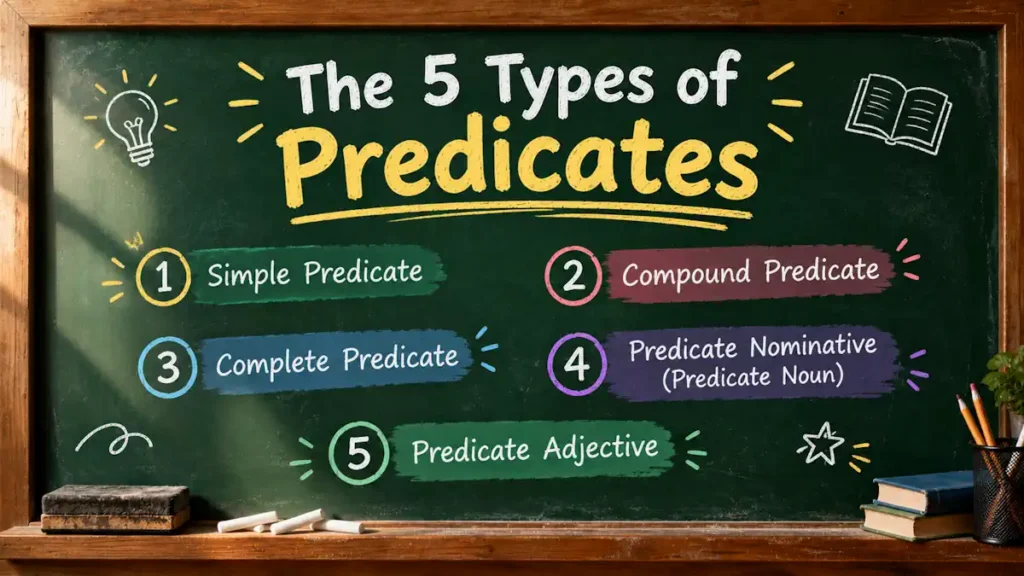
There are five main types you’ll come across. Each one has an example right beside it so the idea sticks.
1. Simple Predicate
Just the main verb or verb phrase, nothing extra.
Example: Friendship is valuable.
2. Compound Predicate
Two or more actions (or states) joined by a conjunction like and or or.
Example: Bridgette reads and writes.
3. Complete Predicate
The main verb plus all the words that complete the action or state.
Example: She is studying at university to earn her degree.
4. Predicate Nominative (Predicate Noun)
A noun or pronoun that follows a linking verb (like is) and renames the subject.
Example: Samuel Clemens’s pen name is Mark Twain.
5. Predicate Adjective
An adjective that comes after a linking verb and describes the subject.
Example: He is exhausted.
Practice Quiz: Identify the Predicate
Pick the predicate in each sentence. Answers are at the bottom; no peeking!
Q1. The red balloon floated away slowly.
a) floated away slowly
b) The red balloon
c) red balloon
Q2. My neighbors were singing on the porch.
a) My neighbors
b) the porch
c) were singing on the porch
Q3. A sudden chill ran through the crowd.
a) A sudden chill
b) ran through the crowd
c) the crowd
Q4. Her explanation was perfectly clear.
a) was perfectly clear
b) Her explanation
c) perfectly clear
Q5. The toddlers napped after lunch.
a) The toddlers
b) after lunch
c) napped after lunch
Answer Key: 1-a 2-c 3-b 4-a 5-c
Frequently Asked Questions
What is a predicate in a sentence?
It tells what the subject does, is, or experiences. It always includes the main verb and may also include objects and modifiers.
Do all predicates have verbs?
Yes, always. A predicate contains either an action verb or a linking verb (like “be”).
How do I find the predicate quickly?
First identify the subject (a noun, pronoun, or noun phrase). Everything that’s left, starting with the verb, is the predicate.
What’s the difference between a simple and complete predicate?
The simple predicate is just the main verb (and any helpers). The complete predicate includes the verb plus all its complements and modifiers.
Can a predicate come before the subject?
Yes. Inverted sentences (e.g., “Here comes the bus”) place the verb before the subject, but the predicate still begins with the verb.

Benen
My name is Benen, and I am an English teacher from the US and UK. I am passionate about helping people improve their English language skills, including grammar, vocabulary, and sentence structure, while building their confidence in a supportive and patient learning environment.