
The correct spelling, the simple rule behind it, and clear examples with a quiz.
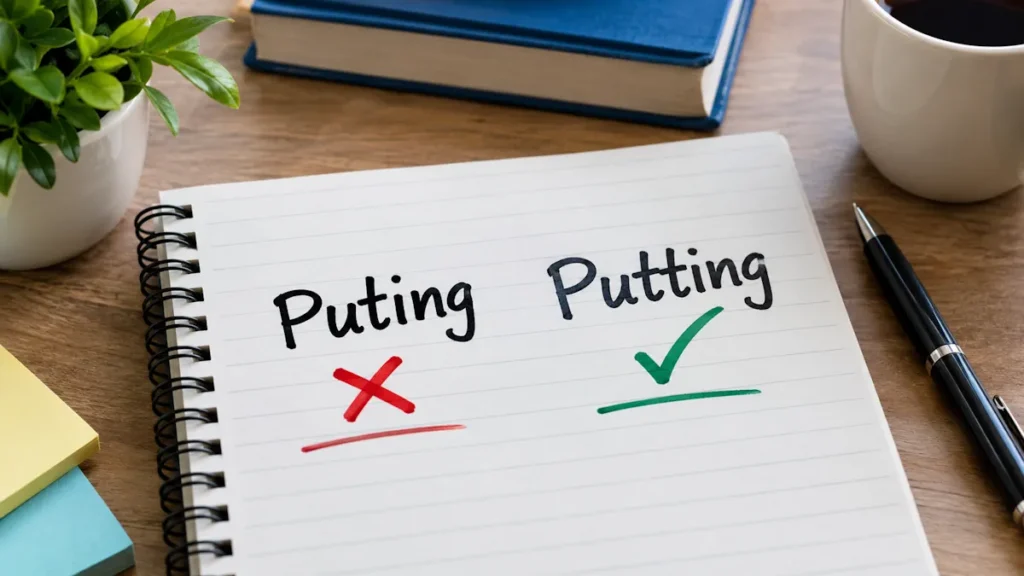
You’re typing fast and suddenly pause: is it “puting” or “putting”? It’s one of the most common spelling slip-ups in English. The correct spelling is putting, with two t’s. “Puting” with one t is always a misspelling. This guide explains the simple spelling rule that makes it stick, why so many people get it wrong, and how to use the word correctly, with plenty of examples.
Quick Answer:
Putting (double t) is correct. Puting (single t) is a misspelling and should never be used. The verb put doubles its final t before adding -ing.
Why Is It Spelled “Putting” with Two T’s?
The answer is a spelling rule often called the 1-1-1 rule (or the doubling rule). When a short verb ends in a consonant-vowel-consonant pattern and the last syllable is stressed, you double the final consonant before adding -ing or -ed.
The word put fits perfectly: p (consonant) + u (vowel) + t (consonant), in one stressed syllable. So the t doubles: put + t + ing = putting.
The Rule in One Line: One syllable, one vowel, one final consonant → double it before -ing. That’s why put becomes putting.
Why “Puting” Is Wrong
If you wrote “puting” with one t, the standard vowel sound would change. By English spelling patterns, a single consonant after the vowel makes the u “long,” so “puting” would look like it should rhyme with “scooting” or sound like “pew-ting.” Doubling the t keeps the short “u” sound you hear in put.
✗ I am puting the books on the shelf.
✓ I am putting the books on the shelf.
All Forms of the Verb “Put”
“Put” is an irregular verb: its past tense is also put. Here are all its forms.
| Form | Spelling | Example |
|---|---|---|
| Base | put | Please put it down. |
| Present (he/she/it) | puts | She puts it away daily. |
| Present participle (-ing) | putting | He is putting it away. |
| Past simple | put | Yesterday I put it away. |
| Past participle | put | I have put it away. |
Good to Know: Unlike most verbs, “put” doesn’t change for past tense: “Yesterday I put it there” is correct, not “putted.” Only the -ing form adds letters, and that’s where the double t appears.
The Same Rule in Other Words
Once you know the doubling rule, you’ll spot it everywhere. These common verbs follow the exact same pattern.
| Base Verb | Add -ing | Why It Doubles |
|---|---|---|
| sit | sitting | s-i-t: one vowel, one final consonant |
| run | running | r-u-n: short vowel, single ending |
| cut | cutting | c-u-t: CVC pattern |
| stop | stopping | st-o-p: stressed CVC |
| get | getting | g-e-t: one syllable CVC |
| swim | swimming | sw-i-m: short vowel + single m |
Contrast: Compare “hoping” (from hope) and “hopping” (from hop). The silent e in “hope” makes a long vowel, so no doubling. “Hop” has a short vowel, so it doubles. “Put” has no silent e, so it doubles too.
“Putting” in Real Sentences
✓ She is putting the final touches on her project.
✓ Thanks for putting up with me today.
✓ They are putting money into a savings account.
✓ He kept putting off the difficult task.
✓ We’re putting on a show this weekend.
Common Phrases with “Putting”
“Putting” shows up in many everyday expressions. Here are a few, all spelled with the double t.
| Phrase | Meaning |
|---|---|
| putting off | Delaying or postponing something. |
| putting up with | Tolerating something annoying. |
| putting together | Assembling or organizing. |
| putting down | Placing down, or criticizing. |
| putting on | Wearing, or staging an event. |
Common Spelling Mistakes to Avoid
| Incorrect | Correct |
|---|---|
| putting | |
| putting off the work | |
| putting on a jacket | |
| put (past tense) |
Note: “Putted” does exist, but only in golf (“she putted the ball”), from the separate verb “to putt.” For the everyday verb “put,” the past tense stays “put.”
Practice Quiz: Test Yourself
Pick the correct spelling or form. The answer key is at the bottom; no peeking!
Q1. Which spelling is correct?
a) puting
b) putting
c) puttting
Q2. She is ___ the dishes away.
a) puting
b) putting
c) puteing
Q3. Why does “put” double the t before -ing?
a) It’s a silent-e word
b) It follows the consonant-doubling (CVC) rule
c) It’s a plural
Q4. What is the past tense of “put” (non-golf)?
a) putted
b) put
c) putting
Q5. Which verb also doubles before -ing?
a) hope
b) sit
c) read
Answer Key: 1-b 2-b 3-b 4-b 5-b
Frequently Asked Questions
Is it puting or putting?
It is “putting,” with two t’s. “Puting” with one t is a misspelling. The verb “put” doubles its final t before -ing.
Why does putting have two t’s?
Because “put” ends in a consonant-vowel-consonant pattern in one stressed syllable. English doubles the final consonant before -ing, so put becomes putting.
What is the past tense of put?
It stays “put.” “Put” is irregular, so you say “I put it there yesterday,” not “putted.” (“Putted” is only used in golf.)
Is “puting” ever correct?
No. “Puting” is never correct in standard English. The only correct -ing form of “put” is “putting.”
How do I know when to double the last letter before -ing?
Use the CVC rule: if a one-syllable word ends in a consonant, a single vowel, and a consonant, double the last letter (run to running, put to putting).
Do you put a comma before “and”?
Sometimes. Use a comma before “and” when it joins two independent clauses (“I cooked, and she cleaned”) or as the optional Oxford comma in a list. You usually skip it when “and” simply joins two words or short phrases.
Can you put a comma before “and”?
Yes, you can, in the right cases: before a second independent clause, or as the serial (Oxford) comma in a list of three or more items. It is not required between just two items.
What are calls and puts?
These are finance terms, not spelling ones. A “call” is an option to buy an asset at a set price, and a “put” is an option to sell it. They are unrelated to the spelling of “putting.”
Remember the double t: short vowel, single ending, so “put” becomes “putting” every time.

Benen
My name is Benen, and I am an English teacher from the US and UK. I am passionate about helping people improve their English language skills, including grammar, vocabulary, and sentence structure, while building their confidence in a supportive and patient learning environment.