
The simple rule, an easy test, and clear examples with a quick quiz.
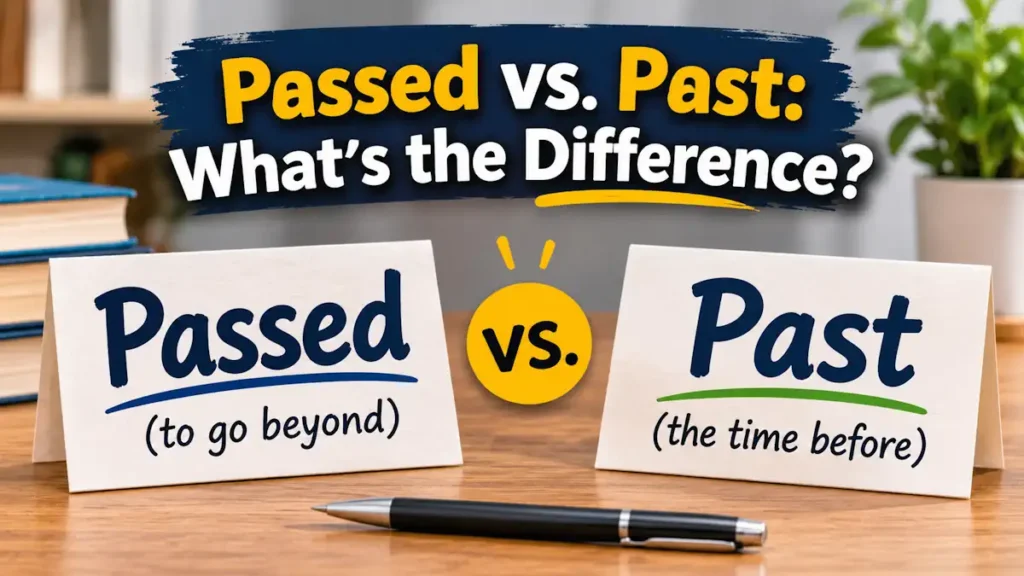
“Passed” and “past” sound exactly the same, so they’re easy to mix up. The difference is actually simple once you know one thing: passed is always a verb (the past tense of “pass”), while past is never a verb. It works as a noun, adjective, adverb, or preposition instead.
If the word is describing an action that already happened, you want passed. For almost everything else, you want past. This guide shows you the one-second test, the different jobs each word does, and plenty of examples.
Quick Answer: Passed is a verb: “She passed the test” / “We passed the store.” Past is a noun, adjective, adverb, or preposition: “in the past,” “the past week,” “walk past.”
Why People Confuse Them
The two words are homophones, so they sound identical when spoken. They also share a history: past actually grew out of an old form of passed. But in modern English they have split into clear, separate roles, and only passed is a verb.
Passed: Always a Verb
Passed is the past tense (and past participle) of the verb to pass. It describes a completed action, such as moving by something, succeeding at something, or time going by.
Examples of “Passed”
✓ She passed the final exam.
(succeeded)
✓ We passed a gas station on the way.
(moved by)
✓ Three hours passed quickly.
(time went by)
✓ He passed me the salt.
(handed over)
Past: Everything Except a Verb
Past never acts as a verb. Instead, it plays four other roles. Here’s each one with an example.
Past as a Noun (a time before now)
✓ We learn from the past.
Past as an Adjective (describing a time gone by)
✓ Over the past week, it rained a lot.
Past as a Preposition (beyond a point)
✓ The office is just past the bank.
✓ It’s ten minutes past noon.
Past as an Adverb (moving by)
✓ The bus drove past without stopping.
The Easy Test
Ask one question: Is this word an action (a verb)?
- If yes, and you could swap in another past-tense verb like “walked” or “moved,” use passed.
- If no (it names a time, describes one, or shows position), use past.
✓ “We [moved] the exit” works → “We passed the exit.”
✓ “Walk [moved] the store” fails → “Walk past the store.”
Quick Tip: Only “passed” is a verb. If you can replace the word with “walked,” “moved,” or “went by,” it’s passed. Otherwise, it’s past.
Passed vs Past: Comparison Table
| Feature | Passed | Past |
|---|---|---|
| Part of speech | Verb only | Noun, adjective, adverb, preposition |
| Meaning | Past tense of “pass” (an action) | A time before now, or beyond a point |
| Quick test | Can swap with “moved/went” | Names or describes a time/position |
| Example | She passed the test. | in the past |
Common Mistakes to Avoid
| Meaning Intended | Incorrect | Correct |
|---|---|---|
| An action (moved by) | We passed the store. | |
| A time before now | in the past | |
| Beyond a point | just past the bank | |
| Succeeded | She passed the exam. |
Watch Out: “Walked passed” is a very common error. Since “walked” is already the verb, the next word shows position, so it must be “walked past.”
Memory Trick
Remember This: Passed has two s‘s, like other action verbs that end in -ssed (kissed, missed, tossed). If it’s an action, double the s: passed.
More Examples in Context
“Passed” (verb)
- Mike passed his driving test on the first try.
- The years passed, and the city grew.
- Emily passed the ball to her teammate.
- We passed three exits before we noticed.
“Past” (noun, adjective, adverb, preposition)
- In the past, people wrote letters by hand.
- The past few days have been busy.
- The train sped past the platform.
- The library is just past the park.
Practice Quiz: Test Yourself
Pick the correct word for each sentence. The answer key is at the bottom; no peeking!
Q1. We ___ the gas station without stopping.
a) past
b) passed
c) pased
Q2. In the ___, she lived in Chicago.
a) passed
b) past
c) past
Q3. He ___ all of his classes this year.
a) past
b) passed
c) passt
Q4. The store is just ___ the traffic light.
a) passed
b) past
c) passt
Q5. Which word is always a verb?
a) past
b) passed
c) both
Answer Key: 1-b 2-b 3-b 4-b 5-b
Final Verdict
The rule is simple: passed is always a verb (the past tense of “pass”), and past is everything else. If you can replace the word with “moved” or “went by,” use passed. Otherwise, it’s past.
Frequently Asked Questions
What is the difference between passed and past?
“Passed” is a verb, the past tense of “pass.” “Past” is a noun, adjective, adverb, or preposition. If the word is an action, use passed; otherwise use past.
Is it walked passed or walked past?
It’s “walked past.” Since “walked” is already the verb, the next word shows position, so it must be “past,” not “passed.”
Is it passed the time or past the time?
Both are correct but mean different things. “Time passed” means time went by (verb). “Past the time” means beyond that point (preposition).
How do I know when to use passed?
Use passed when the word is a verb describing a completed action. If you can swap in “moved” or “went by,” passed is correct.
Can past be a verb?
No. “Past” is never a verb. The verb form is always “passed.” This is the key difference between the two words.
Passed is the action; past is the time or place. If it’s a verb, double the s.

Benen
My name is Benen, and I am an English teacher from the US and UK. I am passionate about helping people improve their English language skills, including grammar, vocabulary, and sentence structure, while building their confidence in a supportive and patient learning environment.