

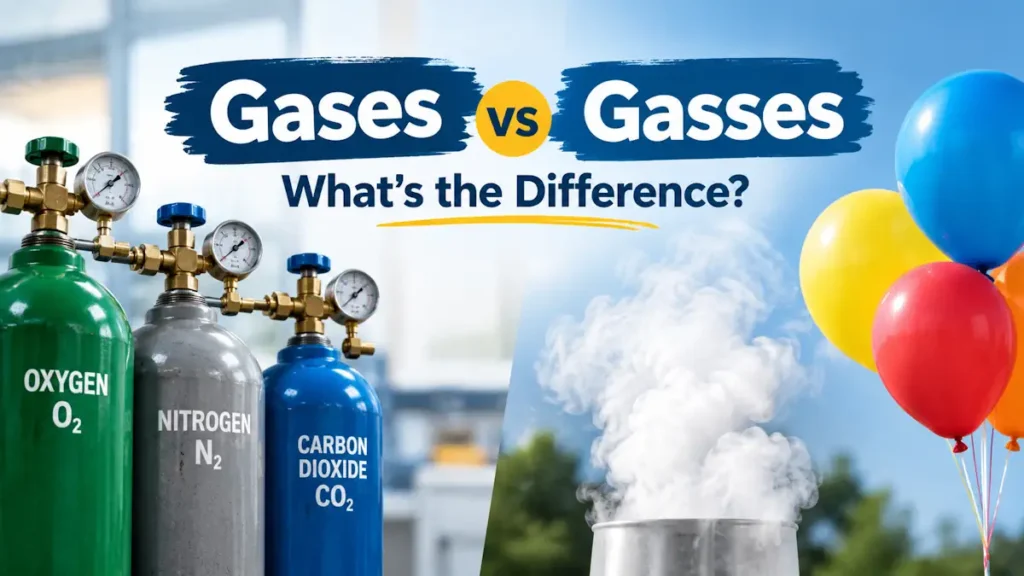
When to use each spelling, why the s sometimes doubles, and clear examples.
Here’s a spelling question that trips up students and science writers alike: is the plural of gas spelled “gases” or “gasses”? The short answer is that both exist, but they do different jobs. Gases (one s) is the standard plural of the noun. Gasses (double s) is mainly the verb form, as in “he gasses up the car.”
That single difference, one s versus two, is where almost all the confusion comes from. The word gas behaves differently as a noun than as a verb. This guide explains exactly when to use each form, the spelling rule behind it, and how to never mix them up again.
Quick Answer: Use gases (one s) for the plural noun: “the gases in the air.” Use gasses (two s) for the verb (he/she/it form): “she gasses up before a trip.”
Why People Confuse Gases and Gasses
The mix-up happens because gas breaks the pattern we expect. With most short words ending in a single consonant, we double that consonant before adding an ending, giving us busses or gasses. But the plural noun “gas” is a special case: it takes just -es, so the standard plural is gases. Meanwhile, the verb “to gas” does double the s, which is why gasses also exists. Same letters, two different grammar jobs.
Gases: The Plural Noun
Gases is the plural of the noun gas. It refers to more than one gas, the airy substances like oxygen, hydrogen, and carbon dioxide. This is the spelling you’ll use in science, chemistry, and everyday writing almost all the time.
Examples of “Gases”
✓ The atmosphere is made of several gases.
✓ Greenhouse gases trap heat in the air.
✓ Noble gases rarely react with other elements.
✓ The factory released harmful gases.
Gasses: The Verb Form
Gasses is the third-person singular of the verb to gas (used with he, she, or it). To “gas” something can mean to fill it with fuel, or to affect it with gas.
Examples of “Gasses”
✓ He gasses up the car every Friday.
✓ The machine gasses off fumes as it heats.
✓ She always gasses the tank before a long drive.
Good to Know: As a plural noun, “gasses” is listed in some dictionaries as a rare variant, but it is strongly discouraged. For the plural of gas, always write “gases” with one s.
Gases vs Gasses: Comparison Table
| Feature | Gases (one s) | Gasses (two s) |
|---|---|---|
| Main role | Plural noun | Verb (he/she/it form) |
| Meaning | More than one gas | To fuel or affect with gas |
| Standard plural of gas | Yes | No (rare variant) |
| Common in science | Yes | No |
| Example | noble gases | he gasses the car |
The Spelling Rule: Noun vs. Verb Forms
This is the heart of the matter, and where most guides stop short. The word gas takes different endings depending on whether it’s acting as a noun or a verb.
| Form | Spelling | Single or Double s |
|---|---|---|
| Plural noun | gases | Single s |
| Verb (he/she/it) | gasses | Double s |
| Verb (past tense) | gassed | Double s |
| Verb (-ing) | gassing | Double s |
| Adjective (gaseous) | gaseous | Single s |
The Key Pattern: The plural noun keeps one s (gases). Every verb form doubles the s (gasses, gassed, gassing). Decide if you mean the thing (noun) or the action (verb), and the spelling follows.
American vs British English
Good news: the rule is the same on both sides of the Atlantic. Gases is the standard plural noun in American, British, Australian, and Canadian English. One small note: some older British texts occasionally used gasses as a plural, but modern usage everywhere prefers gases.
Everyday Examples of Both Forms
“Gases” (plural noun)
- Hydrogen and helium are the lightest gases.
- Volcanoes release several toxic gases.
- The balloon was filled with inert gases.
- Scientists measured the gases in the sample.
- Car engines produce exhaust gases.
“Gasses” (verb)
- He gasses up the truck every morning.
- The reactor gasses off slowly during cooldown.
- She gasses the balloon with helium for parties.
- The old stove gasses out a faint smell.
Common Mistakes to Avoid
| Meaning Intended | Incorrect | Correct |
|---|---|---|
| Plural noun | the gases in the air | |
| Verb he/she/it | he gasses up the car | |
| Past tense | he gassed the room | |
| -ing form | gassing up |
Memory Trick
Remember This: Think: the noun is calmer, so it needs only one s (gases). The verb is an action, so it works harder and doubles the s (gasses, gassed, gassing). Thing = one s; action = two s.
Related Words and Forms
Gassed and Gassing
The other verb forms both double the s: the past tense is gassed (“the leak gassed the room”) and the -ing form is gassing (“he is gassing up the car”). This matches the double-s verb pattern of gasses.
Gaseous
The adjective form is gaseous (one s), meaning “in the form of a gas,” as in “a gaseous state.” It follows the single-s pattern of the noun.
Gasify vs. Gassify
The standard verb meaning “to turn into gas” is gasify (one s), and the process is gasification.
Practice Quiz: Test Yourself
Pick the correct spelling for each sentence. The answer key is at the bottom; no peeking!
Q1. The plural of the noun “gas” is:
a) gasses
b) gases
c) gas’
Q2. He ___ up the car before work.
a) gases
b) gasses
c) gasess
Q3. Greenhouse ___ trap heat in the atmosphere.
a) gases
b) gasses
c) gasies
Q4. The past tense of the verb “gas” is:
a) gased
b) gassed
c) gasd
Q5. The adjective meaning “in gas form” is:
a) gasseous
b) gaseous
c) gassious
Answer Key: 1-b 2-b 3-a 4-b 5-b
Final Verdict
For the plural of the noun, the correct spelling is gases with one s, and this is the form you’ll need almost every time. Use gasses only as the verb (he/she/it gasses). Remember: the thing takes one s, the action takes two.
Frequently Asked Questions
Is it gases or gasses?
For the plural of the noun gas, it is “gases” with one s. “Gasses” with two s is the verb form, as in “he gasses up the car.”
What is the correct plural of gas?
“Gases.” The atmosphere contains many gases, such as oxygen and nitrogen. “Gasses” is not the standard plural.
Is “gasses” a real word?
Yes, but mainly as a verb: the he/she/it form of “to gas” (she gasses the car). As a plural noun it is a rare, discouraged variant.
Why does the verb double the s but the noun doesn’t?
English often doubles a final consonant in verb forms (gassed, gassing, gasses), while the plural noun “gas” takes just -es, giving “gases.”
What is the past tense of the verb gas?
It is “gassed,” with two s. For example, “The fumes gassed the workers.” The -ing form is “gassing.”
Is “gaseous” spelled with one s or two?
One s: “gaseous.” It is the adjective meaning in the form of a gas, and it follows the single-s pattern of the noun.
How do I remember the difference?
Thing versus action. The noun (a thing) uses one s: gases. The verb (an action) doubles the s: gasses, gassed, gassing.
Thing or action? The noun gases takes one s; the verb gasses takes two. That’s the whole rule.

Benen
My name is Benen, and I am an English teacher from the US and UK. I am passionate about helping people improve their English language skills, including grammar, vocabulary, and sentence structure, while building their confidence in a supportive and patient learning environment.