
“Fewer” or “less”? Even native speakers mix these two up, and you’ll see the wrong one on signs and labels every day. The good news: there is one simple rule that sorts out almost every case. In this guide you’ll learn exactly when to use each word, the handful of exceptions with numbers and measurements, and how to never second-guess yourself again.
Quick Answer:
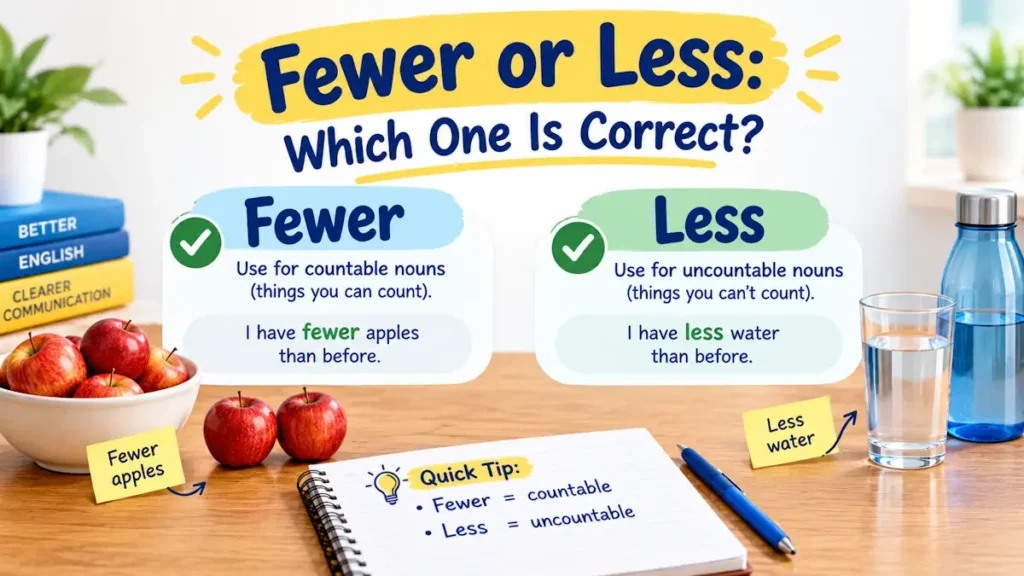
Use fewer for things you can count one by one (fewer apples). Use less for things you measure as a bulk amount (less water). If you can put a number in front of it, use fewer.
Quick Overview: At a Glance
The core difference between fewer and less depends on whether you can individually count the items.
- Fewer: Use for countable nouns (things you can count one by one, like apples, books, or people).
- Less: Use for uncountable or mass nouns (things you measure as a bulk amount or single quantity, like water, time, or sand).
Quick Examples
Fewer (countable):
✓ There are fewer cars on the road today.
✓ I have fewer emails to answer.
Less (uncountable):
✓ There is less traffic today.
✓ I have less time to finish this.
Countable vs. Uncountable Nouns
The whole rule rests on one idea: is the noun countable or uncountable?
Countable nouns are things you can count individually and make plural: one apple, two apples, three apples. Use fewer with these.
Uncountable nouns (also called mass nouns) are measured, not counted, and have no plural: water, rice, information, money. Use less with these.
Quick Tip: Try making the noun plural. If “two apples” works, it is countable, so use fewer. If “two waters” sounds wrong, it is uncountable, so use less.
Side-by-Side Comparison
| Aspect | Fewer | Less |
|---|---|---|
| Use with | Countable nouns | Uncountable / mass nouns |
| Test | Can you count them one by one? | Do you measure it as a bulk amount? |
| Plural noun? | Yes (books, cars, people) | No (water, time, sand) |
| Example | Fewer mistakes this time. | Less effort this time. |
| With a number | fewer than 10 books | (use fewer, not less) |
Common Exceptions: When “Less” Is Used with Numbers
Here is where most guides stop, but it matters. You often use less with plural nouns when they represent a single, measurable block or unit, especially time, money, distance, and weight.
| Category | Correct Example |
|---|---|
| Time | It happened less than five years ago. |
| Money | The bill is less than $50. |
| Distance | It is less than three miles away. |
| Weight | The package weighs less than 10 pounds. |
In each case, the amount is treated as one total quantity, not as separate items you count. “Five years” is a single stretch of time, not five things, so less is correct.
Watch Out: “Less than 10 items” at a store checkout is technically debated. Strict grammar prefers “fewer than 10 items” because items are countable. But “less than $10” is correct, because money is measured as an amount.
Common Mistakes to Avoid
| Context | Incorrect | Correct |
|---|---|---|
| Countable | fewer cars on the road | |
| Countable | fewer people came | |
| Uncountable | less water in the glass | |
| Money (amount) | less than $50 |
The Quick Rule to Remember
Remember This: Count it? Use fewer. Measure it? Use less. The main exception is amounts of time, money, distance, and weight, which take less even with a number.
Practice Quiz: Test Yourself
Pick the correct word for each sentence. The answer key is at the bottom; no peeking!
Q1. There were ___ students in class today.
a) less
b) fewer
c) lesser
Q2. I drink ___ coffee than I used to.
a) fewer
b) less
c) fewest
Q3. The trip takes ___ than two hours.
a) less
b) fewer
c) few
Q4. We made ___ mistakes this time.
a) fewer
b) less
c) lesser
Q5. There is ___ sugar in this recipe.
a) fewer
b) less
c) fewest
Answer Key: 1-b 2-b 3-a 4-a 5-b
Frequently Asked Questions
Is it fewer money or less money?
It is “less money.” Money is measured as an amount, not counted item by item, so it is uncountable and takes less: “I have less money than last month.”
Is it less or fewer days?
Both appear, but they differ. Use “fewer days” when counting individual days (“fewer days off this year”). Use “less” when the days are a single block of time (“in less than 30 days”).
Is it 10 or less or 10 or fewer?
For countable items, the strict form is “10 or fewer” (10 or fewer items). “10 or less” is common in casual use, but “fewer” is correct when the things can be counted.
Is “fewer” grammatically correct?
Yes. “Fewer” is the correct comparative word for countable nouns: fewer cars, fewer people, fewer mistakes. It is not old-fashioned or optional; it is standard English.
When to use fewer or less?
Use fewer for things you can count (fewer chairs) and less for things you measure (less noise). The exception is amounts of time, money, distance, and weight, which take less.
Is fewer more or less?
“Fewer” means a smaller number of countable things, so it points to less in quantity. It is simply the countable version of “less”: fewer cars means not as many cars.
When to use less or fewer?
Use “less” for uncountable amounts (less water, less time) and “fewer” for countable numbers (fewer bottles, fewer minutes counted individually). Ask whether you count it or measure it.
Does fewer mean more or less?
“Fewer” means less, in the sense of a smaller count. It never means more. “Fewer options” means not as many options, the opposite of more.
Count it or measure it: that one question answers almost every fewer-or-less choice you’ll ever face.

Benen
My name is Benen, and I am an English teacher from the US and UK. I am passionate about helping people improve their English language skills, including grammar, vocabulary, and sentence structure, while building their confidence in a supportive and patient learning environment.