
Both are correct: here’s when to use each, why they differ, and examples.
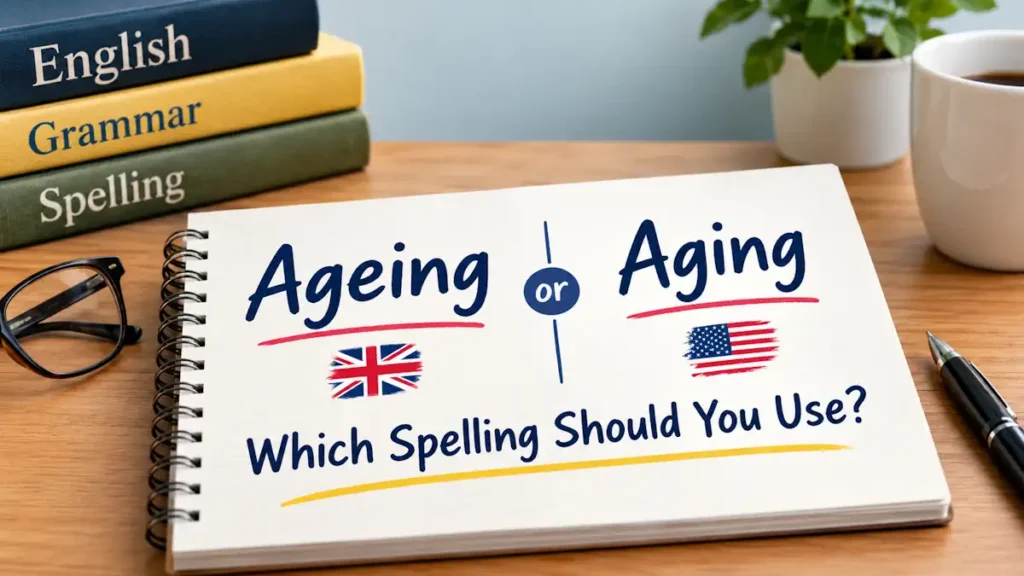
Should you write “ageing” or “aging”? Here’s the good news: both spellings are correct. The difference isn’t right versus wrong, it’s where you are. Aging (no e) is the American spelling, while ageing (with an e) is the British spelling.
Both refer to the same thing: the process of growing older. The only thing that changes is which audience you’re writing for. This guide explains which spelling to pick, why English has two versions, and how to stay consistent, with examples and a quick quiz.
Quick Answer:
Use aging (no e) for American audiences, and ageing (with an e) for British audiences. Both mean “growing older” and are equally correct; just pick one and stay consistent.
Why Are There Two Spellings?
English usually drops a silent e before adding -ing (“make” becomes “making”). American English follows this rule strictly, giving us aging. British English often keeps the e to preserve the look of the root word “age,” producing ageing. Both are long-standing, accepted spellings.
Aging: The American Spelling
Aging (without the e) is standard in the United States and Canada. It follows the regular rule of dropping the silent e before -ing.
✓ The aging population needs more care.
✓ Proper skincare slows visible aging.
✓ The cheese is aging in the cellar.
Ageing: The British Spelling
Ageing (with the e) is standard in the UK, Ireland, Australia, and New Zealand. It keeps the e from the root word “age.”
✓ The UK has an ageing workforce.
✓ She wrote a report on ageing and health.
✓ Anti-ageing creams are popular here.
Ageing vs Aging: Comparison Table
| Feature | Aging | Ageing |
|---|---|---|
| Spelling | No e | Keeps the e |
| Region | US, Canada | UK, Ireland, Australia, NZ |
| Meaning | Growing older | Growing older (same) |
| Follows -ing rule | Yes (drops e) | No (keeps e) |
| Example | aging population | ageing population |
Which Spelling Should You Use?
The choice is simple and depends entirely on your audience:
- Writing for a US or Canadian audience? Use aging.
- Writing for a UK, Irish, Australian, or NZ audience? Use ageing.
- Not sure, or writing globally? Pick one and stay consistent throughout the whole piece.
Key Rule: Never mix the two in one document. Choose the spelling that matches your audience, then use it every time. Consistency matters more than which one you pick.
Examples in Real Sentences
“Aging” (American)
- The aging process affects everyone differently.
- He studies the biology of aging.
- An aging bridge needs regular inspection.
- Aging gracefully is about health, not just looks.
“Ageing” (British)
- The country’s ageing infrastructure is a concern.
- Researchers study healthy ageing.
- Ageing skin benefits from hydration.
- The ageing fleet will soon be replaced.
Common Mistakes to Avoid
| Situation | Watch Out For | Better Choice |
|---|---|---|
| US writing | ageing population | aging population |
| UK writing | aging workforce | ageing workforce |
| Mixing both | one spelling throughout | |
| Wrong word | ageing (for a verb test) | match region, not guess |
Note: Neither spelling is an error. The only real mistake is being inconsistent or using the spelling that doesn’t match your target audience.
Memory Trick
Remember This: Ageing has an extra e, just like the word “England”… think “the British keep the e.” Aging (no e) is the leaner American spelling.
Words That Follow the Same Pattern
“Age” isn’t the only word where American English drops the e and British English sometimes keeps it. A few others behave similarly:
| Root Word | American | British |
|---|---|---|
| age | aging | ageing |
| route | routing | routeing (rare) |
| dye | dyeing | dyeing (both keep e) |
| judge | judgment | judgement |
Note that “dyeing” keeps the e in both varieties, to avoid confusion with “dying” (ceasing to live). So the rule has exceptions, but aging / ageing is the classic US/UK split.
Practice Quiz: Test Yourself
Pick the correct spelling for each context. The answer key is at the bottom; no peeking!
Q1. In American English, the correct spelling is:
a) ageing
b) aging
c) agging
Q2. In British English, the correct spelling is:
a) aging
b) ageing
c) ageling
Q3. Which spelling drops the silent e?
a) ageing
b) aging
c) both
Q4. For a report aimed at UK readers, use:
a) aging
b) ageing
c) either randomly
Q5. The most important rule when choosing is to:
a) always use aging
b) stay consistent
c) always use ageing
Answer Key: 1-b 2-b 3-b 4-b 5-b
Final Verdict
Both aging and ageing are correct spellings of the same word. Choose aging for American audiences and ageing for British ones, then use your choice consistently. There’s no wrong answer, only the wrong audience match.
Frequently Asked Questions
Is it ageing or aging?
Both are correct. “Aging” is the American spelling and “ageing” is the British spelling. They mean the same thing: growing older.
What is the difference between ageing and aging?
Only the spelling and the region. “Aging” (no e) is used in the US and Canada; “ageing” (with an e) is used in the UK, Ireland, Australia, and New Zealand.
Which spelling is correct in American English?
“Aging,” without the e. American English drops the silent e before adding -ing, as in make to making.
Which spelling is correct in British English?
“Ageing,” with the e kept from the root word “age.” This is standard across the UK and most Commonwealth countries.
Can I use either spelling?
Yes, but match your audience and be consistent. Don’t switch between “aging” and “ageing” within the same document.
Why does British English keep the extra e?
To preserve the look of the root word “age.” British spelling often retains letters that American spelling trims for simplicity.
Aging for America, ageing for Britain: pick the one that fits your reader and keep it consistent.

Benen
My name is Benen, and I am an English teacher from the US and UK. I am passionate about helping people improve their English language skills, including grammar, vocabulary, and sentence structure, while building their confidence in a supportive and patient learning environment.