

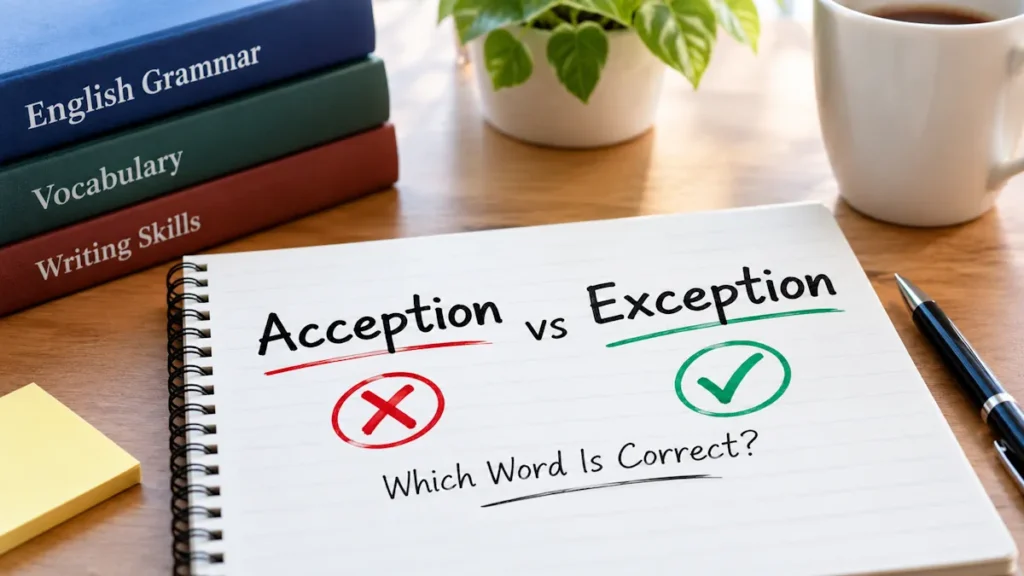
The correct word, clear meanings, a comparison table, and plenty of examples.
At first glance, “acception” and “exception” look like they could be two spellings of the same word. They are not. In everyday modern English, exception is almost always the word you want: it describes a person, thing, or case that doesn’t follow the usual rule. Acception is an extremely rare, old-fashioned word that most readers will simply see as a mistake. This guide walks through what each word means, when to use it, and how to never mix them up again.
Quick Answer: Use exception for anything that breaks a rule or pattern: “She’s the exception to the rule.” Acception is archaic and rarely correct in modern writing, so in nearly every case the right choice is exception.
Why People Confuse These Two Words
The mix-up is understandable. Both words end in -ception, both come from Latin roots, and they sound similar when spoken quickly. On top of that, people often think “acception” must be the noun form of the verb accept. It isn’t: the noun form of accept is acceptance. That false link is the single biggest reason writers reach for the wrong word.
Acception: Meaning and Definition
Acception is a rare, archaic noun. In older or highly specialized texts, it referred to an accepted meaning or sense of a word or phrase. Today it has almost completely dropped out of use.
Example of Acception (archaic)
✓ In its older acception, the word “gay” simply meant cheerful.
✓ Scholars debated the exact acception of the term in the ancient manuscript.
Important Note
Heads Up: Unless you are writing about historical linguistics or quoting a very old text, you almost never need “acception.” If you mean a case that breaks a rule, the correct word is “exception.” If you mean the act of accepting, the word is “acceptance.”
Exception: Meaning and Definition
Exception is a common, everyday noun. It describes a person, thing, or situation that does not follow a general rule or the usual pattern. This is the word you’ll use almost every time.
Examples of Exception
✓ Everyone must wear a uniform, with no exceptions.
✓ Most of the team was late, but she was the exception.
✓ The policy applies to all staff without exception.
✓ There is always an exception to every rule.
Acception vs Exception: Comparison Table
| Feature | Acception | Exception |
|---|---|---|
| Modern everyday use | Very rare / archaic | Common and standard |
| Main meaning | An accepted sense of a word | A case that breaks a rule |
| “to the rule” phrase | Incorrect | Correct (exception to the rule) |
| Best for ordinary writing | Avoid | Use this |
| Example | its older acception | no exceptions allowed |
When to Use Each Word
Use “Exception” in Normal Modern English
In virtually all everyday, academic, and professional writing, exception is the correct word whenever you mean something outside the rule.
✓ We accept all majors, with one exception: applied arts.
✓ He makes an exception for close friends.
Use “Acception” Only in Rare, Specialized Contexts
Reserve acception for historical, religious, or linguistic writing where you are discussing the accepted sense of a word, and even then, many editors will prefer a clearer phrase like “accepted meaning.”
12 Everyday Examples of “Exception”
Here are a dozen natural sentences to show how flexible the word is.
- Attendance is required, and there will be no exceptions.
- The rule applies to everyone, you included, without exception.
- She’s usually quiet, but today was an exception.
- The store closes at 9 p.m., with exceptions on holidays.
- Most reptiles lay eggs, though a few are exceptions.
- We treat every customer the same, with no exceptions.
- In an emergency, we can make an exception to the policy.
- All files must be approved, and this one is no exception.
- He eats healthy all week and makes an exception on Sundays.
- Every student passed, without a single exception.
- The law covers all vehicles, with one exception: bicycles.
- Her kindness is the exception, not the rule, in that office.
Common Mistakes to Avoid
| Mistake | Incorrect | Correct |
|---|---|---|
| Wrong word | an exception to the rule | |
| Noun of accept | We await your acceptance. | |
| Treating as same | they are different words | |
| Misspelling | exception |
Memory Trick
Remember This: Link EXCEPT to EXCEPTION. If something is excepted (left out) from a rule, it’s an exception. And the noun of accept is acceptance, never “acception.”
American vs British English
Good news: there is no spelling or usage difference here. Exception is spelled and used the same way in American, British, Australian, and Canadian English. Acception is equally rare across all of them.
Similar Words People Mix Up
Exception vs. Acceptance
Exception = a case outside the rule. Acceptance = the act of accepting something, such as an offer or an apology.
Exception vs. Exemption
An exception is any case outside the rule. An exemption is a formal, often official, release from a duty or requirement, like a tax exemption.
Exception vs. Exclusion
An exception stands apart from a rule; an exclusion is something deliberately left out, like an exclusion in an insurance policy.
Except vs. Accept
Except means “not including” (everyone except me). Accept means “to receive or agree to” (accept the offer).
Exception vs. Rule
A rule is the general pattern; an exception is the case that doesn’t follow it. The two are opposites, which is why we say “the exception that proves the rule.”
Practice Quiz: Test Yourself
Pick the correct word for each sentence. The answer key is at the bottom; no peeking!
Q1. Everyone must attend, with no ___.
a) acceptions
b) exceptions
c) acceptance
Q2. The correct noun form of “accept” is:
a) acception
b) acceptance
c) exception
Q3. Which word is rare and archaic?
a) exception
b) acception
c) exemption
Q4. She is the ___ to the rule.
a) exception
b) acception
c) acceptance
Q5. A formal release from a requirement is an:
a) exception
b) exemption
c) acception
Answer Key: 1-b 2-b 3-b 4-a 5-b
Final Verdict
For almost all modern writing, exception is the correct word. Keep acception on the shelf unless you’re writing about the historical meaning of a word, and even then, “accepted meaning” is usually clearer. When you want the noun of “accept,” reach for acceptance.
Frequently Asked Questions
Is “acception” a real word?
Yes, but it is rare and archaic. It once meant the accepted sense of a word. In modern English it is almost never used, and most readers will see it as an error.
Which word is correct for something outside a rule?
“Exception.” A person, thing, or case that doesn’t follow the usual rule is an exception, as in “an exception to the rule.”
Is “acception” just a misspelling of “exception”?
Often, yes. Many people type “acception” when they mean “exception” or “acceptance.” While acception is technically an old word, in everyday writing it’s usually a mistake.
What does “exception” mean?
An exception is a person, thing, or situation that does not follow a general rule or usual pattern, such as the one student who was allowed to leave early.
What is the noun form of “accept”?
It is “acceptance,” not “acception.” For example, “We received her acceptance of the job offer.”
How can I remember the spelling of “exception”?
Think of “except.” If something is excepted (left out) from a rule, it is an exception. Both start with “excep-.”
Can I use “without exception”?
Yes. “Without exception” is a correct and common phrase meaning that a rule applies to absolutely everyone or everything, as in “The policy applies to all staff without exception.”
When in doubt, choose exception. It’s the word modern English actually uses.

Benen
My name is Benen, and I am an English teacher from the US and UK. I am passionate about helping people improve their English language skills, including grammar, vocabulary, and sentence structure, while building their confidence in a supportive and patient learning environment.