
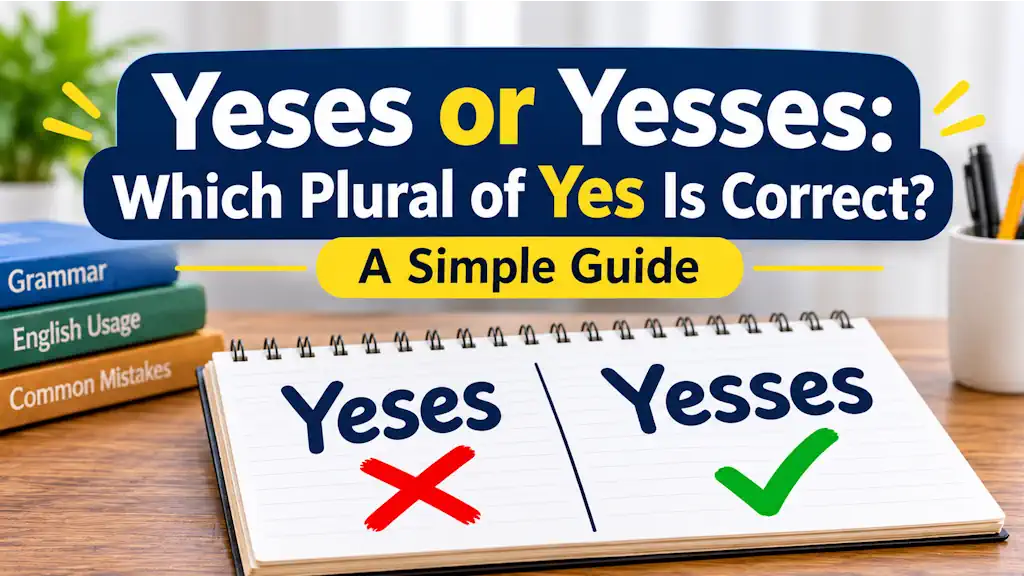
Your survey results are in, the votes are counted, and you need to write the total. Do you write “five yeses” or “five yesses”? Both look a little odd, and that is exactly why so many people stop and search for the answer.
Quick Answer: Yeses or Yesses?
Both are accepted plural forms of the noun yes, but yeses is more common and is the safer choice in most writing. Yesses is a valid variant, yet many readers will assume it is a typo.
- ✅ Preferred: The proposal received six yeses.
- ✅ Accepted variant: The proposal received six yesses.
- ⚠️ Usually avoid: The proposal received six yes’s.
If you want one rule to follow, use yeses.
Yeses vs Yesses at a Glance
| Form | Accepted? | Best use | Example |
|---|---|---|---|
| Yeses | ✅ Yes | Preferred plural in most writing | We counted four yeses. |
| Yesses | ✅ Yes | Less common variant | She heard several yesses. |
| Yes’s | ⚠️ Usually avoided | Not recommended as a normal plural | Rewrite as yeses. |
Why Does “Yes” Even Have a Plural?
Most of the time, yes is simply an answer:
“Are you coming?” “Yes.”
Nothing needs a plural there. But yes can also work as a noun meaning an affirmative answer, a vote in favor, or an approval. Once it is a countable noun, you can have more than one:
- The board needed three yeses to approve the budget.
- Her question got two yeses and one no.
So you only need the plural when you are counting affirmative answers, votes, or approvals.
Why Yeses Is the Preferred Spelling
Yeses follows the ordinary pattern for words that already end in an “s” sound. You add -es:
- bus → buses
- class → classes
- gas → gases
- yes → yeses
Dictionaries recognize both spellings, but they treat yeses as the main form and yesses as the alternative. That is why most editors, teachers, and style guides lean toward yeses.
Is “Yesses” Correct?
Yes, it is. Yesses is an accepted variant, and calling it flat-out wrong is not accurate. The difference is preference, not validity:
- Yeses: valid and more widely used
- Yesses: valid but less familiar
English has other pairs like this, such as buses / busses and focuses / focusses. Over time one form usually wins, but the other can stay in dictionaries. If your school, employer, or publisher has a house style, follow it. Otherwise, pick yeses and stay consistent.
Can “Yesses” Be a Verb?
Occasionally. Yes can be used as a verb meaning “to say yes to” or “to agree with someone,” and then the third-person form could be spelled yesses (or yeses):
- He yeses every idea his manager suggests.
In that sentence, the word is a verb, not a plural noun. This use is rare and can sound clumsy, so a clearer rewrite is usually better: He agrees with every idea his manager suggests.
Is “Yes’s” Correct?
In normal writing, no, it is not recommended. An apostrophe usually does one of two jobs: it shows possession (the team’s goal) or it replaces missing letters (don’t). It does not usually make an ordinary plural.
- ❌ We counted ten yes’s.
- ✅ We counted ten yeses.
Some style guides allow apostrophes when you are pluralizing a word that is being discussed as a word, mainly to avoid confusion. Even then, a rewrite often reads better: The paragraph uses the word “yes” too many times.
Yeses vs Yes’s vs Yeses’
| Form | Meaning | Example |
|---|---|---|
| Yeses | More than one yes | The survey received 200 yeses. |
| Yes’s | Belonging to one yes | A single yes’s effect was huge. |
| Yeses’ | Belonging to many yeses | The yeses’ impact was clear. |
The possessive forms are grammatical but awkward. If a sentence looks clumsy, restructure it: The effect of one yes was huge.
How Do You Pronounce Yeses and Yesses?
Both are pronounced the same way: YES-iz. The plural adds a second syllable. Because they sound identical, you cannot tell from speech which spelling someone means, which is one reason both survived.
Examples of “Yeses” in Everyday Sentences
Votes and decisions
- The motion passed with 12 yeses and three noes.
- We need two more yeses before the plan can go ahead.
Surveys
- The survey produced 84 yeses, 12 nos, and four blanks.
- Count the yeses in the first column.
Work and approvals
- The project cannot start until we get three yeses from the review team.
Conversation
- Every question was met with a string of cheerful yeses.
Sales
- Good salespeople ask simple questions that lead to a few small yeses.
Yeses and Noes or Yeses and Nos?
The plural of no can be noes or nos, so pairs like these all appear in writing:
- yeses and noes
- yeses and nos
- yeas and nays (formal voting)
- affirmative and negative responses
Pick the pair that suits your audience and keep it consistent. In formal legislative writing, yeas and nays is the traditional choice.
When “Yeses” Is Not the Best Word
Sometimes a clearer phrase works better than any plural of yes:
- Instead of “300 yeses,” try 300 affirmative responses.
- Instead of “two yeses from management,” try two management approvals.
- Instead of “40 yeses,” try 40 votes in favor.
- Instead of “the participants’ yeses,” try written consent.
If the word makes readers pause, rewrite it. Correct grammar is not always the most readable option.
Should You Use Quotation Marks or Capital Letters?
- Quotation marks are not needed in a normal sentence: We received more yeses than expected. Use them only when discussing the word itself, such as The word “yes” appears five times.
- Capital letters: write yeses in lowercase in regular prose. Capitalize Yes at the start of a sentence, in a heading, or as a labeled option on a form.
Common Mistakes to Avoid
Mistake 1: Saying “yesses” is never correct. It is an accepted variant. It is just less common.
Mistake 2: Adding an apostrophe automatically. Wrong: ten yes’s. Better: ten yeses.
Mistake 3: Mixing up plural and possessive. Yeses is plural, yes’s is singular possessive, and yeses’ is plural possessive.
Mistake 4: Pluralizing “yes” when it is not a noun. In “Yes, I will,” the word stays singular.
Mistake 5: Assuming it is a US vs UK difference. Neither spelling belongs to one country. Yeses is simply the safer general choice.
Mistake 6: Ignoring house style. If your teacher, editor, or company uses a style guide, follow it.
An Easy Way to Remember
Think of bus → buses and class → classes. Then follow the same pattern:
One yes, two yeses.
That single line will give you the preferred spelling every time.
Quick Practice
Choose the best option: yeses, yesses, or yes’s.
- The proposal received seven ___ and two noes.
- We counted all the ___ in the survey.
- Which is the preferred plural of yes?
Answers: 1. yeses 2. yeses 3. yeses (yesses is an accepted variant; yes’s is usually avoided)
Frequently Asked Questions
Is it yeses or yesses?
Both are accepted. Yeses is more common and generally preferred.
What is the plural of yes?
The plural is yeses, with yesses as an accepted alternative.
Is yesses a real word?
Yes. It is an alternative plural of the noun yes, and it can also appear as a rare verb form.
Is yeses grammatically correct?
Yes. It is the standard plural when you mean more than one affirmative answer, vote, or approval.
Why is the plural yeses instead of yesses?
Because yeses adds the regular plural ending -es, just like buses and classes. Yesses doubles the “s” and is the less common form.
Is yes’s an acceptable plural?
It is usually avoided. Apostrophes do not normally form ordinary plurals.
What is the plural of no?
Both noes and nos are used. Follow your style guide or choose one and stay consistent.
How do you pronounce yeses?
It is pronounced “YES-iz.”
Can yes be a noun?
Yes. In “We need a yes by Friday,” it means an affirmative answer or approval.
Which should I use in an academic paper?
Use yeses, or choose a clearer phrase such as affirmative responses.
Final Verdict: Yeses or Yesses?
Yeses and yesses are both correct, but yeses is the better everyday choice because it is more familiar and follows the standard plural pattern. Use yesses only if you prefer the variant or your style guide requires it, and avoid yes’s as a normal plural. When in doubt, remember: one yes, two yeses.

Mona
Mona is a CELTA-certified English teacher and fluency coach who is passionate about helping learners speak natural, confident English. On Grammar Readers, she shares clear explanations of word meanings, idioms, and everyday expressions, so you can understand English the way native speakers use it. Her lessons focus on practical fluency tips that you can apply in daily conversations.