
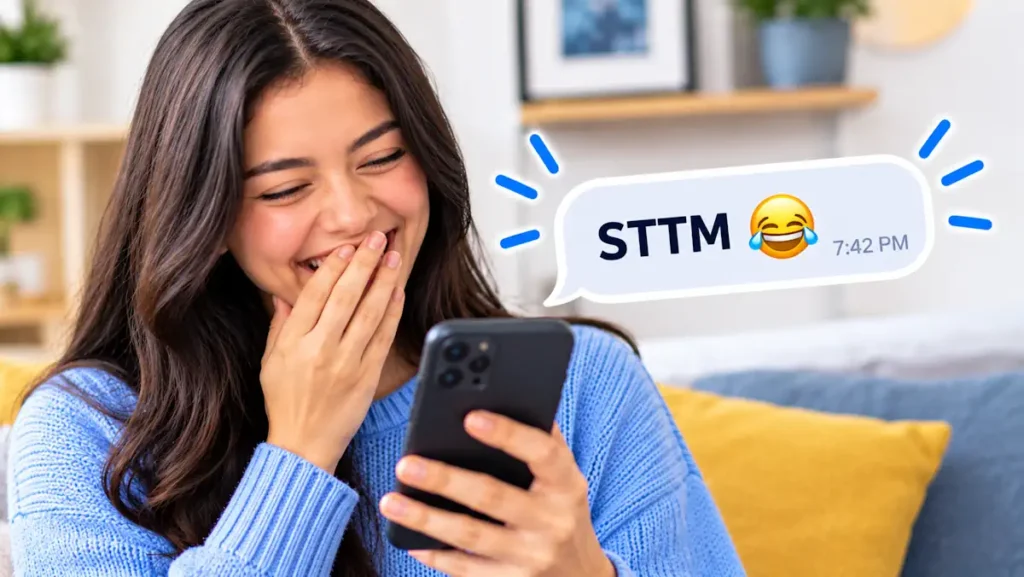
STTM most often means “stop talking to me” in texts, comments, and chats. It’s roughly like saying “give me a break” out loud: playful between friends, firm when someone is genuinely upset.
Few abbreviations can feel as sharp or as silly as STTM. Sent with a laughing emoji after a bad joke, it is friendly banter. Sent alone after an argument, it can be a real request for space. This guide explains what it means, how to read the tone, and how to reply in a way that keeps things kind.
Key Takeaways
- STTM most commonly stands for “stop talking to me,” used to show annoyance, disbelief, or a wish for space.
- Tone decides everything: emojis and a joking setting usually mean teasing, while a bare, punctuated “STTM.” can be serious.
- It is far less common than abbreviations like LOL or IDK, so some people may read it differently.
- If someone seriously says STTM, the respectful response is to give them space.
- Avoid it in professional messages, where it can sound rude or confusing.
What Does STTM Mean in a Text?
In casual messaging, STTM is shorthand for “stop talking to me.” People use it to:
- jokingly react to something shocking or embarrassing
- tease a friend who said something silly
- show real annoyance or frustration
- ask for some quiet or personal space
Quick example
Person A: “I just ate your chocolate.” Person B: “STTM 😭”
Person B is not truly angry. They are dramatically reacting in a playful way.
| Term | Full Form | Typical Tone |
|---|---|---|
| STTM | Stop talking to me | Playful, sarcastic, annoyed, or serious |
| Category | Internet/texting slang | Informal only |
Where STTM Comes From
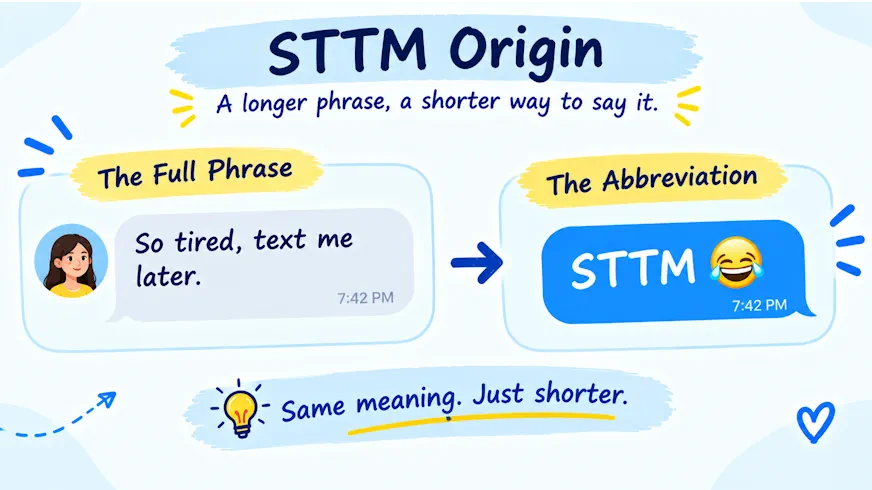
There is no documented origin story for STTM. Like many abbreviations, it most likely grew out of the habit of shortening common phrases to type faster, the same way BRB, IMO, and TBH did. Over time, the phrase went from a blunt demand to something friends often say jokingly when a friend teases them, spoils a plot, or says something outrageous. Social media comment sections and short videos helped spread that playful use.
How the Tone Changes
The same four letters can feel very different depending on who sends them and how.
| Tone | Example | What It Feels Like |
|---|---|---|
| Playful | “STTM 😂 that was hilarious” | Friendly teasing |
| Sarcastic | “Oh great, another lecture. STTM.” | Dry humor |
| Disbelieving | “You actually did that? STTM 😭” | Shock, not anger |
| Flirty | “STTM, you’re too much 😏” | Playful flirting |
| Annoyed | “STTM, I’m trying to study.” | Real irritation |
| Serious | “STTM. I’m serious.” | A genuine request for space |
Emojis, punctuation, and your history with the sender are the best clues. A laughing or crying emoji usually softens it, while a period and no emoji can make it sound final.
How People Use STTM in Daily Conversations
Casual texting: “You forgot my birthday? STTM.”
Reacting to spoilers: “You spoiled the ending. STTM.”
Social media comments: “That joke was terrible. STTM 😂”
Gaming chats: “You missed an easy shot. STTM.”
Between partners: “I won the argument.” / “STTM 😂”
In most of these, STTM is more of a dramatic reaction than a true request to stop talking.
STTM on WhatsApp, Instagram, TikTok, and Snapchat
| Platform | How STTM Usually Appears |
|---|---|
| Friendly teasing or light frustration in personal and group chats | |
| Reactions to memes and funny posts in comments and DMs | |
| TikTok | Humorous reactions to shocking or funny videos |
| Snapchat | Casual banter among friends, with emojis setting the tone |
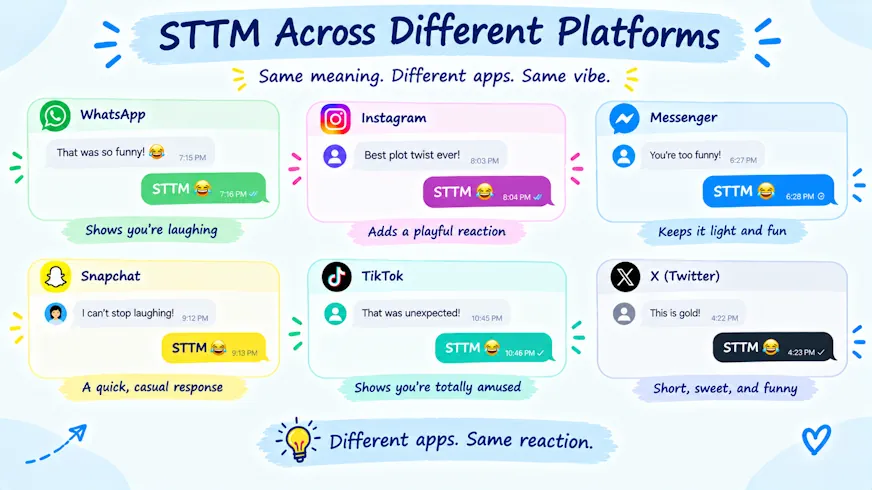
WhatsApp: “You sent 50 voice notes. STTM 😂” is typical.
Instagram: Often used under funny posts, or in DMs when reacting to something outrageous.
TikTok: “This video has me crying. STTM 😭” is the kind of reaction you will see.
Snapchat: Common between close friends, where emojis make the playful tone clear.
Real Chat Examples
- “You forgot my birthday? STTM.”
- “You spoiled the movie ending. STTM 😭”
- “That joke was terrible. STTM 😂”
- “STTM, I have an exam tomorrow.”
- “STTM, I need some space right now.”
- “You actually said that? STTM.”
- “I ate the last slice. STTM.” / “Not happening 😎”
- “STTM 😂 you’re so dramatic.”
Other Readings You May See
Online guides do not fully agree on STTM, so it is worth knowing about a few other readings, all of which are much less common than “stop talking to me.”
- Send this to me: A few guides list this as a request for a photo or file. It is not widely confirmed, so treat it as a possibility only when someone is clearly asking for a picture, clip, or document.
- Group or personal shorthand: Friend groups sometimes invent their own abbreviations, so STTM may mean something private in a specific chat.
- Technical or workplace terms: Some organizations use STTM as an internal abbreviation. In a document or work system, check a glossary instead of assuming the slang meaning.
The conversation around STTM is always the strongest clue.
How to Tell Which Meaning Fits
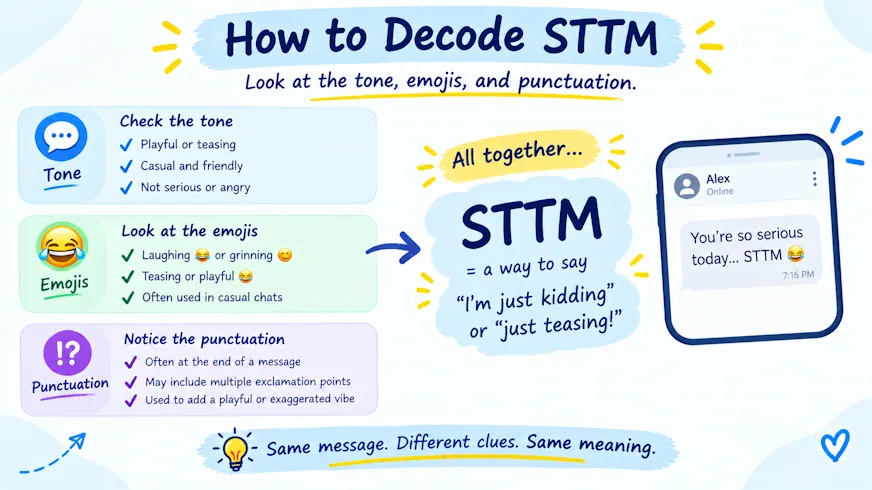
- Look at the situation. After an argument or a spoiled secret, “stop talking to me” fits best.
- Check the emojis. Laughing, crying, or winking faces suggest a joke.
- Notice the punctuation. “STTM.” with a period often sounds more serious.
- Think about the relationship. Close friends banter, while a stranger saying it may mean it.
- Ask if you’re unsure. “Do you mean stop talking to you, or are you joking?” is a fair question.
STTM in Dating and Online Conversations
On dating apps and new chats, tone is hard to read, so a short message can sound colder than intended. A playful “STTM 😂” after a funny line is usually flirty banter. But if STTM arrives after a disagreement, with no emoji and a firm tone, it may be a real boundary. In that case, keep messaging to a minimum and let the person decide when to continue. If you genuinely cannot tell, one polite question is better than guessing.
STTM vs. Similar Abbreviations
| Term | Meaning | Typical Idea |
|---|---|---|
| STTM | Stop talking to me | Asking someone to stop or reacting dramatically |
| IDC | I don’t care | Showing indifference |
| GTG | Got to go | Ending a chat for now |
| BRB | Be right back | Stepping away briefly |
| TTYL | Talk to you later | Ending for now, usually not angry |
| NVM | Never mind | Dropping a topic |
| STFU | A much harsher demand for silence | Far more aggressive |
STTM is blunt but usually lighter than profanity-based expressions. It also differs from GTG and TTYL, which simply end a conversation without any annoyance.
Is STTM Rude?
It can be. When it is serious, it is a direct request to stop messaging, so it can sound cold. Among friends, it is usually playful. The safest way to judge is to read the whole message, including emojis and earlier conversation, before deciding how it was meant.
Common Mistakes With STTM
Assuming the sender is angry. It is often a joke.
Assuming it is always a joke. After an argument, it may be serious.
Treating the friendship as over. A single STTM rarely means that.
Using it with people who may not know it. It is not as widely known as LOL, so it can confuse readers.
Using it in professional messages. It can sound rude or be mistaken for something else.
Ignoring the context. Emojis, punctuation, and recent messages matter more than the letters.
When to Use STTM and When to Skip It
Good moments:
- joking with close friends
- reacting to something shocking or funny
- adding playful drama to a casual chat
Better to skip:
- work emails and professional chats
- messages to people who may take it literally
- real arguments, where it can make things worse
If you truly want space, a clear and kind sentence such as “I need some time, can we talk later?” is usually better than an abbreviation.
How to Reply When Someone Sends STTM
If it seems playful:
- “Never 😎”
- “You love hearing from me 😂”
- “Too late, I’m still texting.”
If it sounds serious:
- “Okay, I understand. I’ll give you some space.”
- “No problem, we can talk later.”
- “Sorry if I upset you.”
If you’re not sure:
- “Are you joking, or do you want me to stop messaging?”
Formal:
- “Understood. Let me know when you’re ready to talk.”
If someone clearly says they want space, respect it and avoid sending more messages.
Is STTM Still Popular?
It is a niche abbreviation compared with LOL, OMG, TBH, SMH, or IDK. It tends to appear in casual chats, comment sections, and among younger users, and it is mostly used for humor and drama rather than as a formal request.
Quick Facts
| Factor | Details |
|---|---|
| Most common meaning | Stop talking to me |
| Category | Internet slang |
| Tone | Playful, sarcastic, or serious |
| Common places | WhatsApp, Instagram, TikTok, Snapchat |
| Formality | Informal |
Conclusion
STTM is a small abbreviation with a big range of tone. Most often it means “stop talking to me,” and most often it is meant jokingly, but it can also be a real request for space. Read the emojis, the punctuation, and the conversation around it, and respond with care.
FAQs
Most often “stop talking to me,” used to show annoyance, disbelief, or a wish for space.
Not always. Between friends it is usually joking, but a bare, punctuated message after an argument can be serious.
Usually “stop talking to me,” often playfully among friends, with emojis showing the tone.
Most often “stop talking to me,” used as a dramatic or humorous reaction to a shocking or funny video, or as a way to end a discussion in the comments.
The same thing: a playful or annoyed reaction in comments and DMs.
No difference. Tone, emojis, and the relationship matter more than who sent it.
Check the emojis, the earlier messages, and the setting. In many cases it is only a joke, but if it follows an argument, give the person space.
Occasionally. Some guides mention “send this to me,” and some workplaces use it as an internal abbreviation. In casual chats, “stop talking to me” is the most likely reading.

Mona
Mona is a CELTA-certified English teacher and fluency coach who is passionate about helping learners speak natural, confident English. On Grammar Readers, she shares clear explanations of word meanings, idioms, and everyday expressions, so you can understand English the way native speakers use it. Her lessons focus on practical fluency tips that you can apply in daily conversations.