
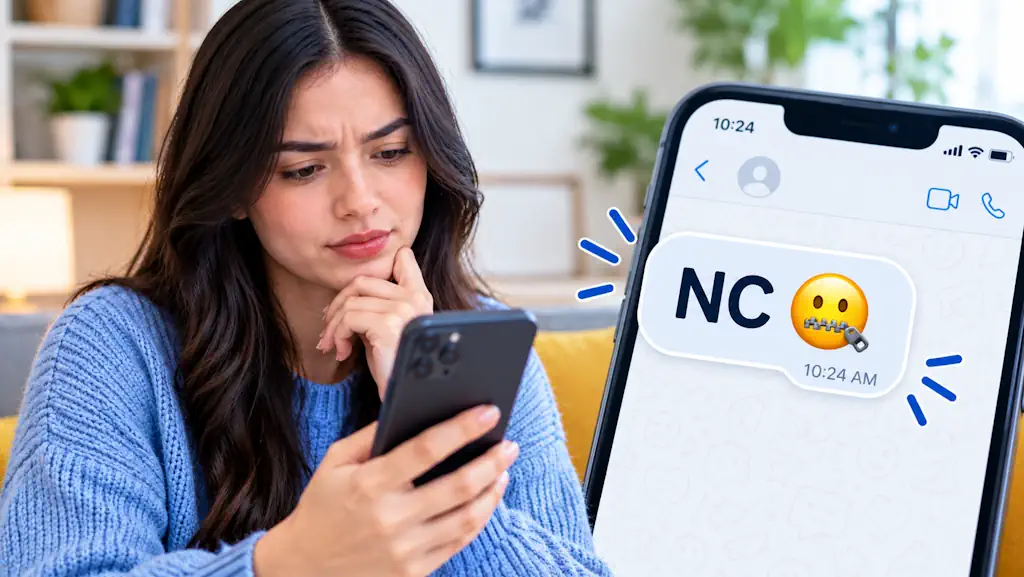
NC most often means “no comment” in texts, a polite way to decline a question without explaining why. It’s roughly like a shrug typed in two letters, though in relationship talk it can also mean “no contact.”
Two letters that end a conversation can feel more pointed than they look. A bare “nc” to a sincere question can read as a closed door, while “nc 😅” feels like a friendly dodge. This guide explains the main meaning, the less common readings, how punctuation changes the tone, and how to reply when someone sends you NC.
Key Takeaways
- NC most commonly stands for “no comment,” a polite refusal to answer or share an opinion.
- In relationship and dating talk, it can mean “no contact,” which means cutting off communication with someone.
- Less common readings include “nice choice” or “nice catch” as a compliment, and “not cool” as disapproval.
- Punctuation and emojis decide the tone, so a bare NC can feel colder than you intended.
- NC is informal, so in work, school, or formal writing it’s better to spell out the full phrase.
Quick Answer: What Does NC Mean in Text?
In everyday texting, NC is a short way to say you would rather not discuss a topic. The main readings, and how well each is supported, look like this:
| Meaning | What It Signals | Where You’ll See It | How Well Supported |
|---|---|---|---|
| No comment | “I’d rather not answer or share my view” | Personal questions, gossip, debates | Strongest, reported by all three sources |
| No contact | “I’ve stopped talking to this person” | Breakups, friendships, dating | Reported by all three sources |
| Nice choice | A compliment on someone’s decision | Purchases, picks, outfits | Reported by two sources |
| Nice catch | Praise for a good play | Gaming and sports chats | Reported by one source |
| Not cool | Disapproval or disappointment | Arguments, unfair situations | Reported by one source, thin |
| North Carolina | The US state | Travel and location talk | Context-only, not slang |
| No charge | Free of cost | Finance and billing | Context-only, not slang |
If you remember one rule, make it this: when NC answers a question about someone’s private life or opinion, it almost always means “no comment.”
Why Sources Disagree About NC
Most of the articles that explain NC agree on the big picture, but they list different secondary meanings. Some add “nice choice,” others “nice catch,” and a few add “not cool.” Some also mention finance and place-name readings, which are real but have nothing to do with texting. That mix is why it helps to think of NC as a flexible reply: the sender’s intent, the topic, and the tone do most of the work, and the dictionary-style meanings are secondary.
NC as “No Comment”
This is the reading to try first. Someone uses NC instead of an answer, usually because they know something, have an opinion, or simply don’t want to get into it.
- “Why did you leave the party early?” / “nc”
- “What do you think about the new schedule?” / “nc”
- “Did you two have a fight?” / “nc 😬”
People choose NC because it saves time, avoids an argument, protects a secret, or keeps things neutral. It is a deliberate choice to stay out of the conversation, not a sign that the person has no idea what’s going on. That difference is what separates NC from IDK, explained further below.
NC as “No Contact”
In relationship and dating conversations, NC often stands for “no contact,” a decision to stop all communication with someone, usually after a breakup, a betrayal, or a relationship that became unhealthy.
- “I decided to go no contact with him for a while.”
- “After what happened, we’re NC now.”
- “If you keep texting me after I said NC, I’ll block you.”
The phrase is about boundaries, so it is a serious word. If someone tells you they are going NC, respect the choice and avoid testing it with messages.
NC as “Nice Choice” or “Nice Catch”
A friendlier group of sources reads NC as praise. Two readings appear:
- Nice choice is a compliment on someone’s decision, such as a new phone, a jacket, or a restaurant pick. “I bought the blue one today.” / “nc!”
- Nice catch is praise for a good move, especially in gaming or sports. “You saved the team in the last round, nc!”
Both use the same spirit: short, upbeat, and encouraging. Since “nice choice” and “nice catch” come from fewer sources, use them only when the message is clearly positive.
NC as “Not Cool” (Thin Support)
One source lists NC as “not cool,” used to show disapproval or disappointment. For example, “You ignored my message all day? nc.” It is possible, but it is not widely reported, so do not assume it unless the message clearly sounds annoyed and the situation is unfair or disrespectful.
Context-Only Meanings: North Carolina and No Charge
Two other readings are real but usually have nothing to do with chat slang.
- North Carolina: The US state abbreviation, which appears when location is the topic. “Driving through NC tomorrow” is the state.
- No charge: Common in billing, invoices, and customer service, such as “replacement part provided, NC.”
If NC shows up in a travel plan, a receipt, or a service report, check the surrounding words before reading it as a text reply.
NC vs. IDK, IDC, and NVM
These four are often confused because they all close a conversation, but each one does a different job.
| Term | What It Says | What It Really Means |
|---|---|---|
| NC | “No comment” | I may know, but I’m not sharing |
| IDK | “I don’t know” | I genuinely don’t have the information |
| IDC | “I don’t care” | I have no stake in this, and it can sound harsh |
| NVM | “Never mind” | Forget I asked |
Take a gossip question: “Did you hear what happened with Jake?” An IDK means you haven’t heard. An NC means you have heard and would rather not say. An IDC means you don’t care about the story at all. The reply is short, but the social message is very different.
How Punctuation and Emojis Change NC
NC carries very little tone on its own, so the way it’s written does a lot of the work.
- “NC.” with a period feels clipped and closed, and in a tense chat it can read as stonewalling.
- “nc 😅” feels playful and apologetic, a friendly dodge with no hard feelings.
- “nc haha” softens the refusal further, suggesting the topic is more amusing than serious.
- “NC!” with an exclamation can read as enthusiasm, closer to a compliment than a refusal.
- “nc 🤐” with a zipper-mouth emoji makes the refusal playful and clearly intentional.
As a rule, a bare NC answering a direct question can feel rude. Adding an emoji or “haha” turns the same refusal into something gentler.
The Sarcastic NC
Some people use NC as a joke, where the words say “no comment” but the emoji says “yes, that was me.” If someone asks, “Who ate the last slice?” and the reply is “nc 😏,” everyone understands the sender is confessing with a wink. The joke only works because the usual meaning is so familiar. Recognizing it helps you avoid taking a playful confession too seriously.
How to Tell Which NC Someone Means
Use this checklist when you’re not sure.
- Look at the question. A personal or gossipy question points to “no comment.” A message about a breakup or boundaries points to “no contact.”
- Check the topic. A purchase or a good play points to “nice choice” or “nice catch.”
- Read the punctuation and emojis. A period sounds cold, while a laughing or sweaty face sounds friendly.
- Consider the relationship. Between close friends, NC is usually playful. From someone you’re in conflict with, it may be a boundary.
- Ask. “NC as in no comment, or no contact?” is always an acceptable question.
| Clue | Likely Meaning |
|---|---|
| Reply to a question about someone’s private life | No comment |
| Talk about a breakup, blocking, or cutting ties | No contact |
| Message about a new item or a good decision | Nice choice |
| Praise after a clutch play in a game | Nice catch |
| Travel or location talk | North Carolina |
| Invoice or customer service context | No charge |
NC on WhatsApp, Instagram, TikTok, and Snapchat
The platform can give you hints, but it doesn’t decide the meaning.
| Platform | How NC Usually Appears |
|---|---|
| A quick reply in personal or group chats: “who’s bringing snacks? nc” | |
| Comments on drama or sensitive posts, where it signals “no comment” | |
| TikTok | Short replies under debate or gossip videos, usually meaning “no comment” |
| Snapchat | Casual banter between friends, often with an emoji that sets the tone |
| Dating apps | Sometimes “no contact” in a serious context, so read the whole conversation |
Real Chat Examples
These examples are illustrative, written to show how NC works in different situations.
- “Did you tell her about the surprise?” / “nc 🤐”
- “Why were you so quiet at dinner?” / “nc, long story”
- “I’m going no contact with them for a while.” / “That’s a healthy choice, I’m here if you need to talk.”
- “I got the leather jacket!” / “nc, that’s a great pick”
- “You clutched that final round, nc!”
- “Who ate my leftovers?” / “nc 😏”
- “Thursday meeting moved to 3pm.” / “Thanks, got it.” (NC would feel out of place here)
The last example shows NC misfiring. When the message is neutral information, NC can sound cold for no reason, and a simple acknowledgment works better.
When NC Backfires
NC is a useful tool, but it can cause trouble in certain situations.
- Serious conversations: If someone needs a real answer about something important, a two-letter refusal can feel dismissive. Try: “I’d rather not get into it right now, can we talk tomorrow?”
- One-on-one sincere questions: In a group chat, NC is a shared joke. Aimed at one person who asked honestly, it can feel personal.
- Repeated use: One NC is graceful. Several in a row can signal you don’t want to talk at all.
- Work settings: NC to a colleague can sound dismissive. Try: “I don’t have that information yet, I’ll find out and get back to you.”
If you need to step away, saying so honestly works better than NC. For example, “I need a few minutes, back soon” is clearer than a dodge.
Common Mistakes With NC
Assuming it always means “no comment.” In a relationship conversation, it may mean “no contact.”
Assuming it’s always rude. Tone and punctuation matter more than the two letters.
Confusing it with “no cap.” Some pages suggest NC stands for “no cap,” but that reading isn’t supported, and people don’t use it that way.
Using it when you have nothing to hide. A neutral question deserves a normal answer, not a refusal.
Reading it without context. Without the question it answers, NC is almost impossible to decode.
Using it at work or school. It looks casual and can be misread in formal writing.
When to Use NC and When to Skip It
Good moments:
- dodging gossip or a loaded question with friends
- staying neutral in a group chat
- playful confessions and light teasing
Better to skip:
- work emails and professional messages
- serious conversations where someone needs a real answer
- messages to people who may not know the slang
When clarity matters, write it out: “I’d rather not comment on that” or “I’ve decided to stop contact for now.”
How to Reply When Someone Sends NC
If it means “no comment”:
- “Fair enough 😊”
- “No worries, I’ll drop it.”
- “Got it, no pressure.”
If it means “no contact”:
- “Thanks for letting me know.”
- “I respect that, take care.”
If it means “nice choice” or “nice catch”:
- “Thanks, I was happy with it!”
- “That means a lot, thanks!”
If it sounds cold or unclear:
- “Did I say something to upset you?”
- “Do you mean no comment, or is something else going on?”
If you’re not sure:
- “NC as in no comment, or no contact?”
Formal:
- “Understood, thank you for letting me know.”
A calm, warm reply usually works best. If someone clearly wants space, give it to them.
Is NC Still Popular?
Yes, especially in casual group chats, comment sections, and relationship talk. It is less famous than LOL or IDK, but many people recognize NC as a polite way to avoid a topic. Because it’s short and flexible, it’s likely to stay part of everyday texting.
Quick Facts
| Factor | Details |
|---|---|
| Most common meaning | No comment |
| Other meanings | No contact, nice choice, nice catch, not cool |
| Context-only meanings | North Carolina, no charge |
| Category | Internet slang |
| Tone | Neutral, depends on punctuation and emojis |
| Common places | WhatsApp, Instagram, TikTok, Snapchat, dating apps |
| Formality | Informal |
Conclusion
NC most often means “no comment,” a polite way to step away from a question. It can also mean “no contact” in relationship talk, and in some chats it’s a friendly compliment. The punctuation, the emojis, and the question itself tell you which one fits. When you’re not sure, ask, and when you want to be clear, write the full phrase.
FAQs
Most often “no comment,” a polite way to decline answering a question. In relationship talk it can mean “no contact,” and in some chats it’s a compliment, “nice choice” or “nice catch.”
Usually “no comment” in casual banter between friends. The emoji and the question usually show the meaning.
Typically “no comment” in replies to drama, debates, or sensitive posts. It can also be a short compliment on a purchase or outfit.
Often “nice catch” or “nice call,” used to praise a smart play.
It can be, especially if it answers a sincere question with a bare period. Adding an emoji or “haha” softens it considerably.
IDK means you genuinely don’t know. NC means you may know something but would rather not share it.
No. Some pages suggest it, but that reading is not supported, and “no cap” is not shortened to NC in real chats.
Better to avoid it. Write a full, polite sentence such as “I don’t have that information yet” instead.

Mona
Mona is a CELTA-certified English teacher and fluency coach who is passionate about helping learners speak natural, confident English. On Grammar Readers, she shares clear explanations of word meanings, idioms, and everyday expressions, so you can understand English the way native speakers use it. Her lessons focus on practical fluency tips that you can apply in daily conversations.