

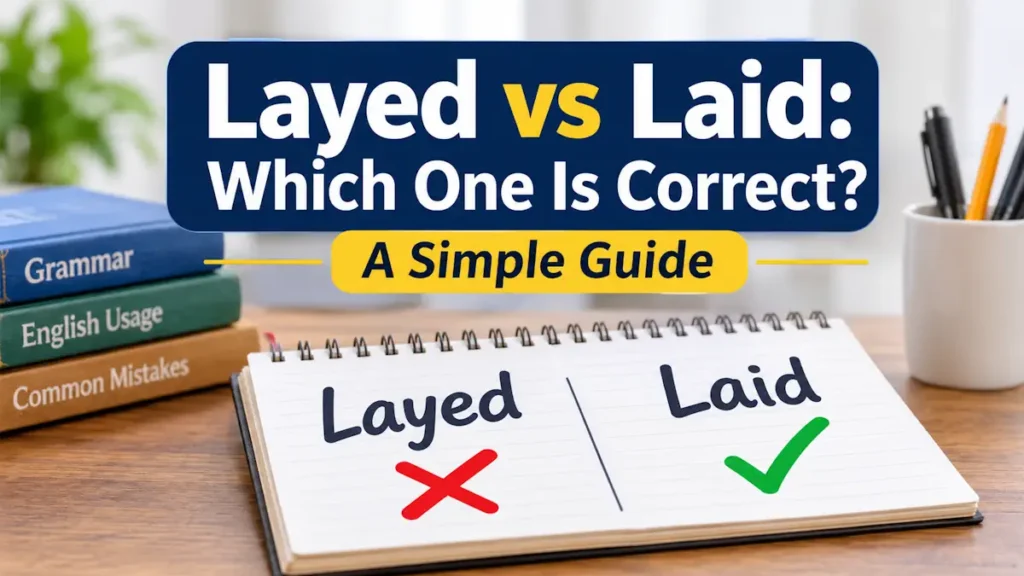
You are writing about a hen’s eggs, a table setting, or a job cut, and the past tense of “lay” comes up. Do you write “layed” or “laid”? Because most past tenses end in -ed, “layed” looks reasonable, and it shows up in emails, social posts, and even published writing.
The answer is short and firm: laid is correct, and “layed” is a misspelling. This guide explains why, clears up the confusing difference between lay and lie, and gives you quick tricks to get it right every time.
Quick Answer: Layed vs Laid?
- Laid is the only correct spelling of the past tense and past participle of “lay.”
- “Layed” is not standard English. It is a spelling error.
- “Lay” is irregular: lay, laid, laid, laying.
- Memory trick: say, said; pay, paid; lay, laid.
- Do not confuse “laid” with lay (the past tense of “lie”) or lain (its past participle).
Layed vs. Laid: The Direct Answer
| Spelling | Status | Example |
|---|---|---|
| laid | Correct | She laid the keys on the counter. |
| layed | Incorrect | Not recognized in standard dictionaries. |
The rule is the same in American, British, Canadian, and Australian English, so there is no regional exception to worry about.
What Does “Laid” Mean?
Laid is the past tense and past participle of the verb lay, which means to put something down carefully or to set something in a particular position. Lay is a transitive verb, meaning it needs an object: you always lay something.
- The hen laid an egg this morning.
- He laid the baby gently in the crib.
- They have laid new tile in the kitchen.
- She had already laid out her clothes for the week.
Why Isn’t It “Layed”?
English has a spelling pattern that pushes writers toward “layed,” and a group of stubborn verbs that break it.
The Regular Pattern
Most verbs ending in a vowel plus y just add -ed: play becomes played, stay becomes stayed, delay becomes delayed. So it feels natural to write “layed.”
The Exception
“Lay” belongs to a small group of verbs that change y to i and drop the -ed ending in favor of -id. It follows the same path as two very common verbs:
| Base verb | Past tense | Not |
|---|---|---|
| say | said | sayed |
| pay | paid | payed* |
| lay | laid | layed |
*”Payed” is correct only in one narrow nautical sense: to coat a ship’s seams with tar. For money, always write “paid.”
Older English texts sometimes show forms like “layd” because spelling was not yet standardized. Modern English settled on “laid.”
Lay vs. Lie: The Real Source of Confusion
Most “laid” mistakes are not really spelling errors. They come from mixing up lay and lie. These two verbs look and sound alike, but they mean different things.
| Verb | Meaning | Present | Past | Past participle | -ing form |
|---|---|---|---|---|---|
| lay | to put something down | lay | laid | laid | laying |
| lie | to recline or rest | lie | lay | lain | lying |
| lie | to say something untrue | lie | lied | lied | lying |
The Easy Test
Ask yourself: is there an object? If something is being put down, use lay or laid. If a person or thing is just resting, use lie, lay, or lain.
- I laid the book on the table. (the book is the object)
- I lay down for a nap. (nothing is being put down; I am resting)
- The cat has lain in the sun all day. (resting)
- She has laid her plans carefully. (the plans are the object)
The Most Common Mix-Up
Many people say “I laid down for a nap,” but the correct past tense of “lie down” is lay: “I lay down for a nap.” This one is so common in casual speech that you will hear it constantly, but formal writing expects the correct form.
Common Phrases With “Laid”
| Phrase | Meaning | Example |
|---|---|---|
| laid off | dismissed from a job, usually because of cutbacks | The company laid off 50 workers. |
| laid back | relaxed and easygoing (hyphenated before a noun: laid-back) | He has a laid-back attitude. |
| laid out | arranged or explained clearly | She laid out the plan step by step. |
| laid up | confined to bed or home by illness or injury | He was laid up with a sprained ankle. |
| laid bare | revealed or exposed | The report laid bare the problems. |
| laid to rest | buried | She was laid to rest beside her husband. |
| laid waste | destroyed | The storm laid waste to the coastline. |
Words Built From “Lay” That Also Use “-laid”
Compound verbs ending in “lay” follow the same pattern.
| Verb | Past tense |
|---|---|
| mislay | mislaid |
| overlay | overlaid |
| inlay | inlaid |
| waylay | waylaid |
Be careful with similar-looking verbs that are regular, such as delay (delayed) and relay (relayed). These do take -ed.
Common Mistakes With Layed and Laid
| Incorrect | Correct |
|---|---|
| The chicken layed three eggs. | The chicken laid three eggs. |
| He layed the cards on the table. | He laid the cards on the table. |
| The company layed off staff. | The company laid off staff. |
| I laid in bed all morning. | I lay in bed all morning. |
| The dog has laid on the couch all day. | The dog has lain on the couch all day. |
A Simple Memory Trick
Say these three pairs out loud: say, said. pay, paid. lay, laid. Each past tense has the letters “ai,” and none of them ends in -ed. If you can spell “said” and “paid,” you can spell “laid.”
Quick Practice
Choose the correct word, then check the answers.
- She (layed / laid) the baby in the crib.
- The company (laid / layed) off 20 workers last month.
- Yesterday I (lay / laid) on the sofa for an hour.
- The hens have (laid / lain) six eggs this week.
- He (mislaid / mislayed) his glasses again.
Answers
- laid
- laid
- lay (resting, so it is the past tense of “lie”)
- laid (eggs are the object)
- mislaid
Frequently Asked Questions
Is “layed” ever correct?
No. “Layed” is not a standard form in modern English. The past tense and past participle of “lay” is always “laid.”
What is the difference between lay and laid?
“Lay” is the base (present tense) form, as in “I lay the book down.” “Laid” is the past tense and past participle, as in “I laid the book down” or “I have laid it down.”
What is the difference between laid and lain?
“Laid” belongs to the verb “lay” (to put something down). “Lain” is the past participle of “lie” (to recline), as in “She has lain awake all night.”
Is it “laid back” or “layed back”?
It is “laid back,” and as an adjective before a noun it is hyphenated: “a laid-back attitude.”
Why is “lay” irregular?
English kept some very old verbs in irregular patterns, and “lay,” “say,” and “pay” are among them. They change y to i and add d, giving “laid,” “said,” and “paid.”
Is “layed” used in any other English variety?
Not as a standard form. American, British, and other major varieties all use “laid.” You may see “layed” as a typo or a casual error, but it is not accepted in formal writing.
Final Thoughts
Write laid, never “layed,” remember it with say/said and pay/paid, and check whether something is being put down (lay, laid) or someone is resting (lie, lay, lain).

Benen
My name is Benen, and I am an English teacher from the US and UK. I am passionate about helping people improve their English language skills, including grammar, vocabulary, and sentence structure, while building their confidence in a supportive and patient learning environment.