

Hyy is not an acronym. It is a casual, stylized spelling of “hi” or “hey.” It’s roughly like “heyy” or “hiii”: the same hello, just with a bit more personality.
If someone opens a chat with “hyy,” you might wonder whether it is a code, a typo, or a flirty hint. The simple answer is that it is just a relaxed hello. This guide explains why people type it, how the tone can change, and how to reply naturally.
Key Takeaways
- Hyy has no hidden full form. It is a playful spelling of “hi” or “hey.”
- It is mostly used to start a chat in a friendly, casual way.
- Whether it feels friendly or flirty depends on the relationship, emojis, and the messages around it.
- It is informal, so skip it in job applications, school work, and business emails.
- Easy replies like “hey,” “hii,” or “what’s up?” work in almost every situation.
What Does Hyy Mean in a Text?
In texts and online chats, “hyy” means hello. People use it to:
- start a conversation
- greet a friend, classmate, or family member
- sound cute, relaxed, or friendly
- get someone’s attention in a playful way
Quick example
“Hyy, how are you?”
That is simply “Hi, how are you?” with a softer tone.
| Term | Full Form | Meaning |
|---|---|---|
| Hyy | None (stylized spelling) | Hi, hey, hello |
| Category | Internet/texting slang | Informal only |
Why People Write Hyy Instead of Hi
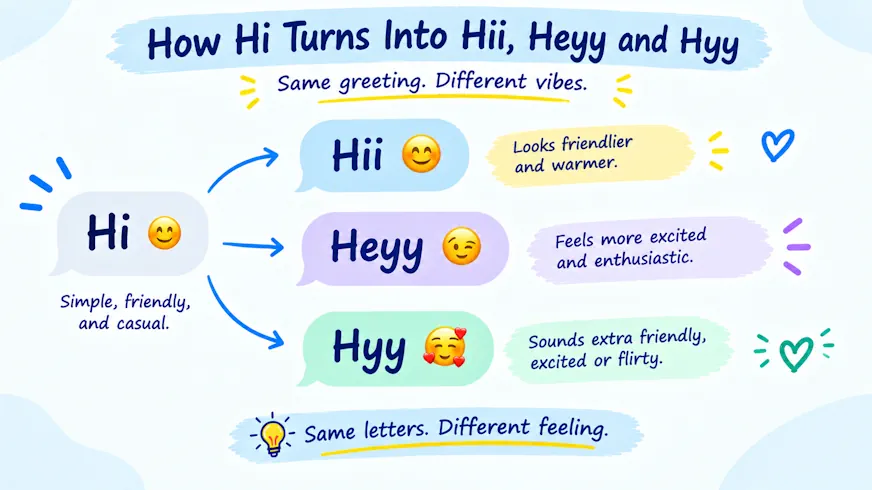
Texting lets people add personality through spelling. An extra letter can make a short greeting feel less plain and more welcoming. People stretch words in the same way with “heyy,” “hiii,” and “okayy,” and there is no special rule behind the extra “y.” For some, “hyy” is just a typing habit. Others use it with people they feel comfortable around, because it sounds softer than a flat “hi.”
Where Hyy Comes From
There is no recorded first use of “hyy.” It most likely grew out of texting and online chat culture, where people shortened words to type faster and later changed spellings to add tone. Instant messengers, social media DMs, and chat apps helped greetings like “hii,” “heyy,” and “hyy” spread, especially among teens and young adults. Some of these spellings may have started as keyboard slips and then stuck because they looked friendly.
How People Use Hyy in Daily Conversations
Friendly greeting: “Hyy, long time no talk!”
Starting a conversation: “Hyy, are you free today?”
Casual check-in: “Hyy, how’s your day going?”
Group chat attention-getter: “Hyy everyone, quick update.”
Replying on social media: “Hyy, thanks for following!”
Flirty opener: “Hyy 😍”
Most of the time it appears at the very start of a conversation.
Is Hyy Flirty?
Not by itself. Between friends, “hyy” is just a relaxed hello. When someone you like sends it with a heart or heart-eyes emoji, it can feel more personal. The word does not automatically signal romantic interest, so the relationship, earlier messages, and overall tone give better clues than the spelling.
| Message | Likely Feel |
|---|---|
| “Hyy bro!” | Friendly |
| “Hyy, how are you?” | Friendly and polite |
| “Hyy 😊” | Warm |
| “Hyy 😍” | Playful or flirty |
| “Hyy.” | Neutral or low energy |
| “Hyyy!!!” | Excited |
Hyy on WhatsApp, Instagram, TikTok, and Snapchat
The meaning stays the same everywhere, but the style shifts a little.
| Platform | How Hyy Is Usually Used |
|---|---|
| Warm, casual greetings with friends, classmates, and family | |
| DMs and comments, sometimes playful or flirty | |
| TikTok | Comments and replies, usually a playful hello to creators or others |
| Snapchat | Quick conversation starters and streak chats |
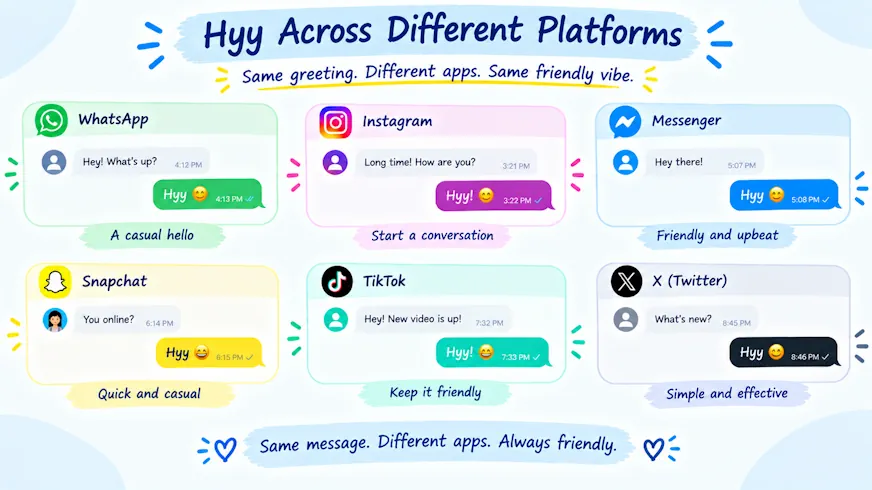
WhatsApp: The most common home of the word, as in “Hyy 😊 good morning!”
Instagram: “Hyy, loved your post!” is typical, and the tone can lean flirty in DMs.
TikTok: “Hyy everyone 😂” is a playful way to greet an audience.
Snapchat: Short and informal, such as “Hyy, what’s up?”
Hyy on Dating Apps
On dating apps, “hyy” is a very common opener. It feels soft and low-pressure, and it is easy to send. The downside is that it can seem low-effort, so people often hope for a more engaging follow-up. If you are the one sending it, adding a short question, such as “Hyy, how’s your week going?” gives the other person something to answer.
Real Chat Examples
- “Hyy 😊 what are you doing?”
- “Hyy bro, wanna game tonight?”
- “Hyy bestie 💕”
- “Hyy, are you awake?”
- “Hyy, I missed you ❤️”
- “Hyy everyone!”
- “Hyy there!”
- “Hyy lol 😂”
- “Hyy, I’m good, thanks.”
Spelling Variations
| Spelling | Feel |
|---|---|
| Hi | Neutral |
| Hey | Slightly casual |
| Hii | Soft and cute |
| Heyy | Friendly, a little excited |
| Hy | Short and quick |
| Hyy | Casual and playful |
| Hyyy | Extra friendly or dramatic |
All of these mean the same thing. Only the tone changes.
Similar Greetings
| Term | Tone |
|---|---|
| Hi | Neutral |
| Hello | Polite, a bit formal |
| Hey | Casual |
| Yo | Very casual |
| Sup | Informal, short for “what’s up” |
| Wassup | Informal and playful |
Other Meanings of Hyy
Unlike many abbreviations, hyy has no technical or professional meaning in fields like science, medicine, or aviation. You may occasionally see it in usernames, gamer tags, or creator branding, or as a plain typing slip for “hey” or “hi.” In every case, there is nothing hidden behind it.
Common Mistakes With Hyy
Thinking it is an acronym. It does not stand for a hidden phrase.
Assuming it always means flirting. Friends use it constantly with no romantic meaning.
Confusing it with HYD or WYD. HYD means “how you doing” and WYD means “what you doing,” while hyy is just a greeting.
Confusing it with “why.” The letters look similar, but hyy is not a question word.
Misreading tone. A message without a voice or face can seem colder or warmer than intended, so look at emojis and earlier messages.
Overusing extra letters. A very long “hyyyyyyyy” can feel dramatic or attention-seeking.
Is Hyy Rude?
No. It is friendly and harmless in almost every case. The only issue is style: a bare “hyy” with nothing else can feel low-effort on a dating app, and extremely stretched spellings can seem overdone.
When to Use Hyy and When to Skip It
Good moments:
- chatting with friends or classmates
- greeting a group chat
- opening a casual DM
Better to skip:
- job applications and professional emails
- school assignments
- formal business messages
In formal settings, “hello” or “hi” is the better choice.
How to Reply When Someone Sends Hyy
Friendly:
- “Hey!”
- “Hii 😊”
- “Hello!”
- “What’s up?”
Casual:
- “Yo!”
- “Hey, nothing much, you?”
Flirty (if it fits the relationship):
- “Hyyy 😍”
- “Hey you 😉”
Professional:
- “Hello, how can I help?”
- “Hi there.”
A good rule is to match the other person’s tone, use emojis naturally, and avoid overthinking it. Most of the time, hyy is simply a friendly opener.
Is Hyy Still Popular?
Yes. It remains common among teens and young adults on WhatsApp, Instagram, Snapchat, TikTok, and Discord. People like stylized spellings because they add personality to short messages, and casual greetings are always needed, so hyy is likely to stay around even as new slang appears.
Quick Facts
| Factor | Details |
|---|---|
| Meaning | Hi, hey, hello |
| Category | Internet slang, stylized spelling |
| Tone | Friendly, casual, sometimes flirty |
| Common places | WhatsApp, Instagram, TikTok, Snapchat, dating apps |
| Formality | Informal |
Conclusion
Hyy is a friendly, casual way of saying “hi” or “hey” online. It has no hidden meaning, and its tone depends on who sends it, the emojis around it, and the conversation. Reply with a relaxed greeting that matches the mood, and save it for casual chats.
FAQs
It means “hi” or “hey,” a casual greeting used to start a chat.
It can be, depending on the emojis and the relationship, but most of the time it is just friendly.
Hyy feels more playful and expressive than a plain “hi.” The meaning is the same.
Usually just “hi” or “hey.” It may sound friendly or flirty depending on the emojis and the conversation.
Yes. Anyone can use it in texting.
No. It is a stylized spelling with no secret or technical meaning.
Informal. Use it in chats and social media, not in professional writing.
Extra letters show emotion, excitement, or personality that is hard to express in plain text.

Mona
Mona is a CELTA-certified English teacher and fluency coach who is passionate about helping learners speak natural, confident English. On Grammar Readers, she shares clear explanations of word meanings, idioms, and everyday expressions, so you can understand English the way native speakers use it. Her lessons focus on practical fluency tips that you can apply in daily conversations.