
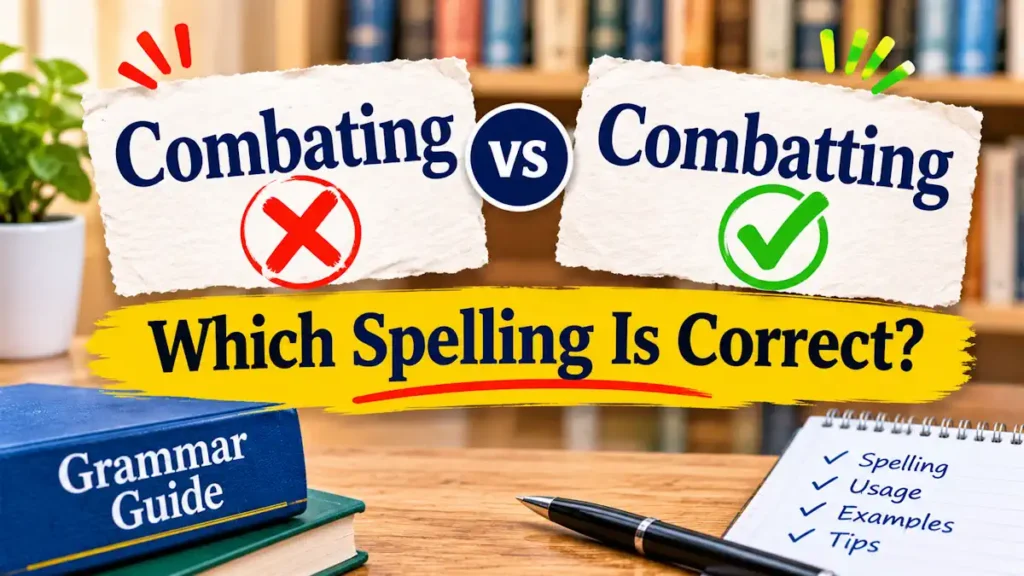
You are writing a sentence about fighting inflation, disease, or crime, and you reach for the word “combat.” Then you add -ing and stop: is it “combating” or “combatting”? Both appear in respected publications, which makes it hard to know whether one of them is a typo.
The good news is that neither one is wrong. This guide explains why two spellings exist, which one suits your audience, and how the same logic works for “combated” and “combatted,” so you can choose confidently and stay consistent.
Quick Answer: Combating or Combatting?
- Both are correct. They mean exactly the same thing.
- Combating (one T) is the more common choice in American English, and it is the safer default for most readers.
- Combatting (two Ts) is an accepted variant, and British writers use it more often than Americans do.
- The same split applies to the past tense: combated and combatted.
- Pick one form and use it throughout your document.
Combating vs Combatting: The Direct Answer
| Form | Spelling | Typical preference | Example |
|---|---|---|---|
| -ing form | combating | More common in the US | The city is combating air pollution. |
| -ing form | combatting | More common in the UK | The charity is combatting hunger. |
| Past tense | combated | More common in the US | Doctors combated the infection quickly. |
| Past tense | combatted | More common in the UK | Doctors combatted the infection quickly. |
What Does Combat Mean?
As a verb, combat means to fight against something or to work hard to stop or reduce it. The “something” can be a literal enemy, but today it is much more often a problem.
- Farmers are combating a long drought.
- The school launched a program to combat bullying.
- New laws aim to combat fraud online.
As a noun, combat means fighting, especially armed fighting (“hand-to-hand combat”), and it is also used as an adjective (“combat boots”). The spelling question only applies to the verb.
Why Two Spellings Exist for the -ing Form
The answer comes down to one of English’s most reliable spelling rules: when a verb ends in a single consonant after a single vowel and the stress falls on that last syllable, double the consonant before adding -ing or -ed.
The Doubling Rule in Action
| Verb | Stress | -ing form |
|---|---|---|
| begin | be-GIN (last syllable) | beginning |
| occur | oc-CUR (last syllable) | occurring |
| commit | com-MIT (last syllable) | committing |
| target | TAR-get (first syllable) | targeting |
| visit | VIS-it (first syllable) | visiting |
| benefit | BEN-e-fit (first syllable) | benefiting |
Where Combat Fits
The verb “combat” can be pronounced two ways: kum-BAT, with the stress on the second syllable, or KOM-bat, with the stress on the first. Both pronunciations appear in standard dictionaries.
- Stress on the second syllable (kum-BAT) follows the doubling rule and gives combatting.
- Stress on the first syllable (KOM-bat) means no doubling and gives combating.
Because the stress can land in either place, both spellings grew up side by side. American usage settled mostly on the single-T form, while the double-T form stayed more common in British writing.
Which Spelling Should You Use?
| If you are writing for… | Use |
|---|---|
| A US audience, website, or publication | combating / combated |
| A UK, Irish, or similar audience | combatting / combatted (combating is also acceptable) |
| An academic journal or style guide with a stated preference | Whatever the guide specifies |
| A global audience and you are unsure | combating, since it is widely understood and appears in both regions |
Combating and Combatting in Sentences
With “Combating”
- Local clinics are combating a rise in flu cases.
- She spent years combating misinformation online.
- The company is combating rising shipping costs with new routes.
With “Combatting”
- Volunteers are combatting litter along the coast.
- The council is combatting a shortage of affordable housing.
- He has been combatting fatigue with better sleep habits.
Other Forms of the Verb Combat
| Form | US spelling | UK spelling |
|---|---|---|
| Base form | combat | combat |
| Third person | combats | combats |
| Past tense | combated | combatted |
| Past participle | combated | combatted |
| -ing form | combating | combatting |
Related words never change spelling: combatant, combative, and noncombat are fixed.
Similar Words With Two Spellings
Combat is not alone. Several verbs follow the same stress-based split, and most of them show the American vs. British pattern too.
| Verb | American | British |
|---|---|---|
| focus | focusing / focused | focussing / focussed (also focusing) |
| bias | biasing / biased | biassing / biassed (also biasing) |
| travel | traveling / traveled | travelling / travelled |
| cancel | canceling / canceled | cancelling / cancelled |
| combat | combating / combated | combatting / combatted |
Common Mistakes to Avoid
| Mistake | Fix |
|---|---|
| Mixing both in one document: “combating” in paragraph one and “combatting” in paragraph five. | Pick one spelling and keep it throughout. |
| The team is combating-ing the problem. | The team is combating the problem. |
| She combatts misinformation. | She combats misinformation. |
| Treating either form as a typo and “correcting” the other writer. | Leave it alone, or match the document’s style. |
Practice Quiz
For each sentence, choose the correct form, then check the answers. Where both are right, the answer says so.
- The mayor is ______ rising crime. (combating / combatting / both)
- The word “combats” needs a doubled T. (true / false)
- In a US news article, which is the safer default: combating or combatting?
- The doctors ______ the infection. (combated / combatted / both)
- Which similar verb also has two spellings: focus or carry?
Answers
- Both are correct; “combating” is more common in the US.
- False. Adding -s never changes the spelling: combats.
- Combating
- Both are correct.
- Focus (focusing/focussing). “Carrying” has only one spelling.
Tips to Choose and Stay Consistent
- Know your audience. US readers expect combating; UK readers will accept either.
- Follow your style guide. If a publication or school specifies one, use it.
- Be consistent across a document. Switching spellings looks unedited.
- Match your other spellings. If you write “traveling” and “canceled,” use “combating.” If you write “travelling” and “cancelled,” “combatting” fits the same style.
- Use search and replace. Before publishing, scan the document for the other spelling.
Frequently Asked Questions
Is it combating or combatting?
Both are correct. Combating is more common in American English, and combatting is more common in British English. The meaning is identical.
Does the spelling change the meaning?
No. The two spellings are interchangeable, and readers will understand either one.
Which spelling should I use in professional or academic writing?
Use the one your style guide or publication specifies. If none is given, match your audience and your other spellings. For US readers, choose combating.
Is it a mistake to mix combating and combatting?
Neither form is a mistake, but mixing them in the same piece is inconsistent. Pick one spelling and apply it everywhere.
Does the same rule apply to combated and combatted?
Yes. Combated is the more common US past tense, and combatted is more common in the UK. Both are acceptable.
Why doesn’t “combats” have a double T?
Consonant doubling only happens before endings that start with a vowel, such as -ing and -ed. The -s ending is added as it is, so the word stays “combats.”
Final Thoughts
Both spellings are right, so use combating for American readers, combatting if you follow British style, and keep your choice consistent from start to finish.

Benen
My name is Benen, and I am an English teacher from the US and UK. I am passionate about helping people improve their English language skills, including grammar, vocabulary, and sentence structure, while building their confidence in a supportive and patient learning environment.