

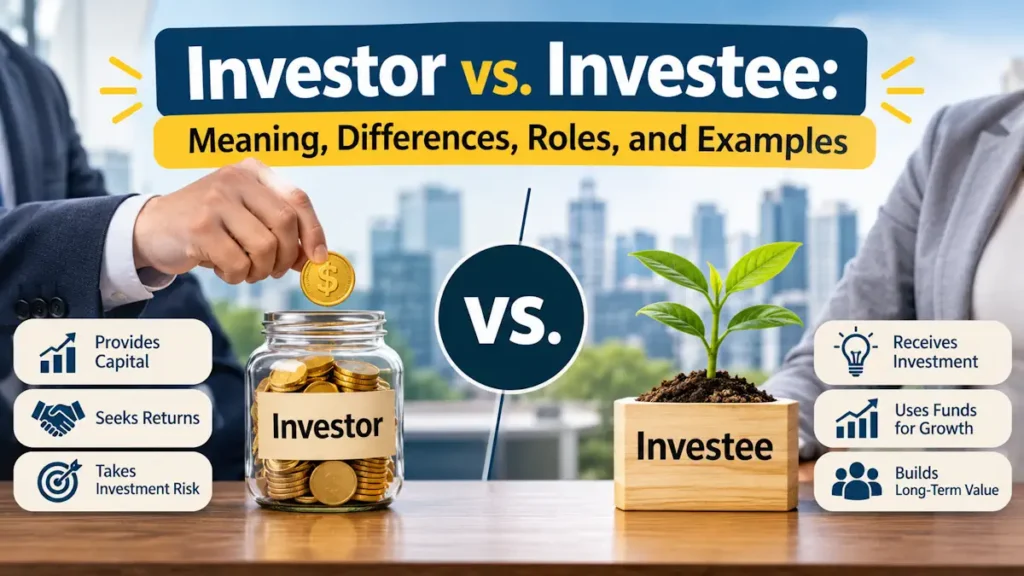
Every investment has two sides. One side puts money in, and the other side takes it and puts it to work. In everyday speech we talk about investors all the time, but the other party often goes unnamed. That party is the investee, and the word appears constantly in finance, accounting, and startup news.
This guide explains what each term means, how the two roles differ, how the relationship works, and where the words show up in startup funding and accounting. You will also find real examples, common mistakes, and a quick quiz to test yourself.
Quick Answer: Investor vs Investee
- An investor is a person or organization that puts capital into something, expecting a return.
- An investee is the company, fund, project, or other entity that receives that capital.
- The investor gives money; the investee receives it and uses it.
- Investors want growth, income, or both. Investees want funding to operate or expand.
- A company can be both at the same time.
Investor vs Investee in One Sentence
The investor is the party that supplies the money, and the investee is the party that receives it and is responsible for putting it to productive use.
What Does Investor Mean?
The word investor comes from the verb invest: to commit money or resources now in the hope of earning more later. An investor is the one doing the committing.
Investor Definition
An investor is any person, business, or institution that allocates capital to an asset, company, or project in order to earn a profit, interest, dividends, or other benefit over time. Investors can fund many types of assets:
- Shares of companies, either private or public
- Bonds, loans, and other debt
- Real estate and land
- Mutual funds, ETFs, and other pooled funds
- Startups and early-stage ventures
Real-Life Examples of Investors
- A retiree who buys shares of a utility company for steady dividends.
- A venture capital firm that funds a promising software startup.
- A pension fund that buys government bonds to cover future payouts.
- A family that purchases a rental property to earn monthly income.
Example Sentence
- The investor committed $2 million to the company’s expansion.
What Does Investee Mean?
The word investee adds the suffix -ee to “invest,” naming the party on the receiving end of the investment. You will find it often in financial reports and accounting standards, where it is the standard term for the entity an investor holds a stake in.
Investee Definition
An investee is a company, organization, fund, or project that receives capital from an investor. The money typically goes toward:
- Launching or scaling a product
- Hiring staff and building a team
- Buying equipment or property
- Research and development
- Paying down debt or improving cash flow
Examples of Investees
- A startup that raises a seed round to build its first product.
- A public company whose shares are bought on the stock market.
- A real estate development project funded by outside partners.
- A nonprofit-backed social enterprise that receives impact investment.
Example Sentence
- The investee used the funding to open three new locations.
Investor vs Investee Comparison Table
| Feature | Investor | Investee |
|---|---|---|
| Role | Supplies capital | Receives capital |
| Main goal | Earn a return on money | Use funds to operate or grow |
| Who it can be | An individual, firm, fund, or institution | A company, fund, project, or organization |
| Financial position | Money goes out, an asset is acquired | Money comes in, as equity or debt |
| Typical risk | Losing part or all of the investment | Pressure to perform, dilution, or repayment obligations |
| Typical reward | Dividends, interest, or growth in value | Resources and credibility to expand |
Key Differences Between Investor and Investee
Purpose
The investor invests to make money grow. The investee takes in money to build something that can generate value, whether that is a product, a service, or a property.
Financial Role
Capital flows in one direction at the start: from the investor to the investee. The investor contributes it, and the investee spends it, manages it, and is accountable for results.
Ownership Position
When an investment is made in exchange for equity, the investor becomes a part owner of the investee. For example, if an investor puts $100,000 into a startup that is valued at $400,000 before the deal, the company is worth $500,000 after it. The investor then owns 20 percent ($100,000 divided by $500,000), and the founders’ share shrinks accordingly.
Not every investment involves ownership. If the investor lends money instead, the investor becomes a creditor and the investee owes repayment, usually with interest.
Risk and Reward
- Investor risk: the investee may underperform or fail, and the money could be lost.
- Investor reward: dividends, interest, or a higher value when the stake is sold.
- Investee risk: giving up some ownership or control, or taking on debt that must be repaid.
- Investee reward: the cash and support needed to grow faster than it could alone.
Understanding the Investor-Investee Relationship
The two parties depend on each other. Neither can reach its goal alone: the investor needs a place for capital to grow, and the investee needs capital to build.
How the Relationship Works
- The investee presents a plan, a product, or a business case.
- The investor evaluates the opportunity and its risks.
- Both sides agree on terms, such as amount, ownership share, or interest rate.
- The investor transfers the capital, and the investee puts it to use.
- The investee reports progress, and the investor eventually earns a return or exits.
Why Both Sides Need Each Other
Investors cannot grow their money without businesses and projects to place it in. Businesses and projects, in turn, often cannot grow fast enough on their own revenue. Investment links the two and moves money to where it can create value.
Investor vs Investee in Startup Funding
Startup funding is the setting where these two words are used most often.
Angel Investors
An angel investor is a wealthy individual who invests their own money in an early-stage company, often in exchange for a small ownership stake. For example, a former tech executive might put $50,000 into a friend’s new app.
Venture Capital Investors
A venture capital (VC) firm invests pooled money from other investors into startups with high growth potential. A VC might lead a multimillion-dollar round for a company that has already proven demand for its product.
Startup as the Investee
Startups seek funding because they usually need money before they earn enough to cover their costs. Common reasons include:
- Building and testing the product
- Hiring engineers, designers, and salespeople
- Marketing and customer acquisition
- Covering operating costs while revenue grows
Investor vs Investee in Accounting
In accounting, “investee” is a technical term. It describes the entity in which a reporting company holds an investment, and the size of the stake determines how the investment is recorded. The exact rules depend on the standards a company follows, such as IFRS or US GAAP, so always check the current standard for your situation.
Minority Ownership
When an investor holds a small stake and has no real influence over the investee, the holding is generally recorded as a financial investment at its fair value.
Significant Influence
When an investor can influence the investee’s decisions without controlling it, the investor is said to have significant influence. Under both IFRS and US GAAP, owning 20 percent or more of the voting power (and less than half) is generally presumed to give this influence. The investor then usually accounts for the stake using the equity method, recording its share of the investee’s profits and losses.
Parent-Subsidiary Relationships
When an investor controls the investee, typically by holding more than half of the voting rights, the investee becomes a subsidiary and the investor is the parent. The parent then combines the subsidiary’s results with its own in consolidated financial statements.
Investor vs Shareholder: Are They the Same?
Not quite. All shareholders are investors, but not all investors are shareholders.
Key Similarities
- Both put money into something to earn a return.
- Both take on some risk of loss.
- Both can benefit when the value of the investment rises.
Important Differences
| Feature | Investor | Shareholder |
|---|---|---|
| Scope | Broad: anyone who invests in any asset | Narrow: someone who owns shares in a corporation |
| Examples | Stock buyer, bondholder, landlord, lender, fund holder | Common and preferred stockholders |
| Ownership rights | Depends on the asset (a lender has no ownership) | Part owner of the company, often with voting rights |
Can a Company Be Both an Investor and an Investee?
Yes. Companies often play both roles at once.
Real Business Example
A fast-growing tech company raises money from venture capital firms, which makes it an investee. At the same time, it uses part of its cash to buy a stake in a smaller software firm, which makes it an investor.
Corporate Investment Chains
Large corporations often hold stakes in many businesses, and those businesses may hold stakes in others. These layers create chains of investors and investees, which is why corporate structures can look complicated on paper.
Common Mistakes When Using Investor and Investee
Mistake #1: Using the Terms Interchangeably
- The investee wired $500,000 to the startup.
- The investor wired $500,000 to the startup.
The investor is always the one sending the money.
Mistake #2: Assuming an Investee Is Always a Startup
Investees come in many forms: public companies, small businesses, real estate projects, funds, and even government-backed ventures. A startup is only one example.
Mistake #3: Confusing Investee With Shareholder
A shareholder is a person or entity that owns shares. An investee is the company those shares belong to. The shareholder is on the investor side, not the investee side.
Easy Memory Trick to Remember the Difference
Look at the endings. Many English word pairs use -or or -er for the doer and -ee for the one on the receiving end.
Investor Gives
The -or ending points to the one who acts: the investor gives the money. Compare: employer and employee, interviewer and interviewee, trainer and trainee.
Investee Receives
The -ee ending points to the one who receives: the investee gets the money. Compare: payer and payee, addresser and addressee.
This pattern is a helpful shortcut, but it is not a perfect rule. Words like “absentee” and “refugee” do not name a receiver, so use the trick for investor and investee, not for every “-ee” word.
Pro Tips for Using These Terms Correctly
Tip 1
Ask who is providing the money. That party is the investor.
Tip 2
Ask who is receiving the money and has to use it well. That party is the investee.
Tip 3
Remember that investment can be equity (ownership) or debt (a loan). In both cases, the party providing the capital is the investor and the party receiving it is the investee.
Tip 4
In startup talks, the investors are the people or firms offering the funding, and the investee is the company seeking it. Founders usually speak for the investee, though a CFO or another leader may lead the negotiations.
Practice Quiz: Investor or Investee?
- A venture firm gives $3 million to a new company. Who is the investor?
- A bakery receives funding to open a second store. Who is the investee?
- An individual buys 100 shares of a public company. Is the person an investor or an investee?
- A company raises money and also buys a stake in another business. How many roles does it play?
- True or false: all investors are shareholders.
Answers
- The venture firm
- The bakery
- Investor (and the public company is the investee)
- Two: it is an investee for the money it raised and an investor in the other business.
- False. A bondholder or a lender, for example, is an investor but not a shareholder.
Frequently Asked Questions
What is the difference between investor and investee?
The investor provides the capital, and the investee receives it. The investor wants a return, while the investee wants funding to run or grow its business or project.
Who is considered an investor?
Anyone who commits money to an asset or business expecting a return, including individuals, venture capital firms, banks, pension funds, and corporations.
Who is called an investee?
The company, fund, project, or organization that receives the investment. In accounting, it is the entity in which a reporting company holds a stake.
Can a company be both an investor and an investee?
Yes. A company can raise money from outside investors while also investing in other businesses.
Is an investee the same as a shareholder?
No. A shareholder owns shares in a company, which puts them on the investor side. The investee is the company that issued those shares.
How do investors make money?
Through dividends, interest payments, or selling their stake for more than they paid. The best route depends on the type of investment, such as stocks, bonds, or real estate.
What is an investor-investee relationship?
It is the arrangement in which one party supplies capital and the other uses it, with agreed terms about returns, ownership, and reporting.
Why are investors important for startups?
Startups often need money before they earn enough revenue to pay their own way. Investors provide the capital, and sometimes advice and connections, that let the business grow.
Final Thoughts
The investor gives capital and the investee receives it, so ask “who is putting the money in?” and you will always pick the right word.

Benen
My name is Benen, and I am an English teacher from the US and UK. I am passionate about helping people improve their English language skills, including grammar, vocabulary, and sentence structure, while building their confidence in a supportive and patient learning environment.