
Quick Summary
The colon and the semicolon can both join two related sentences, but they send different signals. A colon tells the reader that what follows explains, proves, or lists what came before it. A semicolon tells the reader that two complete sentences belong together as equal partners. Beyond that overlap, each mark has its own jobs: the colon handles lists, times, ratios, and letter greetings, while the semicolon untangles long lists whose items already contain commas.
Few punctuation marks cause as much hesitation as these two. They look alike, they are used less often than commas or periods, and both seem to connect sentences. This semicolon vs colon grammar guide explains what each mark does, offers simple tests for choosing between them, and shows examples you can model in your own writing.
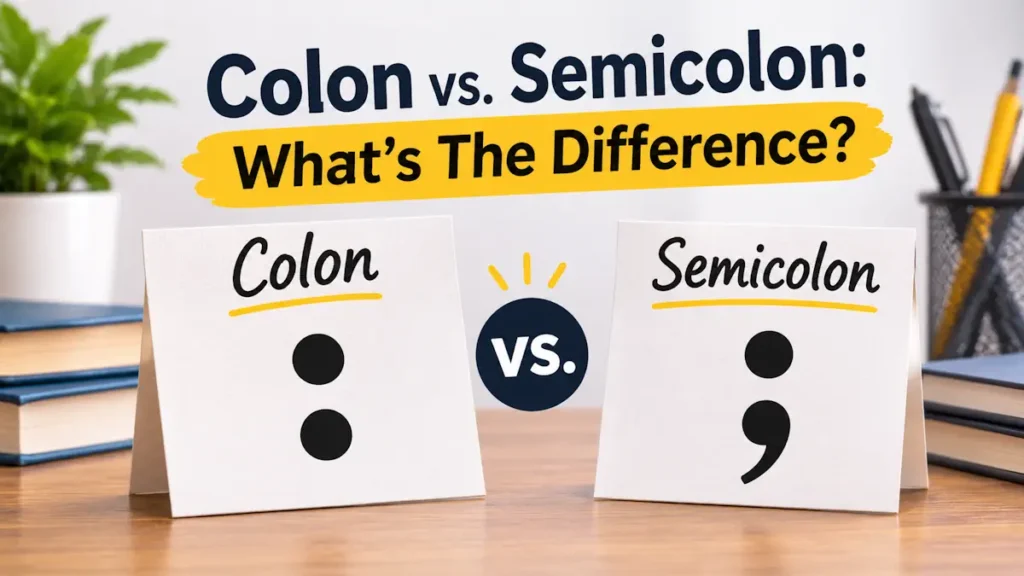
Colon vs. Semicolon
What a Colon Does
A colon is a punctuation mark made of two stacked dots (:). It works like a signpost that says, “here comes the explanation.” Its main uses are:
- Introducing a list: She packed light: a passport, a charger, and one jacket.
- Explaining or finishing a thought: The plan had one flaw: nobody had the key.
- Showing a ratio: Mix sand and cement at 4:1.
- Writing the time: The train leaves at 6:30 a.m.
- Opening a formal letter: Dear Dr. Malik:
What a Semicolon Does
A semicolon is a dot sitting above a comma (;). It acts like a soft stop, stronger than a comma but gentler than a period. It has two main jobs, and the first is far more common than the second:
- Linking two complete sentences: The bakery opens at dawn; the line starts forming an hour earlier.
- Separating list items that contain commas: The team has offices in Austin, Texas; Denver, Colorado; and Portland, Oregon.
A semicolon also appears before transition words such as however, therefore, and instead when they join two full sentences: The store closed early; however, the website stayed open.
Side-by-Side Comparison
| Feature | Colon | Semicolon |
|---|---|---|
| Symbol | : | ; |
| Main Job | Introduces an explanation, example, or list | Joins two equal, related sentences |
| Relationship | The second part explains or completes the first | The two parts are partners of equal weight |
| What Can Follow | A sentence, a phrase, a list, or a number | Another complete sentence, or the next list item |
| Capital After It | Depends on the style guide | Lowercase, unless it is a proper noun |
| Other Uses | Times, ratios, and letter greetings | Long lists with commas inside the items |
On capital letters, style guides disagree. APA capitalizes the first word after a colon when a full sentence follows, while Chicago keeps it lowercase in most cases. Pick one approach and stay consistent.
How to Remember the Difference
The two marks overlap in only one place: joining sentences. Everywhere else they work alone. Only a colon can write a time or a ratio, and only a semicolon can organize a list that already contains commas. For the overlap, these tips settle most cases.
Try the Word Test
Place a small word between the two parts of your sentence and see what fits.
- If you can insert namely or that is, use a colon.
- If you can insert and or also, use a semicolon.
Colon: The forecast left one option: we would cancel the picnic.
Semicolon: The forecast looked grim; the picnic was already packed.
In the first sentence, the second part answers the question the first one raises. In the second, both parts carry equal weight and simply sit side by side.
Check What Follows the Mark
A semicolon needs a complete sentence on both sides. A colon is more flexible, because a fragment or list can follow it. If the words after the mark cannot stand alone, a colon is the right choice.
Incorrect: The kit includes four tools; hammer, tape, pliers, and a level.
Correct: The kit includes four tools: hammer, tape, pliers, and a level.
Common Mistakes to Avoid
- Placing a colon right after a verb or preposition. Incorrect: “My favorites are: pizza and pasta.” Correct: “My favorites are pizza and pasta,” or “I have two favorites: pizza and pasta.”
- Capitalizing after a semicolon. Incorrect: “I stayed late; The report was due.” Correct: “I stayed late; the report was due.”
- Overusing semicolons. One or two per page is plenty. Too many make writing feel heavy, so use a period when a sentence break reads better.
Examples of Colons and Semicolons in a Sentence
The table below shows both marks in everyday sentences, along with the reason each one is the right choice.
| Sentence | Mark | Why It Works |
|---|---|---|
| The reviewer made one request: shorten the introduction. | Colon | The second part answers what the request was |
| The reviewer asked for a shorter introduction; the editor agreed. | Semicolon | Two equal, related sentences |
| Bring three items: a notebook, a pen, and a charger. | Colon | Introduces a list |
| The tour stops in Lyon, France; Turin, Italy; and Zurich, Switzerland. | Semicolon | Separates list items that contain commas |
| The meeting starts at 9:15 a.m. | Colon | Separates hours from minutes |
| Rain was forecast; however, the match went ahead. | Semicolon | Comes before a transition word joining two sentences |
Quick rule: use a colon when the second part explains or lists what the first part promised, and use a semicolon when two full sentences are related and equally important.

Benen
My name is Benen, and I am an English teacher from the US and UK. I am passionate about helping people improve their English language skills, including grammar, vocabulary, and sentence structure, while building their confidence in a supportive and patient learning environment.