
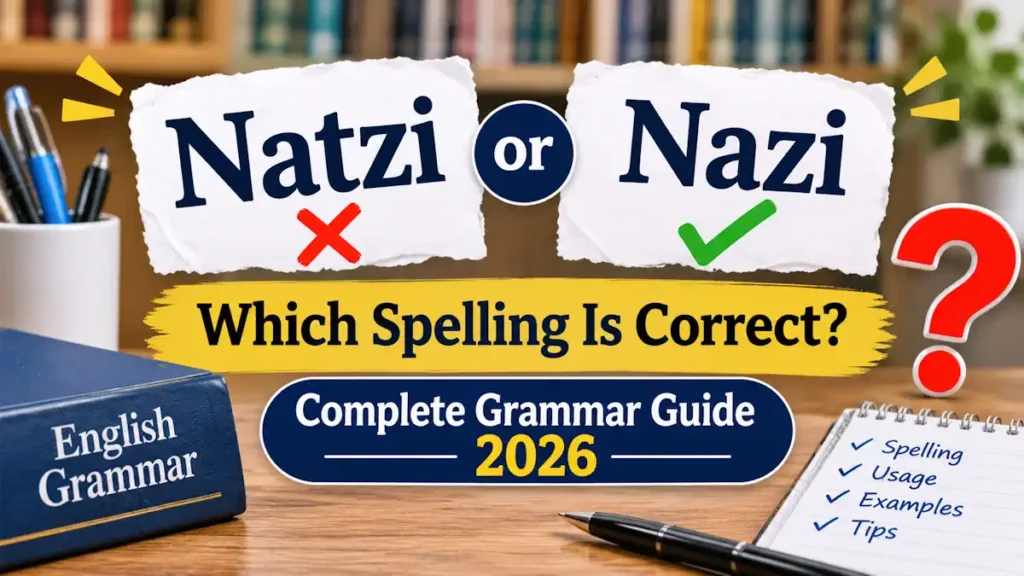
Spelling a word that you mostly hear, rather than see in print, is tricky. “Nazi” is one of those words. Many people pronounce it with a clear “ts” sound in the middle, so they naturally write an extra letter and end up with “Natzi.” If you have ever stopped to wonder whether that T belongs there, this guide gives you a quick, clear answer.
It covers the correct spelling, the German origin of the word, how to pronounce it, why the error is so common, and how to capitalize it in your writing. Because the word refers to a painful period in history, the guide also includes a short note on using it with care.
Quick Answer: Natzi or Nazi?
- Nazi is the only correct spelling. It has no T.
- “Natzi” is a common misspelling and does not appear in standard dictionaries.
- The word is a short form of the German Nationalsozialist (National Socialist).
- It is pronounced NAHT-see, because the German letter “z” sounds like “ts.”
- Always capitalize it: Nazi, Nazis, Nazism, neo-Nazi.
Natzi or Nazi: The Direct Answer
| Spelling | Status | Example |
|---|---|---|
| Nazi | Correct | The museum has an exhibit on Nazi Germany. |
| Natzi | Incorrect | Not a recognized spelling in any standard dictionary. |
| Nazzi | Incorrect | Also a misspelling. |
There is no regional split here. American and British English both use Nazi.
What Does Nazi Mean?
Nazi refers to a member or supporter of the National Socialist German Workers’ Party (in German, the NSDAP). That party led Germany from 1933 to 1945 under Adolf Hitler, and it carried out the Holocaust and started World War II in Europe. As an adjective, “Nazi” describes anything connected with that party, its ideology, or its government.
- The Nazi regime came to power in 1933.
- Many Nazis were tried after the war.
- Historians study Nazi propaganda to understand how the movement spread.
Origin of the Word Nazi
The word comes from German. It is a shortened form of Nationalsozialist, which means National Socialist. German speakers took the first two syllables, “Na” from National and “zi” from Sozialist (pronounced “so-tsi-AH-list”), and combined them into one short word.
Some language references also note that “Nazi” was already a nickname in southern Germany, a pet form of the name Ignaz that had come to suggest a clumsy or simple person. Opponents of the party found the label useful, and it stuck. The party’s own members did not generally use the term for themselves.
English borrowed the word in the 1930s and has kept the German spelling ever since.
Why Do People Misspell Nazi as Natzi?
The mistake has a logical cause, and it is the German “z.”
- The “z” sounds like “ts.” In German, the letter z is pronounced “ts.” So “Nazi” is spoken as “NAHT-see.” When people spell what they hear, the T sound shows up as a letter.
- English spelling habits. English often spells a “ts” sound with “tz,” as in “ritzy” or “blitz,” so “Natzi” looks like it belongs.
- The word is heard more than it is written. Without seeing it in print often, people rely on sound.
- Fast typing and autocorrect. A rushed keystroke can add an extra letter.
How to Pronounce Nazi Correctly
| Word | Pronunciation | Tip |
|---|---|---|
| Nazi | NAHT-see | The “z” makes a “ts” sound, like the “zz” in pizza. |
Some English dictionaries also list “NAT-see,” with a short “a,” as an accepted variant. Both versions have the “ts” sound in the middle.
Correct vs. Incorrect Usage
| Incorrect | Correct |
|---|---|
| The Natzi regime fell in 1945. | The Nazi regime fell in 1945. |
| Many Natzis fled Europe. | Many Nazis fled Europe. |
| She wrote about Natzism. | She wrote about Nazism. |
| The film is set in nazi Germany. | The film is set in Nazi Germany. |
| He joined a neo-natzi group. | He joined a neo-Nazi group. |
Capitalization and Plurals
- Always capitalize it. Nazi is derived from a proper name (the party), so it keeps its capital letter: Nazi Germany, the Nazi Party.
- Plural: Nazis (no apostrophe).
- The ideology: Nazism is the standard term.
- Modern groups: neo-Nazi, with a lowercase “neo,” a hyphen, and a capital N.
Related Terms Worth Knowing
| Term | Meaning | Example |
|---|---|---|
| Nazi | A member or supporter of the Nazi Party; also an adjective | a Nazi official |
| Nazis | Plural of Nazi | The Allies defeated the Nazis. |
| Nazism | The ideology of the Nazi Party | the rise of Nazism |
| Neo-Nazi | A modern follower of Nazi ideas | a neo-Nazi organization |
| National Socialism | The formal name of the ideology | German National Socialism |
| Third Reich | Common name for Germany under the Nazi government | the fall of the Third Reich |
A Simple Memory Trick
German borrowed words keep their original letters, and the “z” already carries the “ts” sound, so no extra T is needed. Remember it this way: the Z already says “ts.” If you can picture the word Nationalsozialist, you can see that it has no T before the Z.
Why Correct Spelling Matters Here
Misspelling this word is more noticeable than most typos. In school papers, news writing, and professional work, “Natzi” looks careless on a topic that calls for accuracy, and it can undercut an otherwise strong argument. Getting the spelling and capital letter right shows respect for the subject.
It also helps to use the word with care. The word names a regime responsible for the murder of millions of people. In formal writing, use it for its historical and political meaning. Casual or joking uses, such as calling someone a “grammar Nazi,” are widely considered insensitive because they trivialize that history. If you want a lighter phrase, words like “stickler,” “pedant,” or “perfectionist” do the job without the baggage.
Quick Practice
Pick the correct spelling in each sentence, then check the answers.
- The documentary explores life under the (Natzi / Nazi) government.
- Historians have studied (Natzism / Nazism) for decades.
- Many (Nazis / Natzis) were tried at Nuremberg.
- Should “Nazi” be capitalized in “Nazi Germany”?
Answers
- Nazi
- Nazism
- Nazis
- Yes. It is always capitalized.
Frequently Asked Questions
Is “Natzi” ever correct?
No. “Natzi” is a misspelling. The only correct spelling in standard English is “Nazi.”
Why does “Natzi” look right to so many people?
Because “Nazi” is pronounced with a “ts” sound, and English often writes that sound with “tz.” Spelling the word the way it sounds leads to the extra T.
Where does the word Nazi come from?
It is a shortened form of the German word Nationalsozialist, meaning National Socialist. English adopted it in the 1930s.
Should Nazi be capitalized?
Yes. Write Nazi, Nazis, Nazi Party, Nazi Germany, and neo-Nazi, always with a capital N.
How do you pronounce Nazi?
Say “NAHT-see.” The middle sound is “ts,” like the “zz” in pizza. Some dictionaries also list “NAT-see” as an accepted variant.
Is it okay to use “Nazi” in casual or joking phrases?
It is best avoided. Casual uses like “grammar Nazi” are often seen as disrespectful to the victims of the regime. In everyday writing, choose a different word.
Final Thoughts
The spelling is simple to remember: Nazi has no T, the “z” already makes the “ts” sound, and the word should always start with a capital N.

Benen
My name is Benen, and I am an English teacher from the US and UK. I am passionate about helping people improve their English language skills, including grammar, vocabulary, and sentence structure, while building their confidence in a supportive and patient learning environment.