
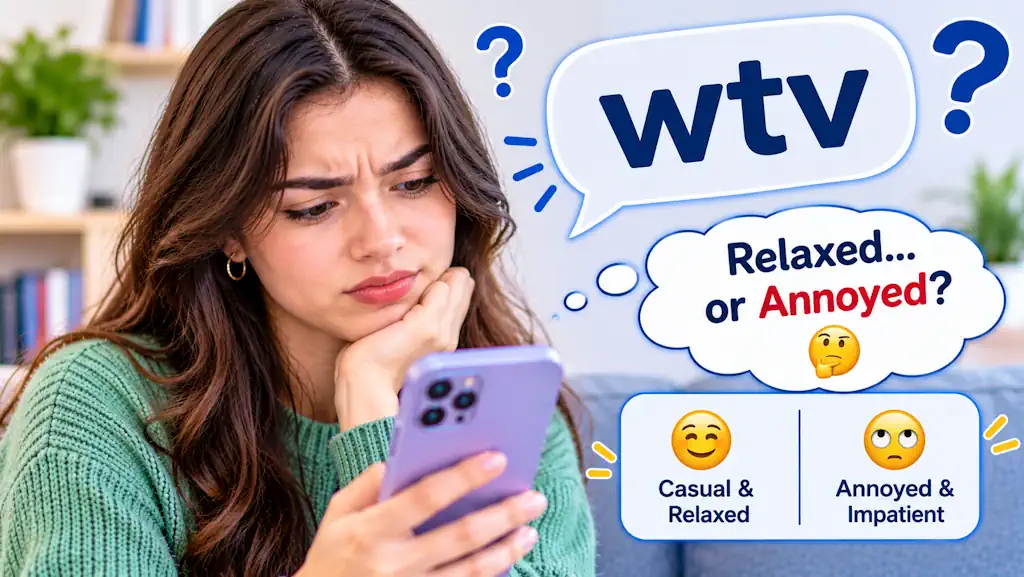
WTV is short for “whatever.” It’s roughly like a shrug typed out: sometimes a relaxed “I don’t mind,” sometimes a cooler “I’m done talking about this.”
Ask a simple question, get back three letters, and suddenly you are wondering whether your friend is easygoing, bored, or annoyed. That is the whole puzzle behind what WTV means in text: the definition is easy, but the feeling behind it changes with punctuation, timing, and the conversation around it. This guide explains the meaning, shows how tone shifts, covers each major app, and gives you replies that fit every mood.
Key Takeaways
- WTV means “whatever,” used to show flexibility, indifference, mild irritation, or a wish to move on.
- It is not automatically rude, but it can sound cold during a tense conversation.
- Punctuation, capital letters, and stretched spellings change how it feels, so read those clues first.
- WTV is softer than IDC (“I don’t care”) and very different from similar-looking abbreviations like WTF or WTB.
- Reply by matching the tone, and ask a gentle question if it seems like the sender is upset.
Quick Answer: What Does WTV Mean in Text?
In texting and online chat, WTV means “whatever.” It is a way to say you do not have a strong opinion, you agree without much excitement, or you would rather drop the topic.
| Term | Meaning |
|---|---|
| WTV | Whatever |
| WTVR | A stretched-out spelling of whatever (same meaning) |
Quick examples
- “Pizza or tacos?” / “wtv, either works.”
- “Let’s meet at 6.” / “wtv, fine with me.”
- “I think you’re wrong.” / “wtv.”
The first two are easygoing. The last one can feel like a door closing.
Where WTV Comes From
“Whatever” was already one of the most common words in casual speech long before anyone shortened it. When early mobile phones made typing slow and early instant messengers made quick replies the norm, people trimmed common words to save time, which is how “u,” “r,” LOL, and eventually WTV became familiar. It has no recorded first use, but it has stayed steady because it is short and everyone understands it.
The Four Main Ways People Use WTV
1. Lack of preference
This is the friendliest use: the sender simply does not mind.
- “Which movie should we watch?” / “wtv, you pick.”
2. Agreement without excitement
It can mean “okay, that works,” with no extra enthusiasm.
- “Let’s meet at 6.” / “wtv works for me.”
3. Mild irritation
Sometimes it signals annoyance without a full argument.
- “You didn’t reply all day.” / “wtv.”
The sender is not asking for a debate. They are saying they would rather not discuss it.
4. Ending the conversation
It can close a topic quickly.
- “I still think you should apologize.” / “wtv.”
In this case, it reads as “I’m done talking about this.”
How Punctuation and Spelling Change WTV
The letters never change, but the way they are typed shifts the emotional read.
| Version | How It Usually Feels |
|---|---|
| “wtv” (lowercase, no punctuation) | Relaxed, low effort, low drama |
| “WTV.” (capitals plus a period) | Sharper, more final, “conversation over” |
| “WTV!!” | Dramatic or exaggerated, sometimes joking |
| “wtv lol” or “wtv haha” | Softened, playful |
| “wtvvv” (stretched letters) | Teasing or dramatic on purpose |
| “wtv 😌” | Calm, chill, easygoing |
| “wtv you win” | A lighthearted way to bow out of a debate |
When you are trying to read someone’s mood, punctuation and stretched letters often say more than the word itself.
“It’s WTV” and Other Phrases
WTV often joins other words to make small phrases.
- “It’s WTV”: a stand-in for “it’s whatever,” meaning “it’s fine,” “it doesn’t matter,” or “I’m over it.” Said kindly, it reassures: “it’s wtv, don’t worry about it.” Said flatly, it can sound resigned.
- “Down for WTV”: open to anything. “I’m down for wtv tonight” means “I’ll go along with your plan.”
- “WTV atp”: whatever “at this point,” used when frustration has built up and the sender has stopped caring.
- “WTV u say”: a slightly sarcastic way of agreeing without really meaning it.
Each version keeps the core idea of indifference but adds a little more feeling.
Is WTV Rude?
Not by itself. The same three letters can be friendly or cold.
Usually fine
- friendly chats about small decisions
- jokes and playful banter
- low-stakes plans
Often sounds rude
- during an argument
- right after someone shares something serious
- when it is the only word in a reply to a real question
A good rule is to look at what came before it. A WTV after a joke is probably playful. A WTV after a sincere question, with no follow-up, may mean the person is frustrated or checked out.
Is WTV Ever Flirty?
Rarely, and only when the rest of the message says so. A playful “wtv you want 😌” in answer to a date-night question can feel warm and teasing. But on a dating app, a bare “wtv” to a question like “what do you want to eat?” can look low effort, so it is worth adding a little more.
WTV on WhatsApp, Instagram, TikTok, Snapchat, and Gaming Chat
The meaning stays the same everywhere. How it feels shifts a little.
| Platform | How WTV Usually Appears | Typical Tone |
|---|---|---|
| Everyday chats with friends and family | Casual or neutral | |
| Comment replies, story replies, and DMs, often to brush off a compliment | Relaxed, easygoing | |
| TikTok | Captions and comments, such as “wtv, posting this anyway” | Funny or sarcastic |
| Snapchat | Streak chats and snap captions between close friends | Playful, but it can turn dismissive |
| Gaming chat | Quickly moving past a disagreement during a match | Efficient, focused on the game |
Instagram: Someone might reply “wtv it’s just a random pic” to a compliment. That is modest deflection, not anger.
TikTok: Creators often caption casual videos “wtv, posting this anyway,” which means “I know it isn’t perfect.” In comments, “wtv you win” is a friendly way to leave a debate.
Snapchat: Because most chats are between close friends, it tends to be lighthearted, but check what came before it.
Gaming: “wtv let’s just go” means “this argument isn’t worth losing the round over.”
WTV vs. IDC, IDK, and Other Similar Terms
| Term | Meaning | How It Differs From WTV |
|---|---|---|
| WTV | Whatever | Flexible, can be playful or dismissive |
| IDC | I don’t care | Firmer and often more blunt |
| IDK | I don’t know | Uncertainty, not indifference |
| NVM | Never mind | Dropping a topic or request |
| WYM | What you mean | A question asking for clarity |
| TBH | To be honest | Introduces an honest opinion |
| Meh | Unimpressed | A mild reaction, not a reply to a choice |
| K | Okay | Very short and sometimes cold |
| ATP | At this point | Frustration building over time |
WTV and IDC overlap, but IDC tends to land with more force. WTV leaves a bit more room, which is why it can be friendlier.
Look-Alike Abbreviations to Avoid Mixing Up
Three-letter combinations that start with W and T get confused easily.
| Abbreviation | Meaning | Where It Appears |
|---|---|---|
| WTV | Whatever | Casual texting |
| WTF | A much stronger, profane reaction | Heated or shocked moments |
| WTB | Want to buy | Marketplace groups and trading forums |
| WTW | Often read as “what’s the word” or “what’s up” | Greetings, in some groups |
WTV is not “what’s the vibe.” That phrase does not have a widely used abbreviation. And it is not a stronger cousin of WTF either: WTV is about indifference, while WTF expresses shock or anger.
What Does WTV Mean in Other Fields?
Outside chat, WTV rarely has a standard meaning. In some laboratory and pharmacy settings, a weight-to-volume ratio appears, usually written w/v. If you see letters like these in a lab document, check its glossary instead of assuming the slang meaning. In ordinary conversations, “whatever” is what people mean.
What Does WTV Mean From a Girl or a Guy?
The sender’s gender does not change the meaning. Context decides.
- If the message follows “I guess so” or “fine, but…” energy, the sender may be conceding rather than truly fine.
- If the topic is small, like picking a restaurant, it is probably easygoing flexibility.
- Some people use WTV to skip a decision (“you pick, wtv”), while others use it to close a topic without saying so directly.
Look at the conversation history and the topic, not at who typed it.
Real Chat Examples
These examples are illustrative, written to show how WTV works in different situations.
Easygoing
- “Should we go out or order in?” / “wtv, I’m good with either.”
- “Beach or park?” / “wtv lol, you decide.”
Agreeable
- “Meet at 7?” / “wtv works.”
Annoyed
- “Why didn’t you text me back?” / “wtv.”
- “Do it your way then.” / “WTV, I’m over it.”
Dismissive
- “Can we talk about what happened?” / “wtv.”
Playful
- “I’m right and you know it.” / “wtv you win 😂”
- “wtvvv, I’m too tired to argue.”
Social media
- A caption: “wtv, posting this anyway.”
When to Use WTV and When to Skip It
Good moments:
- choosing small things with friends
- joking around in group chats
- brushing off a compliment modestly
- gaming and quick, low-stakes chats
Better to skip:
- work messages and professional chats
- serious or emotional conversations
- messages to people who may read it as cold
- formal writing and emails
When tone matters, say it in full: “Anything works for me” is warm, while “I’d rather not discuss this right now” is honest and clear.
Quick Gut-Check Before You Reply
Ask yourself two things.
- Was there tension before it? If yes, the WTV may be a brush-off.
- Is the topic small or important to them? A small topic with no tension usually means real flexibility. An important topic with recent tension suggests they have checked out, and a gentle follow-up helps.
How to Reply When Someone Sends WTV
If it seems easygoing:
- “Alright, sounds good.”
- “Cool with me too.”
- “Okay, I’ll pick then.”
If it seems playful:
- “The WTV master has spoken 😂”
- “That clears up absolutely nothing 😎”
- “Such deep wisdom.”
If it seems annoyed or dismissive:
- “Are you good?”
- “Did I say something wrong?”
- “Want to talk about it later?”
If it is a work or formal setting:
- “Understood, thank you.”
- “I’ll proceed with option A.”
- “Let me know what works best.”
Avoid answering a cold WTV with your own WTV, because it can escalate a tense moment. A calm question usually gets a more honest answer than guessing.
Common Mistakes With WTV
Assuming it always means anger. It is often just flexibility.
Assuming it is always harmless. After a serious question, it may signal frustration.
Confusing it with “whatever you want.” The longer phrase sounds more polite.
Mixing it up with WTF, WTB, or WTW. They mean completely different things.
Using it in professional chats. It can look careless.
Treating one message as the end of a friendship. One WTV rarely defines a relationship.
Replying with an essay. A short, calm reply fits better.
Why Do People Use WTV Instead of Whatever?
It is faster to type, and fast-paced texting rewards short replies. It also sounds casual and slightly detached, which is exactly the tone people sometimes want, whether they mean “I’m flexible” or “I’m done.”
Is WTV Still Popular?
Yes. It is especially common among teens, Gen Z users, gamers, and heavy texters, and it appears in text messages, Snapchat chats, TikTok comments, and Instagram DMs. New slang keeps appearing, but WTV stays steady because it is short and instantly understood.
Quick Facts
| Factor | Details |
|---|---|
| Meaning | Whatever |
| Category | Internet slang |
| Tone | Casual, playful, annoyed, or indifferent |
| Common places | Texts, Snapchat, TikTok, Instagram, WhatsApp, gaming chat |
| Formality | Informal |
| Often confused with | IDC, WTF, WTB, WTW |
Conclusion
WTV means “whatever,” and that part never changes. What changes is the feeling around it: punctuation, stretched letters, timing, and the people involved. Read those cues before assuming the worst, reply in a calm and friendly way, and ask when something feels off.
FAQs
What does WTV mean in text?
It means “whatever,” used to show flexibility, indifference, mild frustration, or a wish to end a topic.
What does WTV mean on Snapchat?
“Whatever.” It tends to be playful between close friends, but it can feel dismissive depending on what came before.
What does WTV mean on Instagram or TikTok?
The same thing. On Instagram it often brushes off a compliment, and on TikTok it is often sarcastic or humorous in captions and comments.
Is WTV rude?
Not by itself. It can sound dismissive in an argument or after a serious question, so check the context and punctuation.
What does WTV mean from a girl or a guy?
The same thing: “whatever.” The topic and the conversation history decide the tone.
Is WTV the same as IDC?
Close, but IDC (“I don’t care”) is usually firmer and more blunt, while WTV is softer.
What does “it’s WTV” mean?
“It’s whatever,” meaning “it’s fine” or “I’m over it,” depending on the tone.
Does WTV mean “what’s the vibe”?
No. WTV means “whatever.”
Is WTV the same as WTF?
No. WTF is a much stronger reaction. WTV is about indifference.
How do I reply to WTV?
Match the tone. If it seems relaxed, reply casually. If it seems upset, ask gently, such as “Are you good?”
Can I use WTV at work?
It is better to avoid it. Write out “anything works for me” or another clear phrase.

Mona
Mona is a CELTA-certified English teacher and fluency coach who is passionate about helping learners speak natural, confident English. On Grammar Readers, she shares clear explanations of word meanings, idioms, and everyday expressions, so you can understand English the way native speakers use it. Her lessons focus on practical fluency tips that you can apply in daily conversations.