
The core rule, the easy test, the exceptions, and examples with a quiz.
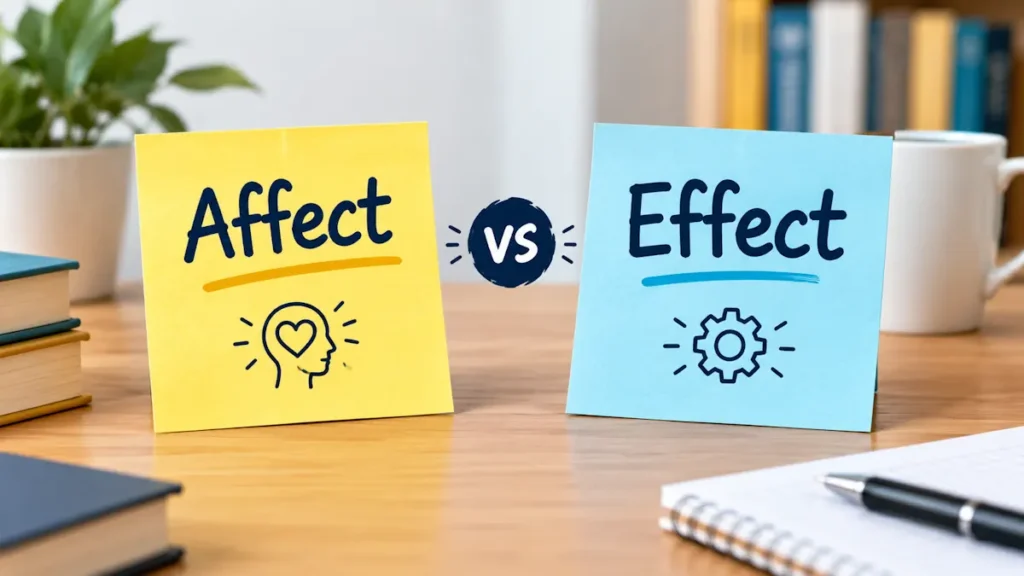
“Affect” and “effect” are among the most confused words in English. Both come from the Latin facere (“to do or make”), which is part of why they overlap. The simplest rule covers almost every case: affect is usually a verb (to influence), and effect is usually a noun (a result).
Quick Answer: Affect (verb) means to influence something: “The rain affected our plans.” Effect (noun) means the result: “The rain had an effect on our plans.”
The Core Distinction
Affect (usually a verb)
To affect something is to influence or change it.
✓ The cold weather affected the crops.
Effect (usually a noun)
An effect is a result or consequence.
✓ The medicine had a strong effect.
The Less Common Meanings
Here’s where most mistakes happen, because each word has a second, rarer sense that flips its usual part of speech.
Affect as a Noun (psychology)
In psychology, affect is a noun meaning a person’s visible emotion or mood. It’s stressed on the first syllable (AF-fect).
✓ The patient showed a flat affect.
Effect as a Verb (to bring about)
As a verb, effect means to bring about or cause something, often in the phrase “effect change.”
✓ The new leader hopes to effect real change.
Related Words
| Word | Meaning | Example |
|---|---|---|
| affected | influenced; or artificial in manner | an affected accent |
| effective | producing a result; working well | an effective plan |
| affective | relating to emotions (psychology) | an affective disorder |
| effects | personal belongings; or results | personal effects |
The Quick Test
When you’re unsure, use these substitution tests:
- Try “alter” or “influence.” If it fits, use affect (both are verbs).
- Try “result” or “end result.” If it fits, use effect (both are nouns).
✓ “The news will [influence] the market” works → use affect.
✓ “The news had an [end result] on the market” works → use effect.
Memory Trick: Remember RAVEN: Remember, Affect = Verb, Effect = Noun.
Comparison Table
| Affect | Effect | |
|---|---|---|
| Usual role | Verb | Noun |
| Core meaning | To influence or change | A result or consequence |
| Substitute with | alter, influence | result, end result |
| Rare use | Noun (emotion, psychology) | Verb (to bring about) |
| Example | It affects me. | It has an effect. |
A Note on the Exceptions
The exceptions are real but uncommon. In everyday writing, stick with affect = verb and effect = noun. You’ll only need “affect” as a noun in psychology, and “effect” as a verb when you mean to bring something about (“effect change”). Getting the main rule right handles over 95% of cases.
Quick Quiz: Test Yourself
Fill in the blank with affect or effect. The answer key is at the bottom; no peeking!
Q1. The weather will ___ our travel plans.
a) affect
b) effect
c) affective
Q2. The new law had a big ___ on small businesses.
a) affect
b) effect
c) affect’s
Q3. She hopes to ___ change in her community.
a) affect
b) effect
c) affects
Q4. Loud noise can ___ your concentration.
a) effect
b) affect
c) effects
Q5. Which word is usually a noun?
a) affect
b) effect
c) both
Answer Key: 1-a 2-b 3-b 4-b 5-b
Frequently Asked Questions
What is the difference between affect and effect?
“Affect” is usually a verb meaning to influence (The rain affected the game). “Effect” is usually a noun meaning a result (The rain had an effect on the game).
Is it affect or effect change?
It’s “effect change.” Here, effect is used as a verb meaning to bring something about. This is one of the few times effect is a verb.
How do I remember affect vs effect?
Use RAVEN: Remember, Affect = Verb, Effect = Noun. Or substitute “alter” for affect and “result” for effect.
Can affect be a noun?
Yes, but rarely. In psychology, “affect” is a noun meaning a person’s visible emotion or mood, stressed on the first syllable.
Which is more common, affect or effect?
Both are common, but in everyday writing affect is most often the verb and effect is most often the noun. That covers the vast majority of uses.
Affect is the action (verb); effect is the outcome (noun). RAVEN keeps it straight.

Benen
My name is Benen, and I am an English teacher from the US and UK. I am passionate about helping people improve their English language skills, including grammar, vocabulary, and sentence structure, while building their confidence in a supportive and patient learning environment.