
The gender rule, the French origin, modern usage, examples, and an easy memory trick.
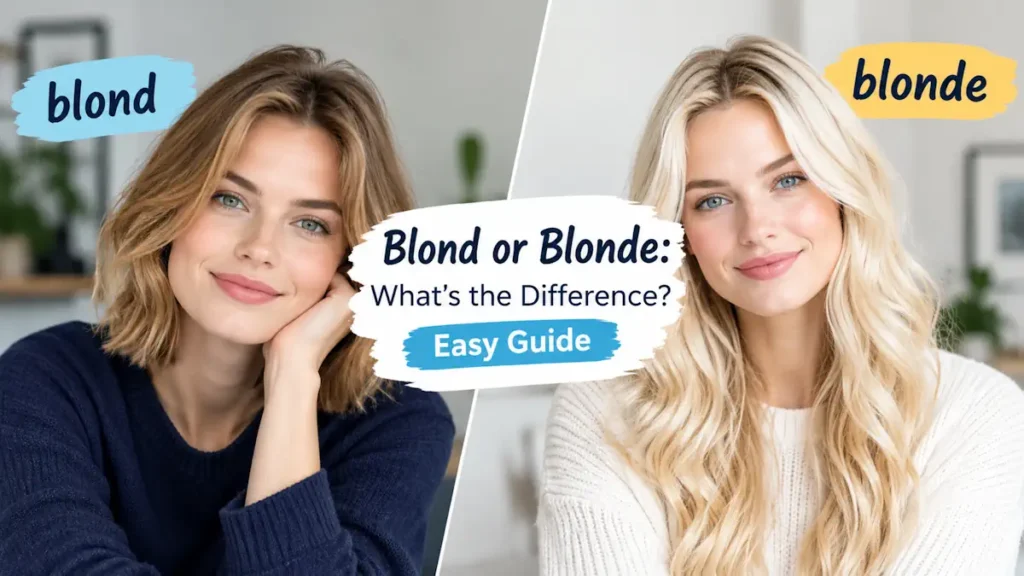
If you’ve ever paused while typing and wondered whether to write “blond” or “blonde,” you are definitely not alone. It’s one of those word pairs where both spellings are correct, which makes it feel even trickier. The difference comes down mostly to gender: blond is traditionally used for males or as a neutral form, while blonde is traditionally used for females.
For example, you’d write “He has blond hair” and “She has blonde hair.” In this easy guide, we’ll break down what each word means, where the two forms came from, when to use each one, and how modern English is slowly relaxing the rule, with plenty of examples, tables, and a quick quiz to lock it in.
Quick Answer: Use blond for a male or as a neutral form (“a blond boy,” “blond hair”). Use blonde for a female (“a blonde woman,” “she’s a natural blonde”). Remember: blonde has an extra e, like female.
Quick Overview of Blond vs Blonde
| Word | Usage | Gender | Common Region |
|---|---|---|---|
| Blond | Adjective / noun | Male or neutral | American English |
| Blonde | Adjective / noun | Female | British & traditional |
What Does Blond Mean?
Blond describes someone, traditionally a male, with light or fair-colored hair. It also works as a general adjective for the hair color itself, and in American English it is increasingly used as a gender-neutral form for everyone.
✓ He is a blond boy with blue eyes.
✓ The child has soft blond hair.
What Does Blonde Mean?
Blonde typically describes a female with light-colored hair. It can act as an adjective (“a blonde actress”) or as a noun referring to the woman herself (“she’s a blonde”).
✓ She is a blonde with long, wavy hair.
✓ The blonde woman smiled warmly.
Blond vs Blonde: What’s the Difference?
The core difference is gender. Traditionally, blond refers to males (or is used neutrally), and blonde refers to females. Both share the exact same meaning (light-colored hair); only the spelling signals who is being described.
Why Are There Two Forms?
The two spellings come from French, where adjectives change their ending to match the gender of the noun they describe. The masculine form is blond, and the feminine form adds an e to become blonde. English borrowed both forms along with the word itself, which is why we still see this male/female split today, even though English adjectives don’t normally change for gender.
Did You Know? This gendered-adjective pattern is common in French. English kept it only for a few borrowed words like blond/blonde and fiance/fiancee. That’s why these pairs feel unusual in English.
Easy Trick to Remember Blond or Blonde
Remember This: Blonde has an extra e, just like the word female. So e = female. No e (blond) is for males or neutral use.
How to Use Blond in Sentences
✓ The blond boy is running across the field.
✓ He has short, blond hair.
✓ That blond actor just won an award.
How to Use Blonde in Sentences
✓ The blonde girl is smiling at the camera.
✓ She is a natural blonde.
✓ The blonde woman entered the room.
Blond or Blonde in Hair Color Descriptions
When you describe the hair color itself (not the person), blond is the safer, more neutral choice: “blond hair,” “blond highlights.” When you refer to the woman as a person, blonde fits: “she is a blonde.”
✓ She has beautiful blond hair.
(describing the color)
✓ She is a blonde.
(describing the person)
Blond or Blonde as a Noun vs Adjective
Both words can act as either part of speech:
- As an adjective, it describes a noun: “blonde hair,” “blond curls.”
- As a noun, it names the person: “She is a blonde,” “He is a blond.”
Style Note: Many editors avoid calling a person “a blonde” as a noun, since describing someone only by hair color can feel reductive. Using it as an adjective (“a blonde woman”) is usually the safer, more respectful choice.
When “Blond” Is Usually Used
- Describing a man or boy: “a blond man.”
- Describing hair color in general: “blond hair,” “blond wood.”
- In American English, for anyone, male or female.
When “Blonde” Is Usually Used
- Describing a woman or girl: “a blonde woman.”
- Referring to a woman as a noun: “a tall blonde.”
- In British and more traditional writing, to mark the feminine form.
Common Phrases Using Blond or Blonde
| Phrase | Form Used | Why |
|---|---|---|
| blond hair | blond | Describing color, neutral |
| blond highlights | blond | Describing color |
| natural blonde | blonde | Refers to a woman |
| She dyed her hair blonde | blonde | About a female |
| a blond with blue eyes | blond | Male or neutral person |
| blonde bombshell | blonde | Set phrase about a woman |
Blond and Blonde in Grammar
Grammatically, both are regular adjectives and nouns. The only special rule is the inherited gender marking: add an e for a female (“She is blonde“) and drop it for a male or neutral use (“He is blond“).
Comparison Table
| Feature | Blond | Blonde |
|---|---|---|
| Gender | Male / neutral | Female |
| Part of speech | Adjective & noun | Adjective & noun |
| Origin | French masculine | French feminine (+e) |
| Meaning | Light-colored hair | Light-colored hair |
| Region lean | American English | British / traditional |
| Memory cue | no e | e = female |
Real-Life Usage Examples
- He is a blond teenager with a big smile.
- She is a blonde actress known for her roles.
- The child has light blond hair.
- The blonde woman waved from across the street.
- His blond beard caught the sunlight.
- She dyed her hair a bright blonde.
- The twins both have curly blond hair.
- A famous blonde singer headlined the show.
Common Mistakes When Using Blond or Blonde
| Situation | Less Precise | Better Choice |
|---|---|---|
| A man | He is a blond man. | |
| A woman | She is a blond woman. | She is a blonde woman. |
| Hair color | blond wood |
Note: Neither form is truly “wrong” since both are real words, but choosing the one that matches gender (or using blond neutrally) makes your writing more precise and polished.
Blond or Blonde in American vs British English
American English increasingly uses blond for everyone, male or female, treating it as the default neutral spelling. British English tends to keep the traditional split, using blonde for women and blond for men. Both approaches are accepted, so match your audience and stay consistent within a single piece of writing.
Which One Should You Use?
A simple decision guide:
- Describing a man or hair color? Use blond.
- Describing a woman? Use blonde.
- Writing in American English and want one safe form? Use blond for everyone.
Blond or Blonde in Writing and Conversation
In everyday conversation, nobody can hear the difference, since blond and blonde sound identical. The distinction only matters in writing. In casual texts and social media, people often use either form without much thought. But in formal or professional writing, such as articles, novels, resumes, or marketing copy, choosing the correct form shows attention to detail and makes your text look carefully edited.
Fiction writers in particular tend to respect the gender rule, because a character described as “a blonde” instantly reads as female, while “a blond” reads as male. That small spelling choice quietly carries information for the reader.
Does Using the Wrong Form Really Matter?
Because both spellings are real words, using the “wrong” one rarely causes confusion about meaning (the hair is still light-colored either way). The impact is more about polish and precision. Writing “a blonde man” isn’t a disaster, but to a careful reader it can look like a small slip, the way “you’re” and “your” errors do.
In high-stakes writing, like a published book, a brand’s website, or an exam, that small slip can chip away at your credibility. In a quick text to a friend, it genuinely doesn’t matter. Match your care to the setting.
Why This Topic Confuses So Many People
Three things make blond and blonde unusually tricky. First, English almost never changes an adjective’s spelling for gender, so this pair feels like an exception to everything else we know. Second, the two words are pronounced exactly the same, giving your ear no clue. Third, modern usage is shifting: as English moves toward gender-neutral language, blond is spreading as the all-purpose form, so you’ll see both spellings used for women, which blurs the old rule even further.
Practice Quiz: Test Yourself
Pick the better form for each sentence. The answer key is at the bottom; no peeking!
Q1. He is a tall, ___ man.
a) blonde
b) blond
c) blondy
Q2. She is a natural ___.
a) blonde
b) blond
c) blonds
Q3. The table was made of pale ___ wood.
a) blonde
b) blond
c) blonde-colored
Q4. Which form has French feminine origins?
a) blond
b) blonde
c) both equally
Q5. American English often uses ___ for everyone.
a) blonde
b) blond
c) neither
Answer Key: 1-b 2-a 3-b 4-b 5-b
Final Verdict
Both blond and blonde are correct English words. Use blond for males, hair color, and neutral or American usage, and blonde for females. The easy memory cue, e = female, will steer you right nearly every time.
Frequently Asked Questions
Is “blond” or “blonde” correct?
Both are correct. “Blond” is used for males or neutrally; “blonde” is used for females. The choice depends on who or what you’re describing.
What is the difference between blond and blonde?
They mean the same thing (light-colored hair) but differ by gender: blond for males or neutral, blonde for females. The split comes from French.
Can I use “blond” for a woman?
Yes, especially in American English, where blond is often used neutrally. Traditionally, though, “blonde” is preferred for a woman.
Is “blonde” only used for women?
Traditionally, yes. “Blonde” marks the feminine form, so it’s used for women, while “blond” covers men and neutral uses.
Should I say “blond hair” or “blonde hair”?
“Blond hair” is the safer, more neutral choice when describing the color. “Blonde hair” is common when the person is female.
Which spelling does American English prefer?
American English leans toward “blond” for everyone, using it as the default neutral spelling for both men and women.
Which spelling does British English use?
British English tends to keep the traditional distinction: “blonde” for women and “blond” for men.
Is “blonde” a noun?
Yes. “Blonde” can be a noun meaning a woman with light hair (“she’s a blonde”), though using it as an adjective is often more respectful.
Is “blond” a noun?
Yes. “Blond” can be a noun for a man with light hair (“he’s a blond”), as well as an adjective for hair color.
How do I remember blond vs blonde?
“Blonde” has an extra e, like “female.” So e = female, and no e (blond) is for males or neutral use.
Just remember: e is for female (blonde), no e for male or neutral (blond). That’s the whole rule.

Benen
My name is Benen, and I am an English teacher from the US and UK. I am passionate about helping people improve their English language skills, including grammar, vocabulary, and sentence structure, while building their confidence in a supportive and patient learning environment.