
The correct spelling, why people slip up, a memory trick, and clear examples.
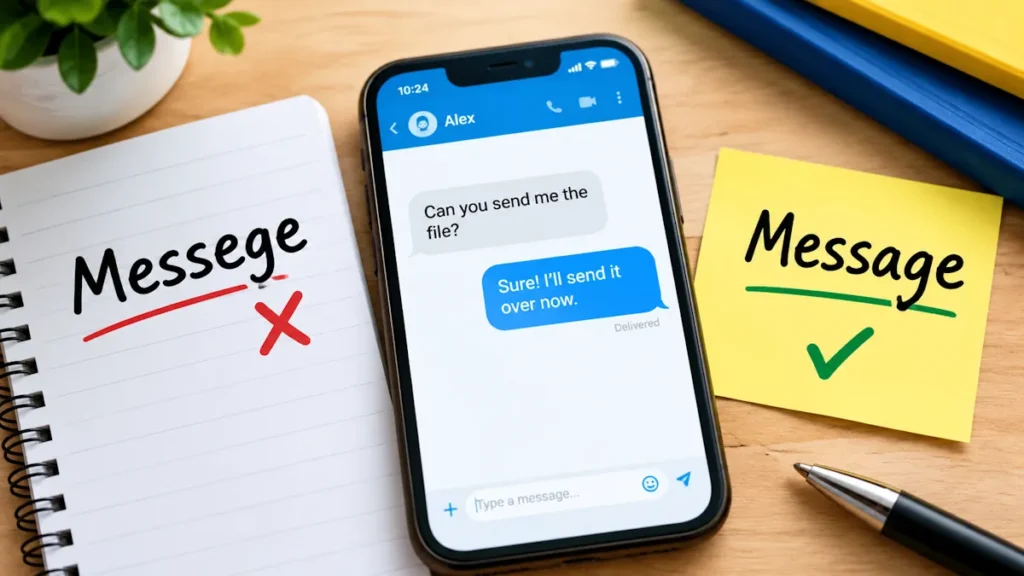
We type the word dozens of times a day, in texts, emails, and chats, yet many people still pause over it: is it “messege” or “message”? The correct spelling is message, ending in -age. The form “messege” with an extra e is simply a misspelling.
It’s an easy mistake to make, because the word doesn’t sound the way it’s spelled. The ending -age is pronounced like “ij,” which tempts people to write -ege. This guide explains the correct spelling, why the error happens, and how to lock it into memory, with plenty of examples.
Quick Answer: Message (ending in -age) is the only correct spelling. Messege is always a misspelling and should never be used. Think of the -age ending in words like package and village.
Why People Confuse the Spelling
The mix-up is all about sound. In message, the final -age is pronounced “ij”, not “ayj.” Because our ears hear an “eh/ih” sound, the fingers want to type “messege.” Autocorrect sometimes lets the error slip through too, especially in fast texting. But English spells this ending -age in a whole family of words, and message is one of them.
Message: Meaning and Definition
Message is both a noun and a verb. As a noun, it’s a piece of information sent from one person to another. As a verb, it means to send someone such a piece of information.
Message as a Noun
✓ I left you a message on your phone.
✓ Her speech had a powerful message.
Message as a Verb
✓ I’ll message you the details later.
✓ She messaged him to say she’d be late.
Messege: Is It Ever Correct?
No. Messege is not a word in standard English. Unlike some confusing pairs where both spellings exist, “messege” has no separate meaning and appears in no dictionary. It is always an error for message.
✗ I got your messege.
✓ I got your message.
Messege vs Message: Comparison Table
| Feature | Message | Messege |
|---|---|---|
| Correct spelling | Yes | No |
| In the dictionary | Yes | No |
| Ending | -age (like package) | -ege (wrong) |
| Part of speech | Noun and verb | Not a word |
| Use it? | Always | Never |
Why the Ending Is “-age,” Not “-ege”
English has a large family of words that end in -age pronounced “ij.” Once you see the pattern, message fits right in and the -ege spelling looks clearly wrong.
| Word | Ends in -age | Sounds like |
|---|---|---|
| package | pack + age | pack-ij |
| village | vill + age | vill-ij |
| manage | man + age | man-ij |
| damage | dam + age | dam-ij |
| message | mess + age | mess-ij |
Pattern Tip: If a word’s ending sounds like “ij” (package, village, manage, damage), it is almost always spelled -age. Message follows the same rule.
12 Everyday Examples of “Message”
Here are a dozen natural sentences using the correct spelling.
- Please send me a message when you arrive.
- I missed your message during the meeting.
- The app shows when a message has been read.
- He left a voice message on my phone.
- Her painting carries a hopeful message.
- Can you message the group about the change?
- I got your message loud and clear.
- The error message popped up again.
- She messaged me three times last night.
- A short message is often more effective.
- The ad’s message is all about kindness.
- Don’t forget to reply to his message.
Common Mistakes to Avoid
| Mistake | Incorrect | Correct |
|---|---|---|
| Extra e | send me a message | |
| Plural | too many messages | |
| Verb form | I messaged you | |
| Doubling | message |
All Forms of “Message”
| Form | Spelling | Example |
|---|---|---|
| Singular noun | message | a kind message |
| Plural noun | messages | unread messages |
| Verb (present) | message / messages | I message daily. |
| Verb (past) | messaged | she messaged me |
| Verb (-ing) | messaging | he is messaging now |
Note: The -ing form doubles nothing and keeps the base: message becomes “messaging,” dropping the final e. Never “messageing” or “messeging.”
Memory Trick
Remember This: A message comes in a mess + age: picture a messy desk “of a certain age.” Or group it with package and village, which all end in -age.
American vs British English
There is no difference. Message, messages, and messaged are spelled exactly the same in American, British, Australian, and Canadian English. Messege is wrong everywhere.
Similar Words People Mix Up
Message vs. Massage
Easy to confuse by one letter. Message = information you send. Massage = rubbing the body to relax muscles.
Message vs. Memo
A message can be any note or communication; a memo is a short, usually formal note within an organization.
Message vs. Text
A text is one type of message sent by phone. Every text is a message, but not every message is a text.
Messenger vs. Messege
Messenger (a person who delivers messages, or the app) is a real word. Messege is not.
Practice Quiz: Test Yourself
Pick the correct spelling or form. The answer key is at the bottom; no peeking!
Q1. Which spelling is correct?
a) messege
b) message
c) mesage
Q2. The plural is spelled:
a) messeges
b) messages
c) messagges
Q3. Past tense of the verb “message”:
a) messeged
b) messaged
c) messageed
Q4. The ending in “message” is spelled:
a) -ege
b) -age
c) -aje
Q5. Which word rhymes in spelling pattern with “message”?
a) beige
b) package
c) college
Answer Key: 1-b 2-b 3-b 4-b 5-b
Final Verdict
The correct spelling is message, every single time. Messege is a misspelling with no meaning of its own. Remember the -age ending (like package and village) and you’ll never second-guess it again.
Frequently Asked Questions
Is it messege or message?
It is “message,” ending in -age. “Messege” with an extra e is a misspelling and is never correct.
Is “messege” a real word?
No. “Messege” does not appear in any dictionary and has no meaning. The correct word is “message.”
Why is message spelled with -age?
Because it belongs to a family of English words that end in -age pronounced “ij,” such as package, village, manage, and damage.
What does message mean?
A message is a piece of information sent from one person to another. As a verb, to message someone is to send them such information.
How do you spell the past tense of message?
It is “messaged.” For example, “She messaged me yesterday.” Not “messeged.”
How do I remember the correct spelling?
Think “mess + age,” and group it with package and village. All end in -age, not -ege.
What is the difference between message and massage?
A message is information you send. A massage is rubbing the body to relax muscles. They differ by just one letter but mean completely different things.
Mess + age, like package and village: that’s all it takes to spell message right every time.

Benen
My name is Benen, and I am an English teacher from the US and UK. I am passionate about helping people improve their English language skills, including grammar, vocabulary, and sentence structure, while building their confidence in a supportive and patient learning environment.