
A clear overview, the key differences, word origins, and plenty of examples.
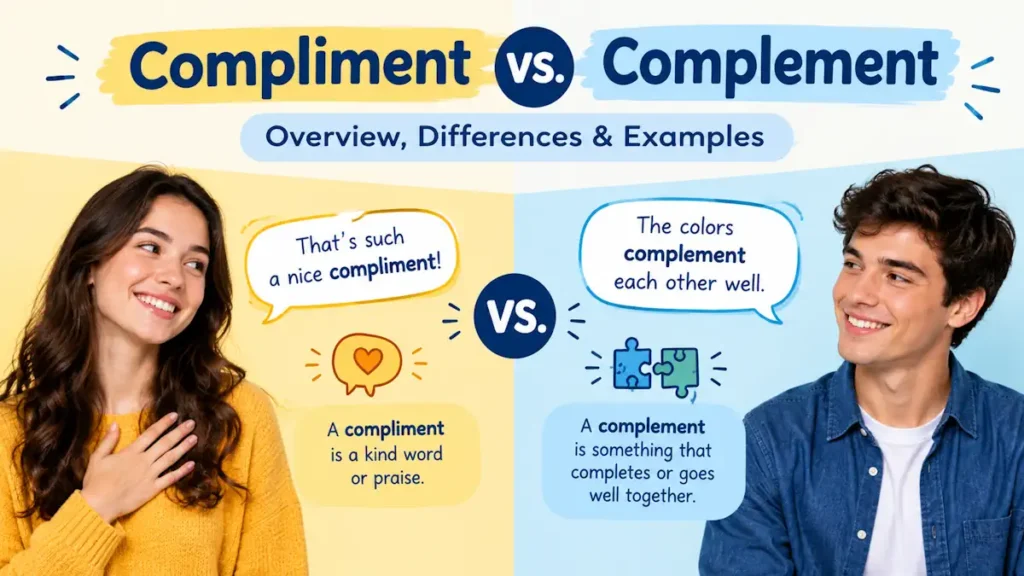
“Complement” and “compliment” are homophones: they sound exactly alike but mean very different things, and they’re among the most commonly confused words in English. The difference hangs on a single letter. A compliment (with an i) is praise. A complement (with an e) is something that completes. This overview breaks down the meanings, the key differences, where each word came from, and how to use them, with examples throughout.
Quick Answer:
Use compliment (i) for praise or a kind remark: “What a lovely compliment.” Use complement (e) for something that completes or enhances another thing: “The sauce complements the dish.”
Overview: Compliment vs. Complement
Both words trace back to the same Latin root but split into two distinct meanings over time. Here’s the big picture before we dig into details.
| Word | Core Idea | One-Line Meaning |
|---|---|---|
| Compliment (i) | Praise | A kind remark, or to give one |
| Complement (e) | Complete | Something that completes or enhances, or to complete |
What Does Compliment Mean?
Compliment (with an i) is about praise. It can be a noun (a kind remark) or a verb (to give praise).
Compliment as a Noun
✓ She gave me a lovely compliment on my presentation.
✓ Please accept this as a sincere compliment.
Compliment as a Verb
✓ He complimented her on the new design.
✓ The chef was complimented for the meal.
Memory Trick: The i in compliment stands for “I like it” or “I’m praising you.”
What Does Complement Mean?
Complement (with an e) is about completing. It can be a noun (something that completes) or a verb (to complete or enhance).
Complement as a Noun
✓ A crisp white wine is the perfect complement to seafood.
✓ The hat was a stylish complement to her outfit.
Complement as a Verb
✓ Her calm personality complements his energy.
✓ These colors complement each other beautifully.
Memory Trick: Complement and “complete” both have an e. If it completes something, it’s complement with an e.
Bonus: Complement in Grammar
In grammar, a complement is a word or phrase that completes the meaning of a verb or subject. For example, in “She is a doctor,” the phrase “a doctor” is a subject complement. This is an extra meaning worth knowing, but it still uses the e spelling.
Key Differences at a Glance
| Aspect | Compliment (i) | Complement (e) |
|---|---|---|
| Core meaning | Praise or admiration | Something that completes |
| Parts of speech | Noun and verb | Noun and verb |
| Key letter | i = I like it | e = it completes / enhances |
| About | People, words, kindness | Things that fit or pair together |
| Noun example | a sincere compliment | the perfect complement |
| Verb example | she complimented him | the scarf complements it |
Where Do These Words Come From?
Both words come from the Latin complementum, meaning “something that completes.” Complement kept that original “completing” sense. Compliment branched off through Italian and French, where it came to mean an expression of politeness or praise. So the two words are distant cousins, not spelling variants, which is exactly why their meanings are so different today.
Complimentary vs. Complementary
The same i/e split carries into the adjective forms, which cause just as much confusion.
| Word | Meaning | Example |
|---|---|---|
| Complimentary (i) | Praising, or free of charge | A complimentary room upgrade. |
| Complementary (e) | Combining well to complete each other | Complementary skills on a team. |
Quick Tip: A free gift or kind words are “complimentary” (i). Two things that work well together are “complementary” (e).
Common Mistakes to Avoid
| Meaning Intended | Incorrect | Correct |
|---|---|---|
| Praise | Thanks for the compliment! | |
| Good pairing | The wine complements the meal. | |
| Free item | a complimentary breakfast | |
| Matching colors | complementary colors |
Which One Should You Use?
A fast two-step check:
- Is it praise or something free? Use compliment / complimentary (i).
- Does one thing complete or match another? Use complement / complementary (e).
Practice Quiz: Test Yourself
Pick the correct word for each sentence. The answer key is at the bottom; no peeking!
Q1. Her speech earned a warm ___ from the audience.
a) complement
b) compliment
c) complementary
Q2. A good red wine will ___ this steak nicely.
a) complement
b) compliment
c) compliments
Q3. The airline offered a ___ meal on the long flight.
a) complementary
b) complimentary
c) complement
Q4. Their skills are ___; together they make a great team.
a) complimentary
b) complementary
c) compliment
Q5. He ___ me on finishing the project early.
a) complemented
b) complimented
c) complement
Answer Key: 1-b 2-a 3-b 4-b 5-b
Frequently Asked Questions
What is the difference between complement and compliment?
“Complement” (e) means something that completes or enhances another thing. “Compliment” (i) means praise or a kind remark. The e is for “complete,” the i is for “I like it.”
Do you compliment or complement someone?
You compliment someone (with an i) when you praise them. You would only “complement” a person in the sense that your qualities complete theirs, as in “Their styles complement each other.”
Is it complement or compliment to your outfit?
If something completes or matches your outfit, it is a complement (e). If someone praises your outfit, that is a compliment (i).
What does it mean to complement something?
To complement something means to complete it or make it better by pairing well with it, such as a side dish that complements a main course.
Is it complimentary or complementary when something is free?
It is “complimentary” (i). Free items or services are complimentary, like a complimentary coffee, because they are given as a courtesy.
How do I remember the difference?
Compliment has an i for “I like it” (praise). Complement shares its e with “complete.” Match the letter to the meaning.
Can complement be used in grammar?
Yes. In grammar, a complement is a word or phrase that completes the meaning of a verb or subject, such as “happy” in “She seems happy.” It still uses the e spelling.
One letter decides it all: i for praise, e for things that complete each other.

Benen
My name is Benen, and I am an English teacher from the US and UK. I am passionate about helping people improve their English language skills, including grammar, vocabulary, and sentence structure, while building their confidence in a supportive and patient learning environment.