

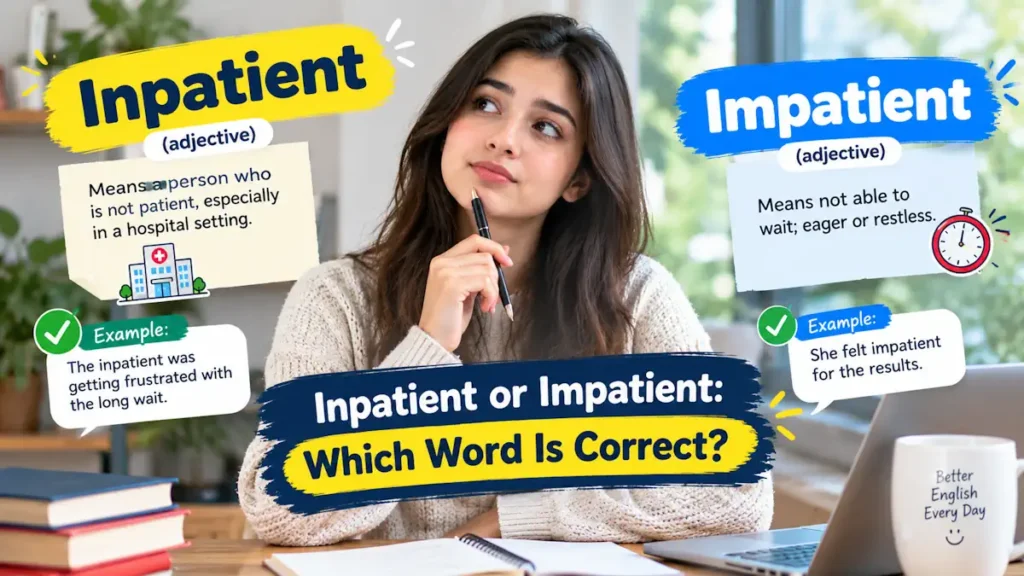
The difference, a simple memory trick, and real examples with a quick quiz.
“Inpatient” and “impatient” look almost identical and sound nearly the same, so it’s easy to type the wrong one. But they mean completely different things: one is about being in a hospital, the other is about lacking patience. This guide makes the difference stick with a simple memory trick, a comparison table, plenty of real examples, and a quick quiz at the end.
Quick Answer:
Inpatient (with an n) is a patient who stays in a hospital for treatment. Impatient (with an m) describes someone who can’t wait calmly. If it’s about a hospital, use inpatient; if it’s about feelings, use impatient.
Why People Confuse Them
The mix-up is easy to understand. The two words differ by a single letter (n versus m), and in fast speech they sound almost the same. Autocorrect also loves to swap one for the other. But they come from different roots and have nothing to do with each other in meaning.
What Each Word Means
Inpatient (noun / adjective)
An inpatient is a person who is admitted to a hospital or clinic and stays overnight (or longer) for treatment. It also works as an adjective for hospital-based care.
✓ She was admitted as an inpatient after her surgery.
✓ He completed a 30-day inpatient rehab program.
Impatient (adjective)
Impatient means lacking patience: feeling annoyed by delay, or eager for something to happen soon.
✓ The kids grew impatient waiting for the movie to start.
✓ I’m impatient to see the results of the test.
Memory Trick: Inpatient has an N, like iN hospital. Impatient has an M, like Mad about waiting.
Key Differences at a Glance
| Context | Best Choice | Why |
|---|---|---|
| Hospital admission | inpatient | Refers to staying in a hospital. |
| Rehab or treatment program | inpatient | Describes hospital-based care. |
| Hospital unit or ward | inpatient | A place for admitted patients. |
| Waiting in a long line | impatient | About feeling restless. |
| Annoyed by a delay | impatient | About lacking patience. |
| Eager for something soon | impatient | Shows strong eagerness. |
Side-by-Side Comparison
| Aspect | Inpatient | Impatient |
|---|---|---|
| Part of speech | Noun or adjective | Adjective |
| Topic | Hospitals and medical care | Feelings and behavior |
| Meaning | Admitted for treatment | Unable to wait calmly |
| Key letter | N = iN hospital | M = Mad about waiting |
| Example | inpatient care | an impatient driver |
How to Pronounce Them
The stress falls on a different syllable, which is the clearest way to tell them apart out loud.
| Word | Pronunciation | Stress |
|---|---|---|
| Inpatient | IN-pay-shunt | Stress on the first syllable (IN) |
| Impatient | im-PAY-shunt | Stress on the second syllable (PAY) |
Quick Tip: In fast speech the two can sound almost the same, so in writing, context is your most reliable guide. Ask yourself: hospital, or feeling?
Common Mistakes to Avoid
| Meaning Intended | Incorrect | Correct |
|---|---|---|
| Feeling restless | He was impatient in line. | |
| Hospital stay | She needs inpatient care. | |
| Annoyed with someone | Don’t be impatient with me. | |
| Treatment program | an inpatient rehab program |
Real-Life Examples
Inpatient (hospital)
✓ The hospital added 20 new inpatient beds this year.
✓ Her insurance covered a five-day inpatient stay.
✓ The clinic offers both inpatient and outpatient services.
Impatient (feelings)
✓ Customers get impatient when the app loads slowly.
✓ Try not to be so impatient; the bus will come.
✓ She was impatient to open her birthday gifts.
Which One Should You Use?
Use this quick test whenever you’re unsure:
- Could you replace the word with “hospital patient”? Use inpatient.
- Could you replace it with “restless”, “annoyed,” or “eager”? Use impatient.
Practice Quiz: Test Yourself
Pick the correct word for each sentence. The answer key is at the bottom; no peeking!
Q1. After the accident, he was admitted as an ___.
a) impatient
b) inpatient
c) impatiant
Q2. Stop being so ___; the food will arrive soon.
a) impatient
b) inpatient
c) inpateint
Q3. The ___ ward was full during flu season.
a) impatient
b) inpatient
c) impateint
Q4. Which word is an adjective about feelings?
a) inpatient
b) impatient
c) both
Q5. She felt ___ waiting for the slow elevator.
a) inpatient
b) impatient
c) inpatiant
Answer Key: 1-b 2-a 3-b 4-b 5-b
Frequently Asked Questions
What is the difference between inpatient and impatient?
“Inpatient” (with an n) is a patient admitted to a hospital. “Impatient” (with an m) is an adjective meaning unable to wait calmly. They share no meaning.
Is it inpatient or impatient when I’m tired of waiting?
Use “impatient.” If you feel restless, annoyed, or eager, the word is impatient, spelled with an m.
What does inpatient mean?
An inpatient is a person who stays in a hospital or clinic overnight or longer for treatment. It can also describe hospital-based care, such as inpatient rehab.
What does impatient mean?
Impatient means lacking patience: feeling irritated by delay or eager for something to happen soon, such as an impatient customer in a long line.
How do I remember which is which?
Inpatient has an N for “iN hospital.” Impatient has an M for “Mad about waiting.” The key letter points to the meaning.
Is impatient a negative word?
Usually it’s mildly negative, suggesting restlessness or irritation. But it can also show eagerness, as in “impatient to start,” which is more positive.
Can inpatient be used as an adjective?
Yes. Inpatient works as an adjective for hospital care, such as “inpatient treatment,” “inpatient unit,” or “inpatient program.”
Remember: N is for the hospital, M is for the mood. Get that, and you’ll never mix them up again.

Benen
My name is Benen, and I am an English teacher from the US and UK. I am passionate about helping people improve their English language skills, including grammar, vocabulary, and sentence structure, while building their confidence in a supportive and patient learning environment.