
The difference, easy memory tricks, and clear examples with a quick quiz.
“Compliment” and “complement” sound exactly the same, so it’s no surprise people swap them constantly in writing. But they mean completely different things, and using the wrong one can change your whole sentence. The difference comes down to a single letter: i versus e. This guide gives you a simple rule, two memory tricks, and plenty of examples so you never mix them up again.
Quick Answer:
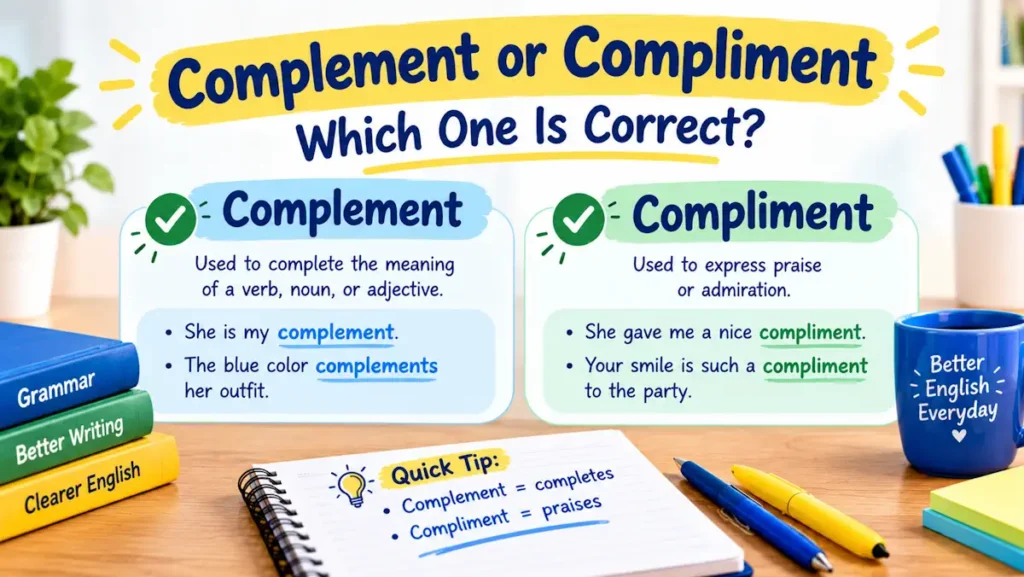
Compliment (with an i) means praise: “She gave me a compliment.” Complement (with an e) means something that completes or goes well with another thing: “The wine complements the meal.”
Quick Overview: At a Glance
Compliment (with an i) and complement (with an e) are homophones: they sound identical, but they have completely different meanings.
Compliment (with an i)
- Meaning: An expression of praise, admiration, or respect.
- Function: Can be a noun or a verb.
Examples:
✓ Noun: She received a nice compliment on her new haircut.
✓ Verb: He complimented her on her great presentation.
Memory Trick: The i in compliment stands for I like you, or I am smart.
Complement (with an e)
- Meaning: Something that completes, enhances, or goes well together with another thing.
- Function: Can be a noun or a verb.
Examples:
✓ Noun: This red wine is the perfect complement to the steak dinner.
✓ Verb: Her shoes complement her dress nicely.
Memory Trick: The e in complement stands for complete or enhancement.
Side-by-Side Comparison
| Aspect | Compliment (i) | Complement (e) |
|---|---|---|
| Meaning | Praise or admiration | Something that completes |
| Key letter | i = I like you | e = enhance / complete |
| Noun example | A kind compliment | A perfect complement |
| Verb example | She complimented him | The scarf complements it |
| Feeling | About people and words | About things that fit together |
Bonus: Complimentary vs. Complementary
The same i/e rule carries over to the adjectives, which trip people up just as often.
| Word | Meaning | Example |
|---|---|---|
| Complimentary (i) | Praising, OR free of charge | Complimentary breakfast at the hotel. |
| Complementary (e) | Combining well to complete each other | Red and green are complementary colors. |
Quick Tip: Free food at a hotel is “complimentary” (with an i), because it is given as a kind gesture, like a compliment. Things that fit together are “complementary” (with an e).
Common Mistakes to Avoid
| Context | Incorrect | Correct |
|---|---|---|
| Praise | Thanks for the compliment! | |
| Pairing | The tie complements the suit. | |
| Free item | a complimentary coffee | |
| Colors | complementary colors |
The Quick Rule to Remember
Remember This: See an i? Think praise (I like you). See an e? Think complete / enhance. One letter decides the whole meaning.
Practice Quiz: Test Yourself
Pick the correct word for each sentence. The answer key is at the bottom; no peeking!
Q1. My teacher gave me a lovely ___ on my essay.
a) complement
b) compliment
c) complementary
Q2. These two flavors really ___ each other.
a) complement
b) compliment
c) compliments
Q3. The hotel offered a ___ breakfast for free.
a) complementary
b) complimentary
c) complement
Q4. Blue and orange are ___ colors on the wheel.
a) complimentary
b) complementary
c) compliment
Q5. He ___ her on finishing the marathon.
a) complemented
b) complimented
c) complement
Answer Key: 1-b 2-a 3-b 4-b 5-b
Frequently Asked Questions
What is the difference between compliment and complement?
A “compliment” (with an i) is an expression of praise, like saying you admire someone’s work. A “complement” (with an e) is something that completes or enhances another thing, like a scarf that goes well with a coat. The i is for praise; the e is for things that fit together.
What’s a compliment?
A compliment is a polite expression of praise, admiration, or respect. For example, “I love your presentation” is a compliment. It can also be a verb: to compliment someone is to praise them.
What does complement mean?
“Complement” means something that completes, enhances, or pairs well with another thing. A side salad can be a complement to a main dish, and two colors can complement each other.
How do you spell compliment (praise)?
When you mean praise, spell it C-O-M-P-L-I-M-E-N-T, with an i. Remember: the i stands for “I like you.” The version with an e, “complement,” means something that completes another thing.
Is free food complimentary or complementary?
It is “complimentary” (with an i). Free food or service is given as a courtesy, like a compliment, so it uses the i spelling: a complimentary meal, a complimentary upgrade.
What does it mean to compliment someone?
To “compliment” someone (with an i) is to praise them or express admiration, such as saying you like their work, their outfit, or their idea.
What are examples of complements?
A complement completes something: “Fries are the perfect complement to a burger,” or “Her calm nature is a complement to his energy.” In grammar, a complement also completes the meaning of a verb.
When to use complement vs compliment?
Use “compliment” (i) for praise and “complement” (e) for things that complete or match each other. If you mean kind words, use i; if you mean a good pairing, use e.
How to remember compliment vs complement?
Use the letter trick: the i in compliment stands for “I like you” (praise), and the e in complement stands for “enhance” or “complete.”
Is it complements of vs compliments of?
The set phrase for something given free is “compliments of” (with an i), as in “compliments of the chef.” It means offered as a courtesy, so it uses the praise spelling.
One letter, one meaning: i for praise, e for things that complete each other.

Benen
My name is Benen, and I am an English teacher from the US and UK. I am passionate about helping people improve their English language skills, including grammar, vocabulary, and sentence structure, while building their confidence in a supportive and patient learning environment.