
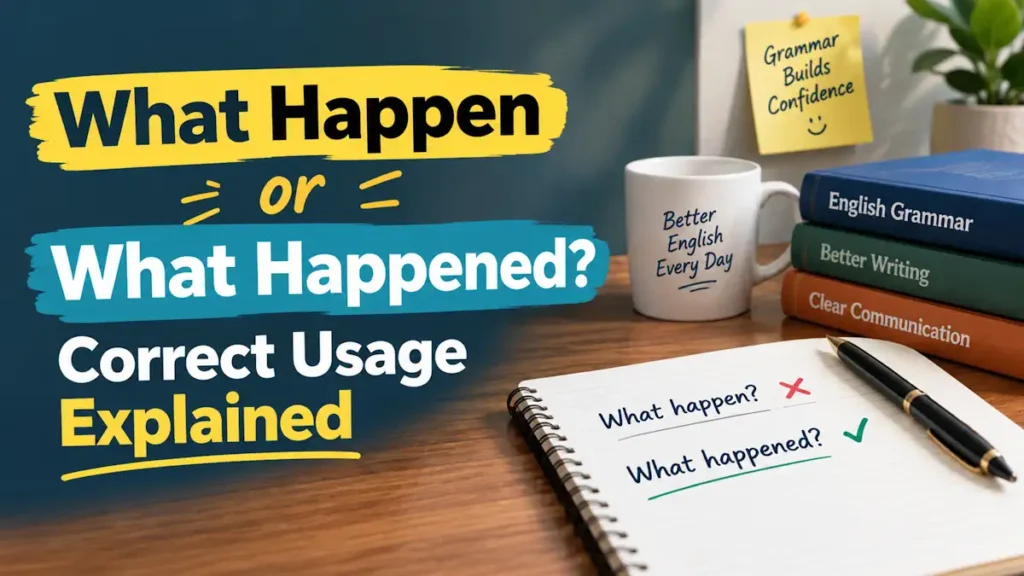
If you’ve ever paused before typing a message and wondered whether it should be “what happen” or “what happened,” you’re not alone. The two sound almost identical in fast, casual speech, yet only one is correct in standard English. Getting it right matters in exams, emails, and any professional setting. By the end of this guide, you’ll know exactly which form to use, why, and how to handle the trickier cousins like “what happens” and “what has happened.”
Quick Answer:
“What happened” is the correct form when asking about a past event. “What happen” is grammatically incorrect in standard English. Use “what happens” only for present or habitual actions.
Quick Overview: At a Glance
“What happened” is the correct standard English phrase when asking about a past event. Here is each form at a glance:
- What happened: Use this past-tense form to ask about an event that already took place (for example, “What happened yesterday?” or “What happened to your phone?”).
- What happen: This phrase is grammatically incorrect in standard English when used on its own as a question, because it lacks the past-tense suffix -ed.
- What happens: Use this present-tense form only when asking about general habits, routines, or things happening right now.
- What’s happened (or what has happened): Use this option when a past event is still connected to, or important in, the present.
Why “What Happen” Feels Right (But Isn’t)
In everyday speech, the -ed ending on happened is often swallowed. When someone says it quickly, “what happened” can sound like “what happen.” Our ears get used to the sound, and the mistake starts to feel natural, especially for learners whose first language doesn’t change the verb to mark past time.
But English marks the past tense on the verb itself. Leaving off the -ed removes the one signal that tells your reader the event is finished.
How Verb Tense Signals Time
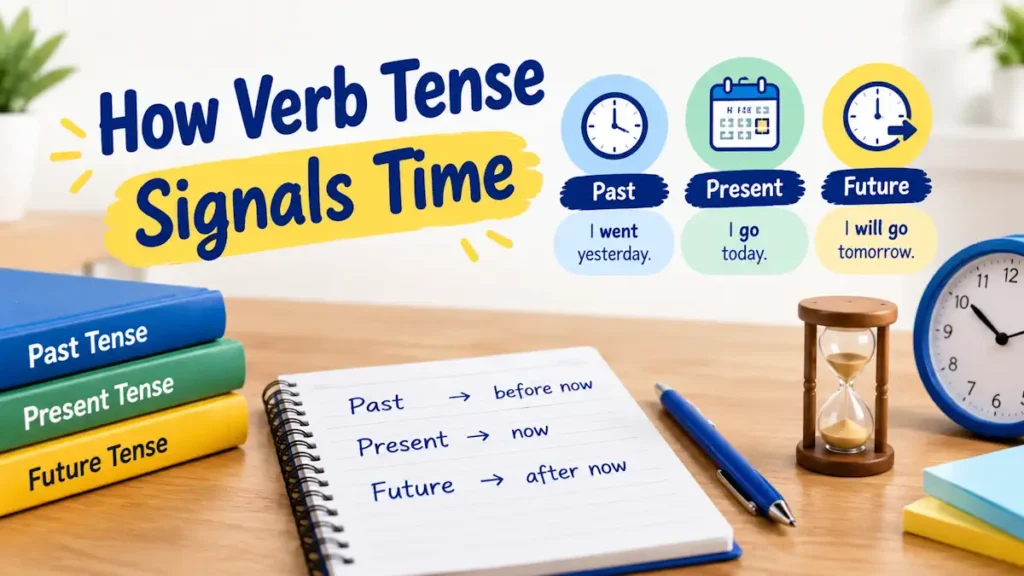
Every English sentence places an action in time through its verb. Happen is a regular verb, so it follows the standard pattern. Here is the full set of forms.
| Verb Form | Tense | Example |
|---|---|---|
| happen / happens | Present simple | Accidents happen. / It happens often. |
| happened | Past simple | Something happened yesterday. |
| happening | Present continuous | What is happening right now? |
| has / have happened | Present perfect | A lot has happened this week. |
Key Rule: To ask about something that already took place, the verb must carry the past-tense ending: happened. No other form shows a completed past event in a simple question.
Why “What Happen” Is Incorrect
When you ask about a past event, the verb has to show past time. “What happen” uses the base form, which signals present or general time, so it clashes with the past meaning you intend.
✗ What happen at the party last night?
The base verb “happen” cannot express a finished past event.
✓ What happened at the party last night?
The -ed ending correctly places the event in the past.
Why “What Happened” Works
“What happened” works because what is the subject of the question. In subject questions, we do not use the helper did; the main verb simply takes the past form instead.
Subject Questions vs. Object Questions
This is the point most guides skip. The rule depends on whether the question word is the subject or the object.
| Question Type | Rule | Example |
|---|---|---|
| Subject question | No “did”; verb takes past form | What happened? / Who called? |
| Object question | Use “did” + base verb | What did you see? / Who did you call? |
✓ What happened?
“What” is the subject, so no “did” is needed.
✗ What did happened?
Never combine “did” with the past form. This is a common overcorrection.
✗ What did happen?
Grammatically possible for emphasis, but unnatural as a normal question.
Watch Out: The most common overcorrection is “What did happened?” Once you add did, the main verb goes back to its base form: “What did you do?” But for a subject question, drop did entirely and just say “What happened?”
“What Happened” vs. “What Has Happened”
Both are correct, but they are not interchangeable. This distinction is what separates confident speakers from the rest.
| Form | When to Use | Example |
|---|---|---|
| What happened? | A finished event at a specific or known past time | What happened at the meeting yesterday? |
| What has happened? | A recent event with a result that still matters now | What has happened? You look upset. |
Use “what happened” when the focus is on the past moment itself (often with a time word like yesterday or last night). Use “what has happened” when the past event’s effect is still felt in the present.
When “What Happens” Is Correct
“What happens” is not wrong; it just means something different. Use it for present, habitual, or general situations, and in storytelling to make events feel vivid.
✓ What happens if I press this button?
A general or hypothetical present situation.
✓ What happens every Monday at the office?
A repeated, habitual action.
Quick Tip: Add a time clue to test yourself. “Yesterday” or “last night” needs happened. “Every day” or “usually” needs happens. “Right now” needs is happening.
Spoken English vs. Written English
You will sometimes hear “What happen?” or “Yo, what happen, bro?” in very casual, regional, or slang speech. In conversation among friends, it passes without notice. In writing, exams, and any professional context, it reads as an error. When in doubt, always write the full “what happened.”
Common Mistakes to Avoid
| Context | Incorrect | Correct |
|---|---|---|
| Conversation | What happened to you? | |
| Texting | what happened last night | |
| Academic | Explain what happened. | |
| Workplace | What happened with the client? |
Real-Life Examples
✓ I heard a loud noise. What happened?
✓ The vase is broken. What happened?
✓ Do you know what happened to John?
✗ What happen yesterday?
The Quick Rule to Remember
Remember This: Asking about the past? Use “what happened.” Asking about the present or a habit? Use “what happens.” The base form “what happen” is never correct on its own.
Practice Quiz: Test Yourself
Pick the correct option for each sentence. The answer key is at the bottom; no peeking!
Q1. Choose the correct question about last night.
a) What happen last night?
b) What happened last night?
c) What did happened last night?
Q2. Which sentence is correct?
a) What did happen to the report?
b) What happened to the report?
c) What happen to the report?
Q3. Fill in: “___ every Monday at the meeting?”
a) What happens
b) What happened
c) What happen
Q4. Which is the correct object question?
a) What did you saw?
b) What did you see?
c) What you saw?
Q5. You walk in and see a mess. The best question is:
a) What happen here?
b) What has happened here?
c) What did happened here?
Answer Key: 1-b 2-b 3-a 4-b 5-b
Frequently Asked Questions
What is the difference between “what happen” and “what happened”?
“What happened” is the correct past-tense question about a finished event. “What happen” uses the base verb and is grammatically incorrect in standard English.
Why is “what happen” incorrect?
Because the base verb “happen” cannot express past time. English marks the past on the verb, so a finished event needs the -ed ending: happened.
Can “what happen” ever be correct?
Not on its own. It only appears correctly as part of a longer structure, such as “What will happen?” or “What can happen?”, where another word carries the tense.
What is the difference between “what happened” and “what has happened”?
“What happened” focuses on a past moment, often with a time word. “What has happened” focuses on a recent event whose result still matters now.
How can I stop making this mistake?
Add a time clue in your head. If the event is over (yesterday, last night), use happened. If it is a habit (every day), use happens. When writing, always spell out the full -ed ending.
When to use happen or happened?
Use “happened” (past form) for a finished event, as in “What happened last night?” Use “happen” only when another word already carries the tense, such as “What will happen?” or “Accidents happen.” On its own as a past question, “happen” is incorrect.
What just happened or what did just happen?
Say “What just happened?” This is a subject question, so no “did” is needed and the verb takes the past form. “What did just happen?” is unnatural; the natural emphatic version would be “What did just happen there?” only in rare spoken stress, so stick with “What just happened?”
What happened and what has happened?
“What happened” points to a finished moment in the past, often with a time word (“What happened yesterday?”). “What has happened” points to a recent event whose result still matters now (“What has happened? You look worried.”).
Do I say happen or happened?
For a past event, always say “happened.” Say “happen” only in the present or general sense (“Things happen”) or after a helping verb (“Did it happen?”, “It will happen”). When asking about something that already occurred, “happened” is the correct choice.
Master this one small ending, and your questions will sound correct every time.

Benen
My name is Benen, and I am an English teacher from the US and UK. I am passionate about helping people improve their English language skills, including grammar, vocabulary, and sentence structure, while building their confidence in a supportive and patient learning environment.