
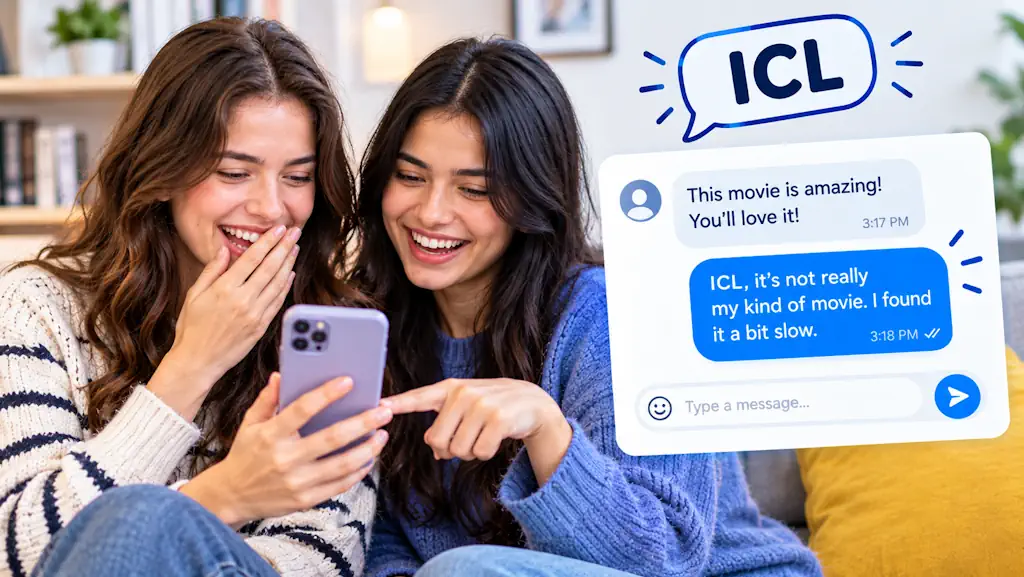
ICL stands for “I can’t lie.” It’s roughly like saying “honestly” or “to be honest,” dropped in before an opinion, an admission, or a reaction.
If a friend texts “icl, that movie was actually good,” they are not announcing a medical inability to lie. They are flagging that the next part is meant to be candid. ICL is one of the most common honesty markers in casual chat, and it sits in the same family as NGL and TBH. This guide explains what ICL means, how tone shifts depending on what follows it, how it differs from similar abbreviations, and how to reply naturally.
Key Takeaways
- ICL means “I can’t lie,” and people use it to introduce an honest opinion, admission, compliment, criticism, or feeling.
- The abbreviation itself is emotionally neutral, so the words after it decide whether the message sounds warm, blunt, or funny.
- ICL is very close to NGL (“not gonna lie”) and TBH (“to be honest”), and the choice usually comes down to personal style.
- It is not inherently flirty, rude, or serious, so read the whole message and the relationship.
- ICL is informal, so skip it in work emails, school writing, and formal documents.
Quick Answer: What Does ICL Mean in Text?
In texting and social media, ICL means “I can’t lie.” It works as a casual lead-in to something the sender wants to say honestly.
| Letter | Stands For |
|---|---|
| I | I |
| C | Can’t |
| L | Lie |
Quick examples
- “icl, I was nervous before the interview.”
- “That game was better than I expected, icl.”
- “Icl, your new haircut looks great.”
You can usually swap ICL for “honestly,” “I have to admit,” or “to be honest” without changing the meaning.
What Does ICL Stand For?
ICL is an initialism for the phrase “I can’t lie.” It takes the first letter of each word and works as a shortcut, so people type three letters instead of three words. Dictionary-style references list it as internet slang for the same phrase, and it appears in lowercase, uppercase, and mixed forms (icl, ICL, Icl) with no difference in meaning.
The phrase is figurative. Nobody means they are literally unable to lie. It is closer to a conversational “I’m going to be straight with you.”
[IMAGE: icl-stands-for.webp “Simple graphic showing the letters I, C, L expanding into I can’t lie”]
How People Use ICL
ICL can introduce several kinds of statements.
An honest opinion
- “ICL, I think the first movie was better.”
An admission
- “ICL, I forgot about the meeting.”
A compliment
- “ICL, you’re really good at this.”
A feeling
- “ICL, I miss those days.”
A criticism
- “ICL, that update made the app harder to use.”
A surprised reaction
- “ICL, I didn’t expect to enjoy that concert.”
A simple formula helps: ICL + an honest statement = a candid reaction.
Where ICL Goes in a Sentence
It is flexible, and placement changes the rhythm more than the meaning.
- At the start: “ICL, I really enjoyed that game.” This prepares the reader for something sincere.
- At the end: “That game was actually fun, ICL.” This works like an afterthought or a wink.
- With no punctuation: “icl that movie was actually good.” Texting often skips punctuation, and the meaning stays the same.
How Tone Changes With ICL
ICL does not set the emotion of a message. The surrounding words do.
| Tone | Example | What It Feels Like |
|---|---|---|
| Positive | “ICL, you did great.” | Honest praise |
| Negative | “ICL, I didn’t like it.” | Honest criticism |
| Neutral | “ICL, I already ate.” | A plain admission |
| Surprised | “ICL, I didn’t expect that.” | Genuine surprise |
| Emotional | “ICL, I missed you.” | A sincere feeling |
| Humorous | “ICL 😂 that was ridiculous.” | A playful reaction |
| Sarcastic | “ICL, great timing.” (said to someone who arrived late) | Irony, not praise |
Emojis, punctuation, and your history with the sender all help. A laughing emoji points toward a joke, while a calm, personal sentence points toward sincerity.
ICL vs. NGL, TBH, IMO, FR, and No Cap
These expressions overlap, but each puts the spotlight on something slightly different.
| Term | Full Form | Main Emphasis | Typical Tone |
|---|---|---|---|
| ICL | I can’t lie | Honesty or candor | Casual |
| NGL | Not gonna lie | Honesty or candor | Casual |
| TBH | To be honest | Honesty | Casual to neutral |
| IMO | In my opinion | A personal viewpoint | Neutral |
| FR | For real | Agreement or emphasis | Casual |
| No cap | No lie, seriously | Truthfulness | Very casual |
ICL vs. NGL: Almost identical. “ICL, this song is catchy” and “NGL, this song is catchy” say the same thing. People pick whichever feels more natural.
ICL vs. TBH: TBH literally says “to be honest,” while ICL is built from the phrase “I can’t lie.” In everyday chat, either works.
ICL vs. IMO: IMO marks something as an opinion, while ICL highlights the speaker’s willingness to be candid. You can use ICL before a confession that is not really an opinion, like “ICL, I forgot.”
ICL vs. FR: FR often replies to something (“That movie was incredible.” / “fr”), while ICL usually introduces your own statement. They can appear together: “ICL, that was amazing fr.”
[IMAGE: icl-vs-ngl.webp “Comparison graphic showing ICL, NGL, and TBH introducing the same honest opinion”]
ICL on TikTok, Snapchat, Instagram, WhatsApp, and Discord
The meaning stays the same everywhere. What shifts is the setting.
| Platform | How ICL Usually Appears |
|---|---|
| TikTok | Comments and replies: “icl this trend is actually funny 😂” |
| Snapchat | Casual chats and snap replies: “ICL, I forgot to reply yesterday.” |
| DMs, story replies, and comments: “ICL, this might be your best photo.” | |
| Friendly conversations: “ICL, the food was better than I expected.” | |
| Discord | Quick, compressed gaming chat: “ICL, that boss fight was brutal.” |
Snapchat has no special ICL meaning. If you are wondering what ICL means on Snapchat specifically, the ordinary “I can’t lie” reading applies.
What Does ICL Mean From a Girl or a Guy?
Nothing different. ICL has no special meaning based on who sends it.
If a girl writes “ICL, you looked really good yesterday,” that is a candid compliment. Whether it carries extra personal meaning depends on the relationship and the rest of the conversation, not on the three letters. The same goes for a guy writing “ICL, I was worried.” Read what was actually said, what you were discussing, the tone, and how well you know the sender.
Is ICL Flirty or Romantic?
Not by itself. Romantic messages can include ICL because people share honest feelings with someone they like, but ICL just introduces the statement. Compare “ICL, that movie was amazing” with “ICL, I’ve missed talking to you.” The second message carries the emotional content, and ICL only opens the door. Treat ICL as a hint to read the sentence carefully, not as a secret code.
Is ICL Rude?
No, but the statement that follows it can be blunt. “ICL, that shirt doesn’t look good” is direct criticism, while “ICL, I don’t think that color works as well” delivers a similar point more gently. Adding ICL does not make an insult polite, and it is not a free pass to be unkind. When you receive an ICL message, look at the complete wording before deciding how it was meant.
Real Chat Examples
These examples are illustrative, written to show how ICL works in different situations.
Opinions
- “Did you like the movie?” / “icl, it was better than I expected.”
- “ICL, the sequel was weaker.”
Admissions
- “Did you finish the assignment?” / “ICL, I completely forgot.”
- “icl I thought you were going to cancel.”
Compliments
- “What do you think of my new shoes?” / “ICL, they look really good.”
Feelings
- “Are you okay?” / “ICL, I’ve had a rough week.”
Reactions
- “icl 😂 I did not see that ending coming.”
- “ICL, that level was ridiculously hard.”
Sarcasm
- “ICL, perfect timing” (said to someone who showed up late)
When ICL Is a Joke, Not a Confession
ICL does not always signal a solemn statement. Sometimes it is a playful exaggeration, such as “icl I’m starving” an hour after a big lunch. It can also follow a joke, where it marks a light reaction. And sarcasm survives the abbreviation: a sarcastic “ICL, great timing” is not a compliment. Context is the deciding factor.
What About “TS PMO ICL”?
You may see ICL stacked with other abbreviations in annoyed comments, such as “ts pmo icl.” In that phrase, ICL keeps its usual “I can’t lie” meaning, and the other two abbreviations carry the annoyance (one of them includes profanity, so it is not spelled out here). A clean translation is roughly “this annoys me, honestly.” Stacked abbreviations are often a meme-style joke, so the exact wording is less important than the overall mood.
Other Meanings of ICL
Outside chat, ICL appears in specialized fields.
| Context | Possible Meaning |
|---|---|
| Texting and social media | I can’t lie |
| Eye care | Implantable collamer lens, a type of vision-correction lens |
| Computing history | The name of a historic British computer company |
| Technical fields | Various specialized terms |
If you see ICL in a medical discussion, a vision-care context, or a history of computing, it is almost certainly not slang. Check the surrounding text before assuming the texting meaning.
Does ICL Mean “I Care Less”?
Some pages list “I care less” as a possible meaning, but it is not supported in ordinary texting. In casual chats, “I can’t lie” is the meaning to expect. If a message really does seem to mean something else, the topic and the sender’s style will usually show it, and asking is always fine.
How to Tell What ICL Means in a Message
Use this four-part check.
- Read the words after ICL. “That was amazing” is positive, “That was disappointing” is negative, and “I forgot” is a neutral admission.
- Consider the relationship. A close friend may use ICL casually, while an acquaintance may use it to sound candid.
- Think about the topic. A movie opinion, a school assignment, and a personal worry all change the feel.
- Check emojis and punctuation. “ICL 😂 that was wild” feels playful, while “ICL, I’m really proud of you.” feels sincere.
Common Mistakes With ICL
Thinking it means “I am lying.” The phrase is “I can’t lie,” and it signals candor.
Assuming it is always serious. It can introduce jokes, trivial opinions, and playful reactions.
Assuming it is always flirty. The abbreviation does not establish romantic interest.
Using it to excuse rudeness. Honesty does not make a hurtful comment kind.
Reading lowercase and uppercase as different. “icl” and “ICL” mean the same thing.
Using it in formal writing. It looks out of place in professional or academic messages.
When to Use ICL and When to Skip It
Good moments:
- texts, DMs, and group chats
- social media comments
- gaming and Discord conversations
- casual talks with friends
Better to skip:
- business emails and proposals
- school essays and applications
- formal reports and official letters
For a more formal tone, replace “ICL, I think this has problems” with “To be honest, I think this approach has some limitations” or “In my view, this approach has several limitations.”
How to Reply When Someone Says ICL
You do not need a special reply. Respond to the statement that follows.
If you agree:
- “Honestly, same.”
- “Exactly.”
If you disagree:
- “I see it differently.”
- “Really? I thought the opposite.”
If someone shares something personal:
- “Thanks for being honest with me.”
- “I understand, I’m here if you want to talk.”
If it is a compliment:
- “Thank you, that means a lot.”
- “That’s really kind.”
If it is a joke:
- “Okay, that’s fair 😂”
Why Do People Use ICL Instead of “I Can’t Lie”?
Three letters are quicker than three words. Online messaging rewards speed, so people compress familiar phrases without losing much meaning. ICL also feels casual and conversational, the way a spoken “honestly” does, and shared slang makes a chat flow faster when both people already understand it.
How Do You Pronounce ICL?
Most people read it by its letters (eye-see-el). In everyday speech, though, people usually say the full phrase “I can’t lie,” because the abbreviation is mainly a typing shortcut.
Is ICL Still Popular?
Yes. It is widely recognized in casual texting, comment sections, and gaming chats, and it is often grouped with NGL and TBH as part of the same honesty-marker family. It is also easy to combine with other abbreviations, which keeps it showing up in short, compressed comments.
Quick Facts
| Factor | Details |
|---|---|
| Meaning | I can’t lie |
| Category | Internet slang, initialism |
| Tone | Casual, honest, neutral on its own |
| Similar terms | NGL, TBH, IMO, FR, no cap |
| Common places | TikTok, Snapchat, Instagram, WhatsApp, Discord |
| Formality | Informal |
| Gender-specific | No |
Conclusion
ICL is a small abbreviation with one clear job: it tells the reader that what follows is meant to be candid. It means “I can’t lie,” it sits alongside NGL and TBH, and it takes its emotional tone from the sentence around it, not from the three letters. Read the whole message, reply to what was actually said, and keep ICL for casual chats.
FAQs
What does ICL mean in text?
ICL means “I can’t lie.” People use it to introduce an honest opinion, admission, compliment, criticism, or reaction.
What does ICL stand for in texting?
It stands for “I can’t lie,” and works much like “honestly” or “to be honest.”
What does ICL mean on Snapchat?
The same thing: “I can’t lie.” There is no special Snapchat meaning, and the tone comes from the rest of the message.
What does ICL mean on TikTok?
Usually “I can’t lie,” in comments, captions, and replies, such as “icl this trend is actually funny.”
Is ICL the same as NGL?
They are very similar. ICL means “I can’t lie” and NGL means “not gonna lie,” and both introduce candid statements.
Is ICL flirty?
Not by itself. Whether a message feels flirty depends on the whole message and your relationship with the sender.
Is ICL rude?
No, but the statement after it can be blunt. Read the full wording before deciding how it was meant.
What does ICL mean from a girl?
The same as from anyone else: “I can’t lie.” Look at the message and the relationship, not the abbreviation.
Does ICL mean “I care less”?
Some pages list it, but it is not supported in ordinary texting. “I can’t lie” is the meaning to expect.
Can I use ICL in a professional email?
It is better to avoid it. Use “to be honest,” “in my view,” or “I believe” instead.

Mona
Mona is a CELTA-certified English teacher and fluency coach who is passionate about helping learners speak natural, confident English. On Grammar Readers, she shares clear explanations of word meanings, idioms, and everyday expressions, so you can understand English the way native speakers use it. Her lessons focus on practical fluency tips that you can apply in daily conversations.