
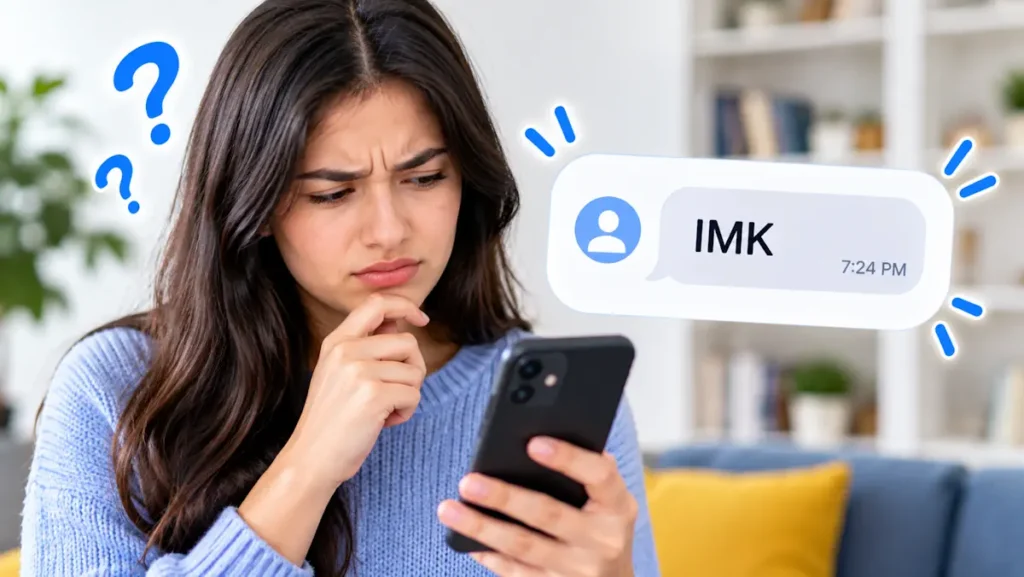
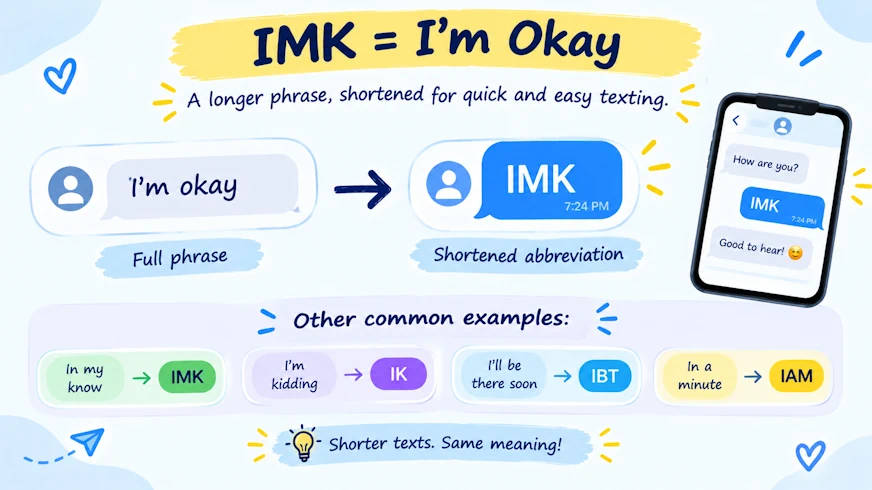
IMK is a rare abbreviation with no single settled meaning. It is most often read as “in my knowledge” or “I’m kidding.” It works like a small tag on a sentence: one version says “this is what I know,” the other says “don’t take that seriously.
If you have run into “IMK” in a message and could not match it to a familiar abbreviation like LOL or IDK, that is not surprising. IMK is far less common than most texting shorthand, and online guides do not agree on what it stands for. This article lays out the readings people actually give it, shows how to tell them apart, and gives you safe ways to reply.
Key Takeaways
- IMK is not a standardized abbreviation, so there is no official full form.
- The two readings you will most often see are “in my knowledge” (sharing information cautiously) and “I’m kidding” (signaling a joke).
- Where IMK sits in the sentence and what tone surrounds it are the best clues.
- It is much rarer than similar abbreviations such as JK, AFAIK, and IMO, so when in doubt, ask.
- Keep it for casual chats and avoid it in professional messages.
What Does IMK Mean in a Text?
Online guides give IMK different meanings, which is itself a sign that it is not widely standardized. The two main ones are below.
| Reading | What It Signals | Where It Usually Sits |
|---|---|---|
| In my knowledge | “This is what I know, though I may be wrong” | At the start or end of a statement of fact |
| I’m kidding | “That was a joke, don’t take it seriously” | After teasing or an exaggerated statement |
Examples
- “IMK, the event starts at 6.” (in my knowledge)
- “You’re the worst friend ever, IMK 😂” (I’m kidding)
Both readings are short, harmless, and friendly. The difference lies in what the sender is trying to do, share information or soften a joke.
Where IMK Comes From
There is no reliable record of where IMK started. Like many shortened phrases, it probably grew out of the habit of trimming longer expressions to type faster, the same way LOL, BRB, and IDK were formed. But unlike those, IMK never became widespread, and there is no clear history behind it. Treat any guide that claims a precise origin date or location with caution.
How to Tell Which IMK Someone Means
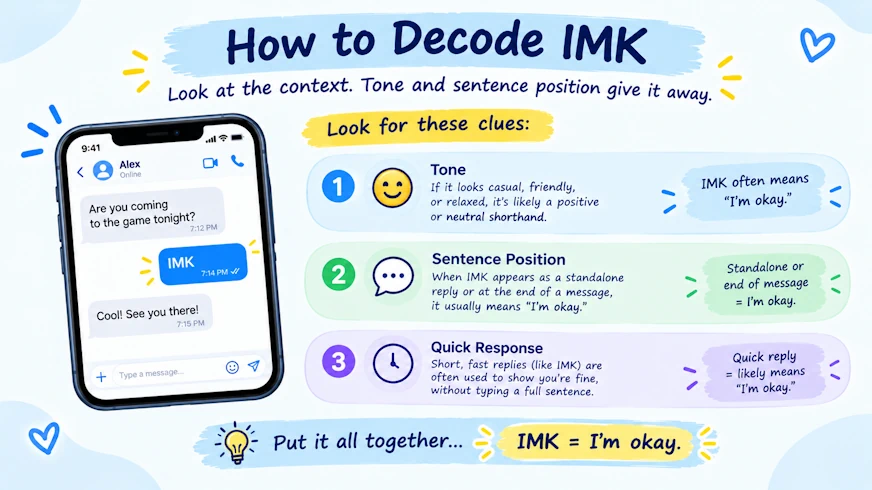
Because the meaning is not fixed, a few quick checks help.
- Look at the sentence before it. If it was teasing, exaggerated, or sarcastic, “I’m kidding” fits.
- Look at what comes after. If IMK introduces a fact, a time, or a rumor, “in my knowledge” fits.
- Check the emojis. Laughing or winking faces point toward a joke.
- Consider the sender’s habits. If they often use shorthand like AFAIK or IMO, they may mean “in my knowledge.”
- Ask. A short “IMK as in I’m kidding?” is completely normal.
IMK as “In My Knowledge”
In this reading, IMK works like a cautious label on a statement. The sender is sharing something they believe is true without promising it is correct.
- “IMK, the movie starts at 7.”
- “The shop closes early today, IMK.”
- “IMK, she’s bringing snacks to the party.”
It is closely related to “as far as I know” (AFAIK), which is far more widely recognized. If you want to be clear, AFAIK is the safer choice.
IMK as “I’m Kidding”
In this reading, IMK is a joke marker, a softer cousin of JK. It tells the reader that a harsh or exaggerated line was not meant seriously.
- “You can’t even cook noodles 😜 IMK”
- “I ate your chocolate 😅 IMK, don’t be mad!”
- “I hate you… IMK, don’t take it seriously.”
It keeps teasing friendly and prevents hurt feelings, which is useful in text where tone is easy to miss.
IMK on WhatsApp, Instagram, TikTok, and Snapchat
IMK is not tied to any one app, and it is rare everywhere, so there are no strict platform rules. In general:
| Platform | Typical Use |
|---|---|
| Personal chats between friends, either as a joke tag or a cautious fact | |
| DMs and comments, often with emojis for humor | |
| TikTok | Occasional comment replies |
| Snapchat | Quick, casual messages |
[IMAGE: imk-platforms.webp “Generic chat bubbles showing IMK used in casual messages on different apps”]
On every platform, the tone and emojis around it matter far more than the app itself.
IMK on Dating Apps
On dating apps and in early chats, a “kidding” tag can make flirty teasing feel safer, such as “you’re boring 😏 IMK.” The “in my knowledge” reading is less common there. Since tone is hard to read with someone new, add an emoji or a short follow-up so your meaning is clear.
Real Chat Examples
- “IMK, the concert is on Friday.”
- “You’re so slow 😂 IMK”
- “IMK, Sarah is bringing the drinks.”
- “This movie is the worst ever 😆 IMK”
- “IMK, they only sell tickets online.”
- “You forgot my birthday 😭 IMK, it’s fine”
- “Don’t quote me, but IMK it’s closed on Sundays.”
- “I’m moving to another country 😂 IMK”
IMK vs. Similar Abbreviations
| Term | Meaning | Use |
|---|---|---|
| IMK | In my knowledge / I’m kidding (not standardized) | Information tag or joke marker |
| JK | Just kidding | Widely used joke marker |
| AFAIK | As far as I know | Widely used cautious statement |
| IMO | In my opinion | Opinion |
| IMHO | In my humble opinion | Polite opinion |
| LMK | Let me know | Asking for information |
| IDK | I don’t know | Showing uncertainty |
The most useful comparison is with JK and AFAIK. If you want to be understood by the largest number of people, those two are safer than IMK.
Common Mistakes With IMK
Assuming there is one official meaning. There is not, so context matters.
Confusing it with LMK. LMK means “let me know,” a request, while IMK is a statement or a joke tag.
Confusing it with IMO or IMHO. Those mark opinions, not facts or jokes.
Assuming it is offensive. It is harmless and informal.
Using it with people who may not know it. Because IMK is rare, it can cause confusion.
Trusting precise statistics about it. Some guides quote exact usage percentages or trends without any evidence, so be skeptical.
When to Use IMK and When to Skip It
Reasonable moments:
- casual chats with friends who use similar shorthand
- softening a joke
- sharing information you are not completely sure about
Better to skip:
- work emails and professional chats
- messages to people unfamiliar with texting slang
- situations where clarity matters, since a spelled-out phrase avoids confusion
How to Reply When Someone Sends IMK
If it seems like “I’m kidding”:
- “Haha, I knew it 😆”
- “Nice try 😜”
- “Don’t scare me like that 😂”
If it seems like “in my knowledge”:
- “Thanks, I’ll check.”
- “That’s what I heard too.”
- “Are you sure? Let me double-check.”
If you are not sure:
- “IMK as in I’m kidding, or in my knowledge?”
Formal:
- “Thank you for the information.”
Is IMK Still Used?
It shows up occasionally in casual chats and online comments, but it is uncommon compared with abbreviations like JK or AFAIK. Because it has no firm definition, some people avoid it and write the full phrase instead. If you use it, keep it light and add context so your meaning is clear.
Quick Facts
| Factor | Details |
|---|---|
| Common readings | In my knowledge, I’m kidding |
| Official meaning | None (not standardized) |
| Category | Internet slang |
| Tone | Casual, harmless |
| Common places | Texts, DMs, comments |
| Formality | Informal |
Conclusion
IMK is a small abbreviation with a big caveat: there is no official meaning behind it. Most often it points to either “in my knowledge” or “I’m kidding,” and the sentence around it usually tells you which. If you are unsure, ask, or reach for a clearer alternative like JK or AFAIK.
FAQs
It has no official meaning. It is most often read as “in my knowledge” or “I’m kidding,” depending on the sentence around it.
Only if it is being used as “I’m kidding.” JK is much more widely used, so it is the safer choice for a joke tag.
When it means “in my knowledge,” it is similar, but AFAIK is far more widely recognized.
The same as anywhere else. Look at the tone and wording to decide whether it is a joke tag or a cautious fact.
No. It is harmless and usually playful or neutral.
There is no difference. The meaning depends on context, not on who sent it.
It is better not to. Write out “as far as I know” or “I’m kidding” if you need to be clear.
Because it is not a standardized abbreviation. Different writers assign it different meanings, so the safest approach is to read the context or ask the sender.

Mona
Mona is a CELTA-certified English teacher and fluency coach who is passionate about helping learners speak natural, confident English. On Grammar Readers, she shares clear explanations of word meanings, idioms, and everyday expressions, so you can understand English the way native speakers use it. Her lessons focus on practical fluency tips that you can apply in daily conversations.