
A clear guide with correct and incorrect examples, a comparison table, and a quiz.
The present simple and the present perfect are two of the most mixed-up tenses in English. One talks about things that are generally true or happen regularly; the other links the past to right now. In this guide you’ll learn exactly when to use each one, see correct versus incorrect examples, and test yourself at the end. Tap Listen on any section to hear the examples read aloud.
What’s the Main Difference?
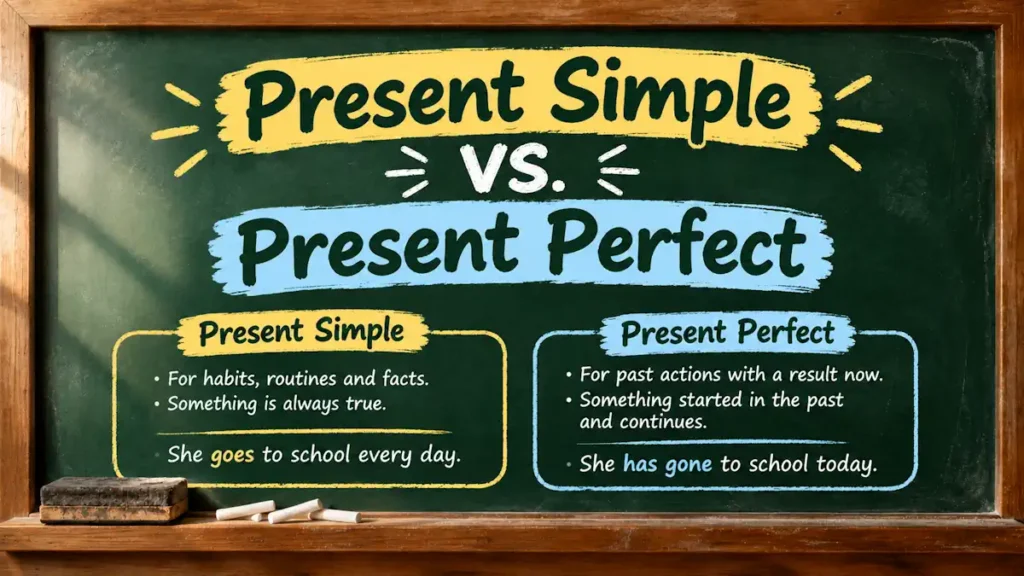
The present simple describes routines, habits, and facts: things that are true in general. The present perfect connects a past action to the present moment: the action happened before now, but it still matters now.
When to Use Each Tense
Here are the five situations that cause the most confusion. Each one shows the correct form, the incorrect form, and a short reason.
1. Routines & Habits
For something you do regularly, use the present simple.
A daily habit is not a finished action linked to now, so the present simple fits.
2. Facts & General Truths
Scientific facts and things that are always true take the present simple.
A permanent fact has no connection to a single past moment, so the present perfect is wrong here.
3. Recently Completed Actions
When an action has just finished and the result matters now, use the present perfect.
“I finish” sounds like a routine; the present perfect shows the action is done and the result is present.
4. Ongoing Actions (with for / since)
For something that started in the past and is still true now, use the present perfect with for or since.
5. Life Experiences (unspecified time)
To talk about an experience when the exact time doesn’t matter, use the present perfect.
The present perfect says “at some point in her life”; the present simple would turn it into a routine.
Side-by-Side Comparison
| Aspect | Present Simple | Present Perfect |
|---|---|---|
| Main use | Routines, habits, facts | Past action linked to now |
| Time focus | Always / in general | Before now, result felt now |
| Structure | base verb (+s/es) | have / has + past participle |
| Signal words | always, usually, every day, often | already, yet, just, ever, since, for |
| Example | She plays tennis. | She has played tennis. |
How to Form Each Tense
Present Simple Structure
Use the base verb. For he / she / it, add -s or -es.
Present Perfect Structure
Use have or has plus the past participle (the third form of the verb: gone, seen, eaten, worked).
Signal Words to Watch For
| Present Simple signals | Present Perfect signals |
|---|---|
| always, usually, often | already, yet, just |
| every day / week / year | ever, never, so far |
| sometimes, rarely, never | since 2019, for five years |
| on Mondays, twice a week | recently, lately, up to now |
Common Mistake to Avoid
Practice Quiz: Test Yourself
Choose the best answer. The quiz tells you instantly if you’re right.
Frequently Asked Questions
What is the main difference between present simple and present perfect?
The present simple describes routines, habits, and facts that are generally true. The present perfect describes a past action that is connected to the present moment, for example a recent result or an experience in your life.
Can I use “yesterday” with the present perfect?
No. “Yesterday” is a finished past time, so it needs the simple past: “I saw her yesterday.” The present perfect is used when the exact time is not stated.
When do I use “for” and “since”?
Both are used with the present perfect for actions that continue up to now. Use “for” with a length of time (for five years) and “since” with a starting point (since 2019).
Is “I have ever been” correct?
“Ever” is mostly used in questions: “Have you ever been to Japan?” In a statement, you usually drop it: “I have been to Japan,” or use “never” for the negative: “I have never been to Japan.”
Why is “She has gone to the gym every day” wrong?
“Every day” signals a routine, which belongs to the present simple: “She goes to the gym every day.” The present perfect would need a present-connected meaning, such as “She has gone to the gym three times this week.”
Keep practicing: once you can tell a routine from a result-that-matters-now, choosing the right tense becomes automatic.

Benen
My name is Benen, and I am an English teacher from the US and UK. I am passionate about helping people improve their English language skills, including grammar, vocabulary, and sentence structure, while building their confidence in a supportive and patient learning environment.