
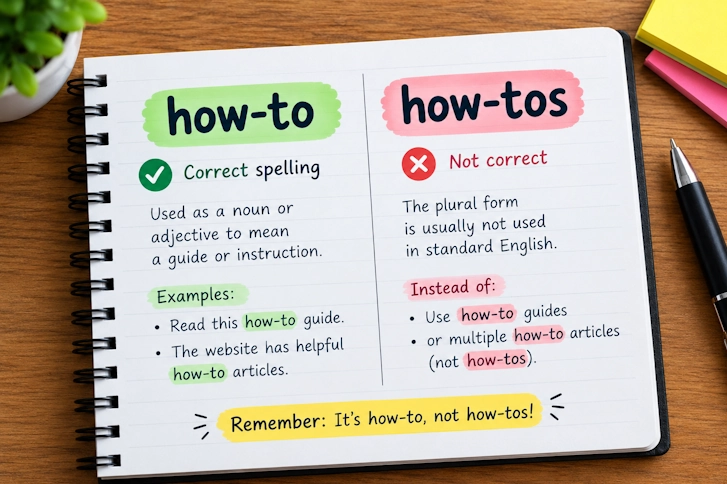
How-to (singular, hyphenated) means a single instructional guide, while how-tos (plural, no apostrophe) means more than one of them. It’s roughly like check-in and check-ins, the hyphen stays, the “s” just goes on the end.
If you’ve ever typed “how to,” then paused and wondered whether it needed a hyphen, an apostrophe, or neither, you’re dealing with one of the smaller but stickier grammar puzzles in everyday writing. The confusion usually isn’t about meaning, it’s about form: when to hyphenate, when to pluralize, and why “how to’s” keeps showing up even though it’s wrong. Here’s the simple version.
What “How-To” Actually Means
At its core, “how-to” describes something instructional. It shows up in two main roles:
As a noun: “I love reading how-tos about gardening.”
As an adjective before a noun: “She bought a how-to guide on starting a business.”
In both cases, the hyphen tells the reader that “how” and “to” are working together as a single idea rather than as two separate words in a sentence.
| Form | Role | Example |
|---|---|---|
| how to | Verb phrase | “Here’s how to fix your laptop.” |
| how-to | Noun or adjective | “I wrote a how-to on gardening.” |
| how-tos | Plural noun | “These are the most popular how-tos.” |
When to Hyphenate (and When Not To)
The rule is more straightforward than it looks once you separate the two situations.
Hyphenate it when:
- It’s used as a noun: “This website publishes helpful how-tos.”
- It’s used as an adjective right before a noun: “I’m creating a how-to video today.”
Skip the hyphen when:
- You’re using the plain phrase in a sentence describing an action: “Here’s how to start.”
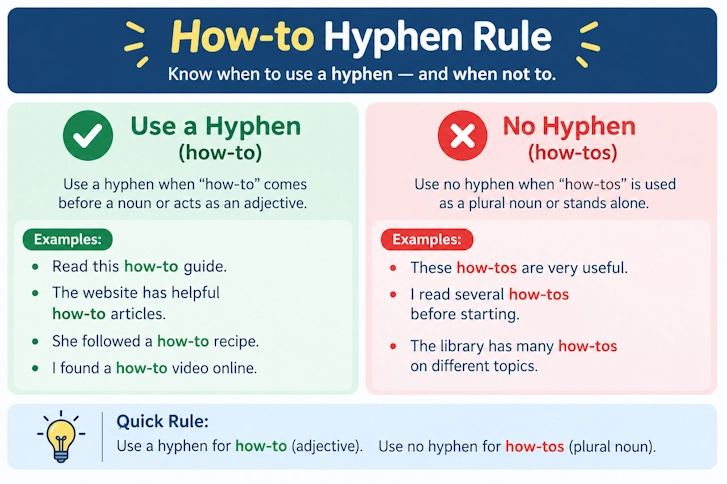
A quick way to remember it: if the phrase names a thing, hyphenate it. If it describes an action, leave it alone.
The Plural Question: How-Tos vs. How To’s
This is where most of the real confusion around “how tos vs how tos” actually comes from, not two identical spellings, but the singular form versus its plural.
Pluralizing a hyphenated noun follows a consistent pattern: add the “s” to the very end of the whole term, not to the first word, and never with an apostrophe.
| Singular | Plural |
|---|---|
| how-to | how-tos |
| check-in | check-ins |
| runner-up | runner-ups |
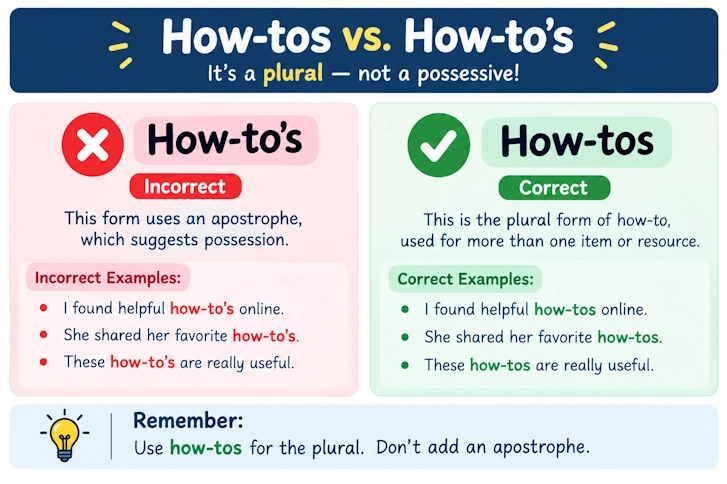
So the correct plural is simply how-tos. The version with an apostrophe, how to’s, looks like a possessive or a contraction, which is exactly why it trips readers up.
| Incorrect | Correct |
|---|---|
| I teach several how-to’s. | I teach several how-tos. |
| These how to’s are outdated. | These how-tos are outdated. |
| She collects old how to’s. | She collects old how-tos. |
Using “How-To” Before a Noun
When “how-to” sits directly in front of another noun, it acts as a descriptor, and the hyphen becomes non-negotiable.
Common examples include how-to guide, how-to lesson, how-to training, and how-to blog. Drop the hyphen in these cases and the phrase reads like two unconnected words instead of one clear concept, for example “how to guide” instead of “how-to guide.”
Common Mistakes Writers Make
Treating “how to” as a noun on its own. “Did you read that how to?” should be “Did you read that how-to?”
Adding an apostrophe to make it plural. The plural never needs one; it’s “how-tos,” not “how-to’s.”
Assuming the apostrophe version looks cleaner. It doesn’t, it just reads as possessive or confusing, and clarity should always win over a style preference.
Skipping the hyphen in adjective position. “How to tips” should be “how-to tips” when it comes directly before a noun.
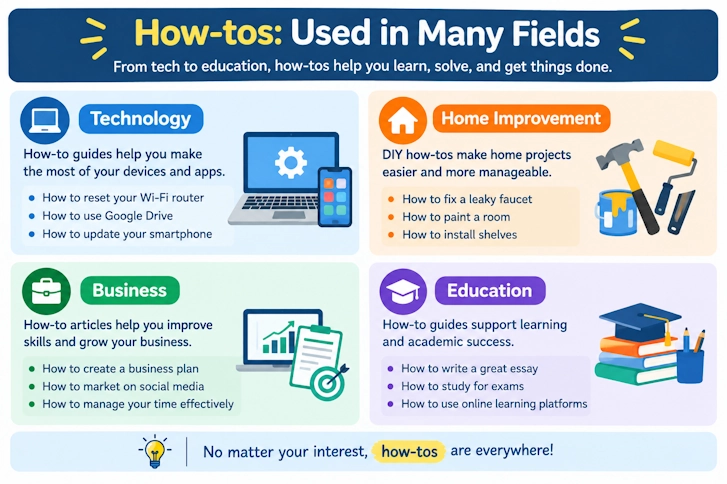
How-Tos in Real-World Writing
Seeing the term used naturally across different topics helps the rule stick.
- Technology: “The site publishes coding how-tos for beginners.”
- Home improvement: “Their woodworking how-tos are incredibly detailed.”
- Business: “Leadership how-tos receive strong monthly traffic.”
- Education: “Students love interactive how-tos in digital textbooks.”
When to Just Avoid the Word Entirely
If a sentence still feels clunky no matter which form you pick, rewriting it is often the cleanest fix. Swap in alternatives like instructional guides, tutorial pieces, learning materials, or step-by-step articles.
For example, instead of “These how-tos are confusing,” try “These tutorials are confusing.” Instead of “I’m writing several how-tos,” try “I’m writing multiple instructional guides.”
Conclusion
Once you separate the singular “how-to” from its plural “how-tos,” the confusion mostly disappears. Hyphenate it when it names a thing, skip the hyphen when it describes an action, and always pluralize by adding an “s” to the end, never an apostrophe.
FAQs
The correct plural is “how-tos,” with no apostrophe.
Not in standard modern writing. It reads as possessive and tends to confuse readers rather than clarify anything.
Hyphenate it when it functions as a noun or adjective. Skip the hyphen when it’s part of a plain verb phrase, like “how to cook.”
Because it follows the standard rule for pluralizing hyphenated nouns and avoids the apostrophe confusion between plural and possessive forms.
When people search this phrase, they’re usually comparing the singular “how-to” with its plural “how-tos,” or comparing the correct plural against the incorrect apostrophe version, “how to’s.” The spelling itself isn’t duplicated without reason.
Yes. Words like “tutorials,” “guides,” or “instructional content” work as easy substitutes when the plural feels awkward.

Mona
Mona is a CELTA-certified English teacher and fluency coach who is passionate about helping learners speak natural, confident English. On Grammar Readers, she shares clear explanations of word meanings, idioms, and everyday expressions, so you can understand English the way native speakers use it. Her lessons focus on practical fluency tips that you can apply in daily conversations.